KEY NUMBERS
-
Global Iron Ore Exports: Higher in May 2026
-
Primary Growth Driver: Increased Chinese buying activity
-
China's Iron Ore Imports (Jan-Apr 2026): +8% YoY
-
Port Inventory Trend: Elevated but stable
-
Steel Production Trend: Mixed across major markets
-
Major Exporters: Australia, Brazil, South Africa and India
-
Market Sentiment: Stable to Positive
-
Key Risk: Sustainability of Chinese demand in H2 2026
MARKET ANALYSIS
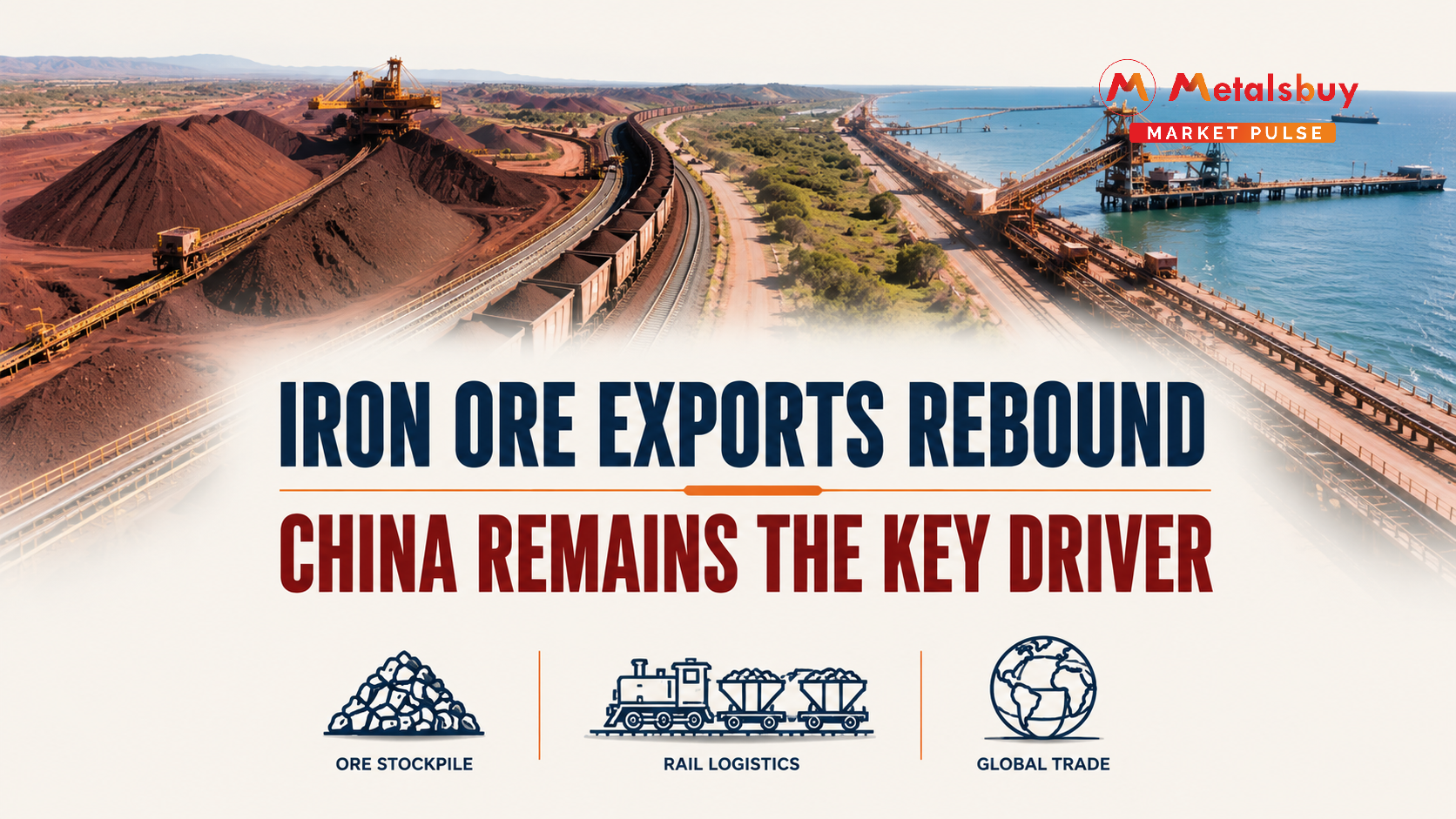
Global seaborne iron ore trade regained momentum in May 2026 as stronger procurement activity from China supported export volumes across major producing regions. The recovery in shipments comes despite ongoing uncertainty in the global steel sector, highlighting the continued importance of Chinese buying behavior in shaping international iron ore markets.
China remains the world's largest iron ore consumer, accounting for roughly three-quarters of global seaborne demand. As a result, even modest changes in Chinese procurement strategies can significantly influence trade flows, freight markets, and pricing trends across the broader raw materials sector. Recent import trends suggest that Chinese buyers have continued to actively secure cargoes despite mixed signals emerging from downstream steel markets.
The increase in export volumes during May indicates that buyers remain focused on maintaining adequate raw material availability, even as steel demand growth remains uneven across several regions.
CHINESE BUYING CONTINUES TO DRIVE GLOBAL FLOWS
One of the defining trends of 2026 has been the resilience of Chinese iron ore imports. While steel production growth has moderated in recent months, iron ore purchases have remained comparatively strong.
China imported more than 418 million tonnes of iron ore during the first four months of 2026, reflecting continued demand for upstream steelmaking raw materials. Imports have remained supported by inventory replenishment, supply security considerations, and the growing reliance on imported higher-grade ores.
An interesting development observed throughout the year has been the divergence between steel production and iron ore imports. While steel output has softened due to weakness in parts of the construction and real estate sectors, iron ore arrivals have remained elevated. This suggests that procurement decisions are increasingly being influenced by inventory management and long-term supply planning rather than immediate steel production requirements alone.
For global exporters, this trend has provided an important source of market stability at a time when many industrial commodities continue facing uncertain demand conditions.
INVENTORY STRATEGY EMERGES AS A KEY MARKET FACTOR
Port inventories have become one of the most closely watched indicators in the iron ore market. Chinese inventories remain relatively high by historical standards, reflecting active purchasing and stock management by mills and traders.
Traditionally, iron ore inventories decline during periods of stronger steel production. However, inventory levels have remained elevated through much of 2026, suggesting that buyers continue prioritizing supply security.
Several factors may be contributing to this behavior:
-
Concerns regarding future supply disruptions
-
Increased focus on raw material availability
-
Competitive pricing opportunities
-
Declining domestic ore quality and production
The result has been a procurement environment that continues to support seaborne trade volumes despite softer downstream demand indicators.
EXPORTING NATIONS BENEFIT FROM STRONGER SHIPMENTS
The rise in May exports provides positive support for major producing regions. Australia and Brazil continue to dominate global iron ore exports, while India and South Africa remain important suppliers to regional markets. Export recovery helps mining companies improve operational efficiency, optimize logistics networks, and maintain shipment schedules.
The market is also preparing for the gradual arrival of new supply sources over the coming years. Large-scale projects currently under development could significantly increase global iron ore availability and reshape trade flows. Simandou in Guinea remains one of the most important long-term developments being monitored by market participants.
However, until these new supplies reach full commercial scale, Chinese procurement patterns are likely to remain the dominant factor influencing global trade volumes.
STEEL MARKET REMAINS THE CRITICAL DEMAND INDICATOR
Although iron ore trade has strengthened, the steel sector continues to present a more balanced picture.
Infrastructure, manufacturing, engineering, and industrial activity continue supporting steel demand across several regions. At the same time, weakness in property markets and slower construction activity have limited growth in some major economies. China's steel output has softened compared with previous years, yet raw material imports have remained robust.
This divergence raises an important question for market participants: Are current imports being driven by consumption growth or inventory accumulation? The answer will likely determine the direction of iron ore prices and trade flows during the second half of 2026.
IMPLICATIONS FOR INDIA
For India, stronger global iron ore trade activity is broadly positive.
India remains one of the fastest-growing steel markets globally and continues expanding steelmaking capacity across both integrated and secondary production routes. Healthy international demand supports mining sector investment, infrastructure development, and export opportunities for the country's raw material producers.
At the same time, sustained Chinese buying activity can influence global benchmark pricing, affecting procurement costs for domestic steelmakers and traders. Market participants across India's mining and steel sectors will therefore continue monitoring developments in Chinese imports and inventory trends.
MARKET OUTLOOK
The iron ore market enters the second half of 2026 with relatively balanced fundamentals. Strong Chinese procurement activity continues supporting export volumes, while inventory management remains a key driver of buying behavior.
The biggest variable remains the future direction of China's steel sector. If infrastructure activity, manufacturing output, and industrial production remain supportive, iron ore demand could continue to underpin global trade flows. However, if inventory accumulation slows or steel demand weakens further, buyers may adopt a more cautious procurement strategy.
For now, the increase in May exports reinforces the resilience of the global iron ore market and highlights the continuing influence of Chinese demand on global commodity trade.