Key Numbers
• Project Investment: $80 Million (Approx. ₹690 Crore)
• Location: Donimalai Iron Ore Mine, Karnataka
• Project Objective: Expansion of Iron Ore Production Capacity
• Project Developer: NMDC Limited
• NMDC FY26 Iron Ore Production: 53.15 Million Tonnes
• NMDC FY26 Iron Ore Sales: 50.23 Million Tonnes
• NMDC Production Target by 2030: 100 Million Tonnes
• Planned NMDC Capital Investment: ₹50,000 Crore
Market Analysis
NMDC Continues to Build Capacity for India's Next Phase of Steel Growth
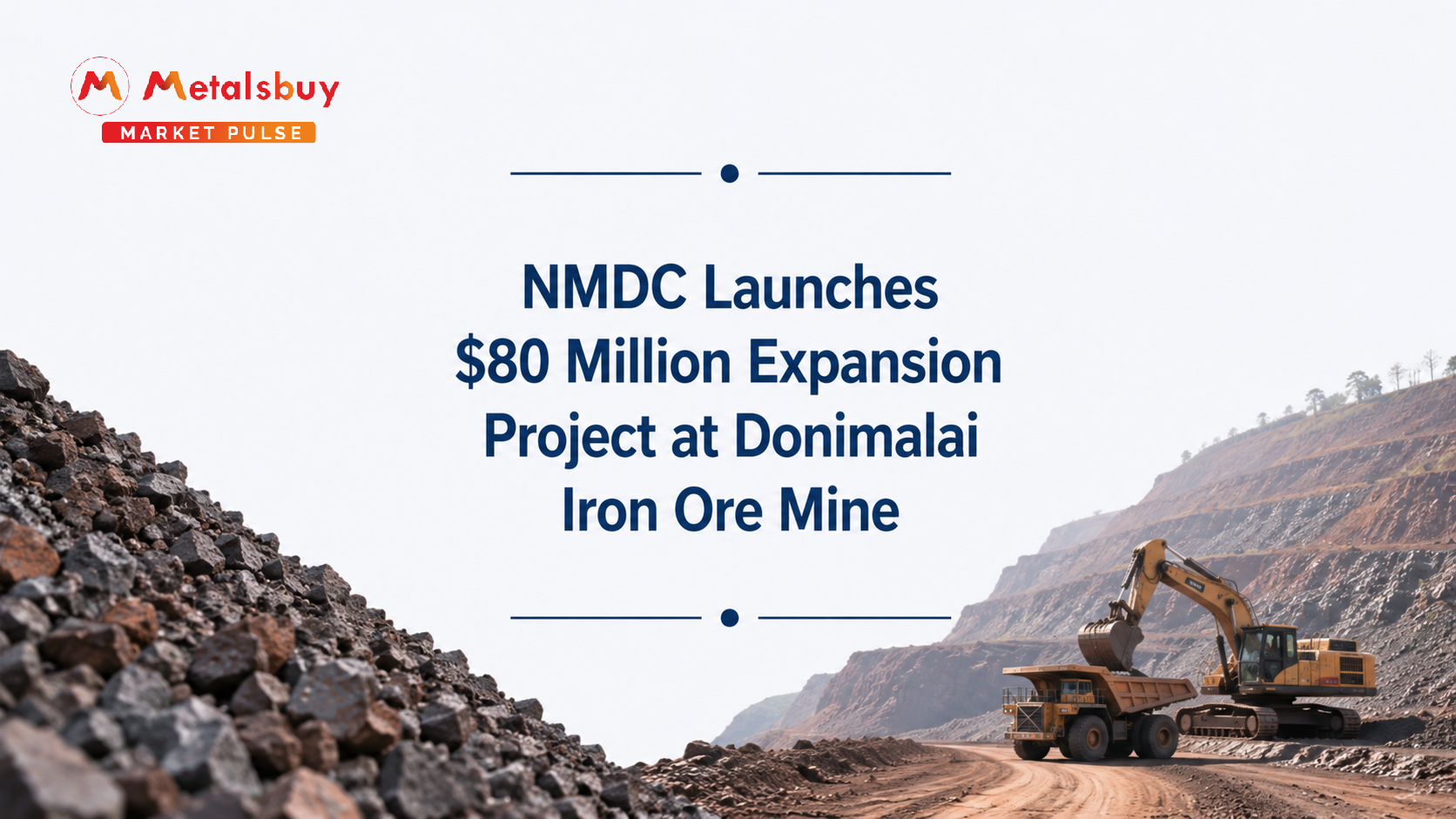
India's largest iron ore producer, NMDC Limited, has launched an $80 million expansion project at its Donimalai Iron Ore Mine in Karnataka. While the investment may appear modest compared to large integrated steel projects announced recently, it represents another important step in strengthening the country's raw material ecosystem. India's steel industry is entering a phase where consistent availability of iron ore will become just as critical as expanding steelmaking capacity. As domestic producers continue announcing new blast furnaces and integrated steel plants, mining companies are under equal pressure to ensure that raw material supplies keep pace with future demand.
The latest investment demonstrates that NMDC is no longer focusing solely on increasing mining volumes. Instead, the company is systematically upgrading mining infrastructure, operational efficiency and long-term production capabilities. This aligns with its broader strategy of doubling annual iron ore production to 100 million tonnes by 2030, a target that will require sustained investments across multiple mining complexes.
Donimalai Remains a Strategic Mining Asset
The Donimalai mine has long been one of NMDC's most valuable assets, supplying high-grade iron ore to steelmakers across southern and western India. Its location provides logistical advantages for customers in Karnataka, Andhra Pradesh, Telangana and Tamil Nadu, while also supporting exports through nearby ports when market conditions are favourable. Maintaining productivity at Donimalai is therefore essential not only for NMDC but also for several downstream steel producers that depend on reliable iron ore supplies.
The expansion project is expected to modernize mine infrastructure, improve operational efficiency and enhance production capabilities. Such investments are becoming increasingly important as mining companies prepare for higher extraction volumes while simultaneously complying with stricter environmental and operational standards.
Iron Ore Supply Is Becoming the Foundation of Steel Expansion
India has witnessed a series of large steel investment announcements over the past few months. Companies including JSW Steel, POSCO, Rashmi Metallurgical and several other producers have announced capacity additions running into millions of tonnes. These projects collectively point towards a significant increase in domestic steelmaking capacity over the next decade.
However, additional steelmaking capacity will only succeed if supported by adequate supplies of iron ore, pellets, coal and ferro alloys. This makes investments in mining infrastructure just as important as investments in steel plants themselves. NMDC's expansion at Donimalai should therefore be viewed as an enabling investment that supports the broader ambitions of India's steel industry rather than an isolated mining project.
Capacity Expansion Requires Stronger Mining Infrastructure
Producing more iron ore is no longer simply a matter of opening new mines. Modern mining operations require advanced crushing systems, beneficiation facilities, material handling infrastructure, digital monitoring and efficient logistics. Companies also need to improve recovery rates while ensuring environmental compliance and operational safety.
The Donimalai project reflects this broader shift in India's mining sector. Recent announcements from NMDC, including the ₹2,977 crore iron ore blending and buffer stockyard project at Visakhapatnam, indicate that the company is strengthening every stage of the supply chain. Together, these investments will help improve ore availability, quality consistency and delivery reliability for domestic steelmakers.
Strong Domestic Demand Continues to Drive Mining Investments
India remains one of the few major steel markets where long-term demand continues to grow steadily. Infrastructure spending, railway expansion, urban development, renewable energy projects and manufacturing investments continue to support steel consumption. Recent World Steel Association data also showed that India recorded positive crude steel production growth even as global steel output declined.
This healthy demand outlook provides mining companies with confidence to continue investing in expansion projects. Unlike many mature steel markets where demand has plateaued, India offers long-term visibility for both miners and steel producers. The Donimalai expansion is therefore another reflection of confidence in India's infrastructure-led growth story.
Preparing for the Next Decade
NMDC has already outlined ambitious plans to increase annual iron ore production to 100 million tonnes while investing nearly ₹50,000 crore across mining and infrastructure projects. Achieving these targets will require sustained investment in technology, logistics, beneficiation and mine modernization.
Projects like Donimalai are unlikely to generate headlines in the same way as multi-billion-dollar steel plants, but they remain equally important for the industry's future. Every additional tonne of steel ultimately begins with reliable iron ore production. By expanding mining capacity today, NMDC is helping create the foundation required for India's next phase of steel sector growth.
Industry Impact
The Donimalai expansion reinforces the growing alignment between India's mining sector and its steel industry's long-term growth ambitions. As steelmakers continue increasing production capacity, mining companies are responding with investments that strengthen raw material availability and operational efficiency.
For steel producers, improved mining infrastructure means greater supply reliability and reduced procurement risks. For the broader industry, it signals that India's steel expansion is being supported across the entire value chain rather than only at the manufacturing stage.
Outlook
The pace of investment across India's mining sector suggests that raw material security is becoming a strategic priority. While integrated steel plants continue attracting attention, projects like Donimalai demonstrate that sustainable steel growth depends equally on strengthening upstream mining operations.
As India moves towards its 300 million tonne steel capacity vision, investments in iron ore production, logistics and beneficiation are expected to accelerate further. The Donimalai expansion is another milestone in that journey and highlights how the country's mining sector is preparing for the steel industry's next decade of growth.