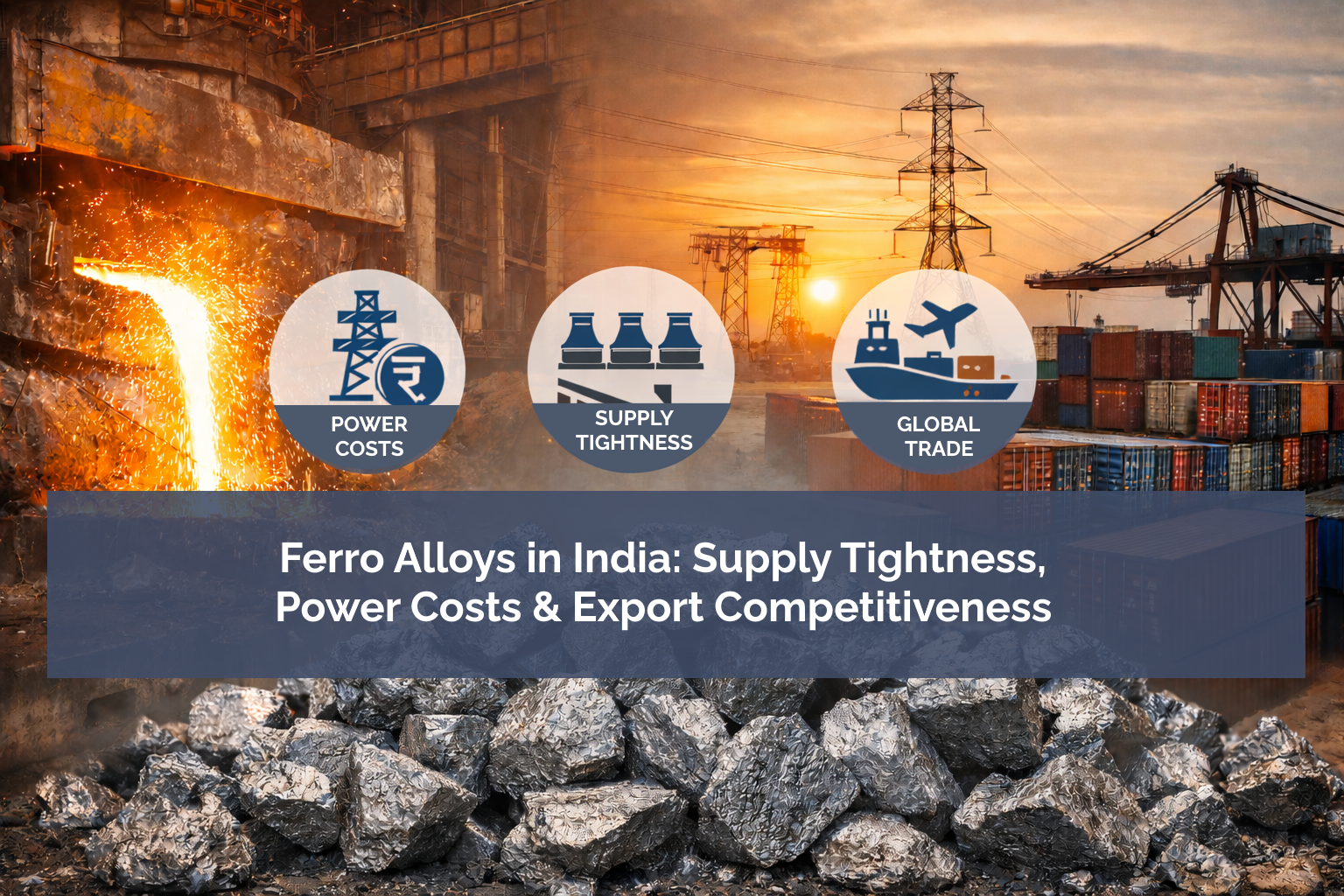
India is today among the top three producers of ferro alloys globally, supported by strong steel demand, raw material availability, and export-oriented capacity. However, headline capacity figures often mask the structural constraints that are currently shaping the market.
A closer look at capacity utilization, power economics, and export data reveals why ferro alloy prices in India have remained resilient despite periodic demand slowdowns.
Supply Tightness: Capacity Exists, Output Doesn’t
India’s installed ferro alloy capacity is estimated at 6.5–7.0 million tonnes per annum, spread primarily across Odisha, Chhattisgarh, Andhra Pradesh, and the North-East. On paper, this suggests ample supply. In practice, effective production is significantly lower.
Industry estimates indicate:
-
Average utilization: 60–65%
-
Older furnaces (<15 MVA) often run at 40–50% utilization or remain idle
-
Nearly 20–25% of installed capacity is intermittently offline due to cost or compliance issues
Key constraints include:
-
High power tariffs
-
Environmental compliance costs
-
Maintenance of aging furnaces
-
Working capital pressures
At the same time, producers have shifted away from volume-led strategies. Unlike previous cycles, many plants now operate only when realizable prices cover variable costs plus minimum margins.
Data takeaway: Even a 5–7% rise in steel demand can tighten ferro alloy availability quickly, as spare capacity is neither uniform nor immediately deployable.
Power Costs: The Dominant Cost Variable
Ferro alloy production is among the most energy-intensive processes in the steel value chain.
Typical energy consumption:
-
Silico manganese: 3,800–4,200 kWh/MT
-
Ferro manganese: 3,000–3,400 kWh/MT
-
Ferro silicon: 8,500–9,000 kWh/MT
With electricity accounting for 30–45% of total production cost, even small tariff changes have a direct impact on pricing.
Current power cost indicators:
-
Grid power tariffs in major producing states range between ₹5.5–8.0 per kWh
-
Captive coal-based power costs average ₹4.5–6.0 per kWh, excluding logistics volatility
-
Renewable power adoption remains limited for continuous furnace operations
Despite coal prices easing from earlier highs, power costs have not declined proportionately, keeping marginal production expensive. As a result, many producers prefer furnace shutdowns over loss-making output.
Data takeaway: At current power tariffs, a ₹0.50/kWh change can move production costs by ₹1,500–2,000 per MT, effectively defining the price floor.
Export Competitiveness: A Swing Factor Backed by Volumes
India exports 1.2–1.5 million tonnes of ferro alloys annually, accounting for roughly 20–25% of domestic production. Key destinations include Japan, South Korea, the EU, and the Middle East.
Export realizations depend on:
-
Freight rates (which can account for 10–15% of FOB value)
-
INR–USD exchange rates
-
Import duties and safeguard measures
-
Carbon-related compliance in developed markets
When export economics turn favorable, domestic supply tightens rapidly. Conversely, when freight rises or export prices soften, volumes are redirected to the domestic market, increasing price pressure.
Recent trends show:
-
Indian material remains cost-competitive versus EU and South African supply
-
Competition from China and Malaysia remains intense, especially during demand slowdowns
Data takeaway: Even a 10–15% shift in export volumes can materially influence domestic price trends.
The Overlooked Data Point: Structural Capacity Discipline
What is often ignored in price discussions is the structural change in producer behavior.
-
New furnace additions are larger, more capital-intensive, and selective
-
Environmental and power constraints limit rapid restarts
-
Producers increasingly prioritize cash flow stability over volume growth
This has reduced supply elasticity. Unlike earlier cycles, the market can no longer flood itself with material during short-term demand upticks.
Data takeaway: Supply response times have lengthened, increasing the risk of sharp price spikes during restocking phases.
Outlook: What the Data Suggests?
Based on current indicators:
-
Power costs are likely to remain the key price determinant
-
Steel demand growth of 6–7% in India provides a stable base load
-
Export volatility will continue to amplify price movements
-
Deep price corrections appear unlikely without a sustained drop in energy costs
Numbers Explain the Market Better Than Sentiment
India’s ferro alloy market today is not driven by sentiment but by measurable constraints—utilization gaps, energy economics, and trade-linked volumes. Installed capacity may look comfortable, but effective supply is structurally tight.
For buyers, this means planning procurement around cost realities rather than waiting for sharp corrections. For producers and traders, competitiveness will increasingly depend on power efficiency, furnace scale, and export timing.
Understanding these data points is essential to navigating the next phase of the ferro alloy cycle.