Key Highlights
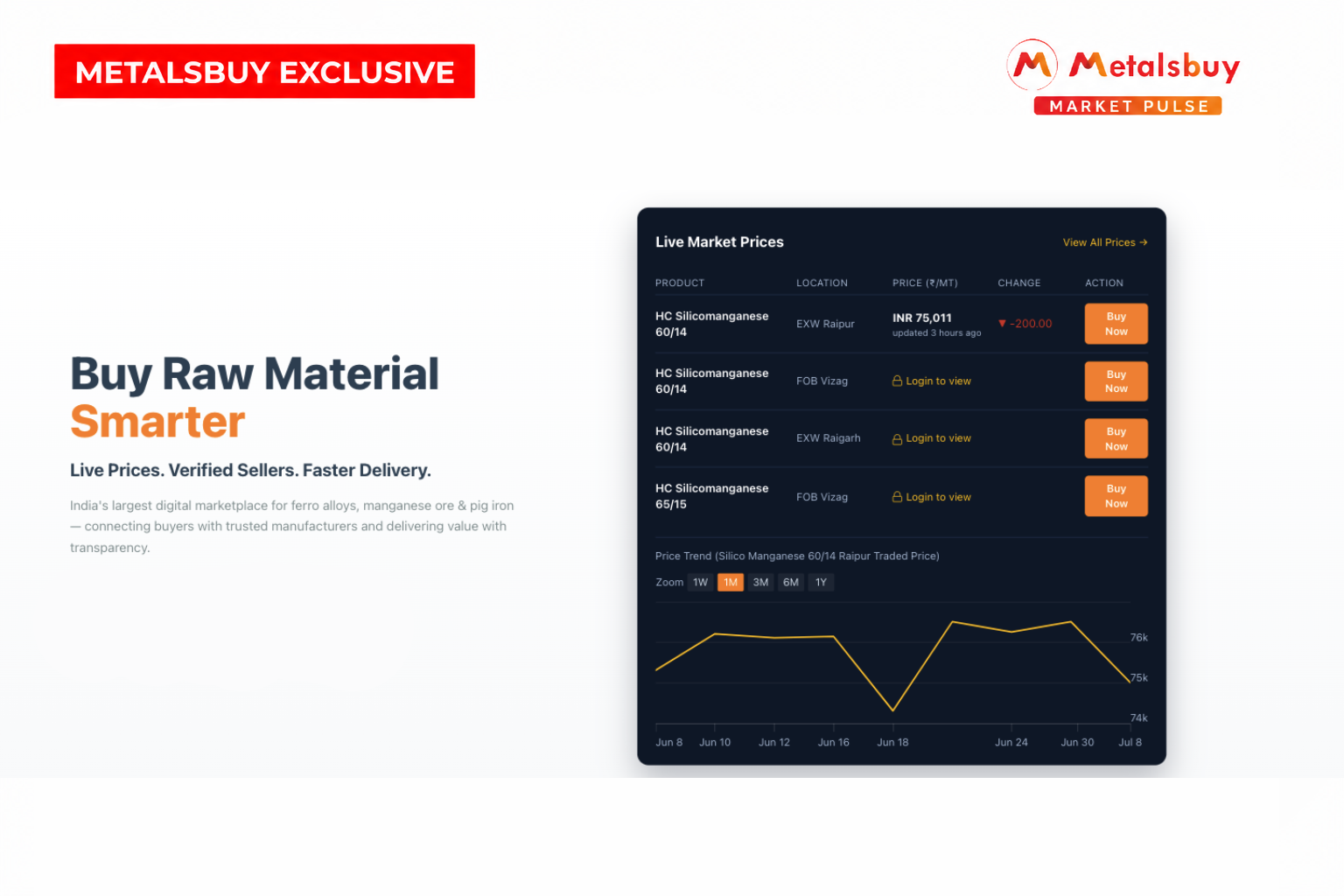
- Metalsbuy Domestic SiMn 60/14 Index (ExW Raipur): ₹75,000/PMT, down around ₹900-1,000/PMT week-on-week.
- Metalsbuy Domestic SiMn 60/14 Index (ExW Raigarh): ₹75,000/PMT, witnessing a similar weekly decline.
- Weak procurement from steel mills continues to limit fresh buying activity across the domestic market.
- Lower manganese ore prices have eased production costs but have failed to revive alloy demand.
- Export enquiries remain limited, while aggressive competition in international markets continues to restrict Indian shipments.
- Market participants expect prices to remain range-bound unless domestic steel production and export demand improve.
Introduction
India's domestic Silico Manganese market remained under pressure this week, with the Metalsbuy Domestic SiMn 60/14 Index declining to ₹75,000 per tonne ExW for both Raipur and Raigarh. The correction reflects another week of cautious buying by steel manufacturers, who continue to procure material strictly on a need basis amid weak finished steel demand. Although the decline is relatively modest compared to previous weeks, it reinforces the bearish sentiment that has dominated the ferro alloy market throughout the past month. Market participants believe the industry is currently caught between easing raw material costs and sluggish downstream consumption, preventing any meaningful price recovery.
Market Analysis
The domestic ferro alloy market continues to struggle with inadequate demand despite several supportive cost-side developments. Most integrated steel producers and secondary steel mills have maintained conservative procurement strategies, purchasing only immediate requirements rather than building inventories. Traders reported that spot enquiries remained limited across major producing regions, forcing several alloy manufacturers to reduce offers in order to secure business. As a result, the market witnessed another gradual price correction, with producers prioritising cash flow over margin protection.
The slowdown in finished steel consumption continues to be the biggest concern for the ferro alloy industry. Demand from long steel producers has remained below expectations, while flat steel manufacturers have also shown restrained purchasing activity. Without any significant improvement in steel production schedules, alloy consumption has remained subdued despite the ongoing infrastructure push across the country. Consequently, sellers continue to compete aggressively for available orders.
Supply Side Analysis
Supply conditions remain relatively comfortable across the domestic market. Most ferro alloy plants continue to operate at stable production levels, although a few smaller producers have marginally adjusted operating rates in response to weaker margins. Since production has not declined significantly, sufficient material availability continues to keep pressure on market prices. Buyers therefore have multiple sourcing options, limiting producers' ability to negotiate higher offers.
Lower input costs have also allowed several manufacturers to continue production despite declining alloy prices. While margins have narrowed considerably compared to earlier quarters, reduced manganese ore costs have partially offset the fall in finished alloy prices. However, prolonged weakness may eventually force some high-cost producers to reconsider production schedules if profitability continues to deteriorate.
Raw Material Analysis
The raw material market has shown signs of weakness over the past few weeks, particularly following the decline in domestic manganese ore prices. Lower ore prices have reduced production costs for ferro alloy manufacturers and eased immediate cost pressures across the industry. International manganese ore prices have also softened amid balanced supply conditions and cautious demand from Chinese alloy producers. While lower raw material costs normally improve competitiveness, the current market has failed to benefit because downstream demand remains exceptionally weak.
Coke prices have remained largely stable during the week, while power tariffs continue to be one of the most significant cost components for alloy producers. Electricity expenses remain elevated in several producing states, preventing any substantial improvement in operating margins despite softer ore prices.
Export Market Analysis
Export activity has remained relatively muted as Indian suppliers continue to face stiff competition in international markets. Although overseas enquiries have emerged periodically, the overall booking volume has remained below expectations due to competitive offers from other producing countries and cautious global steel demand. Higher freight costs and currency fluctuations have also affected export competitiveness for Indian suppliers. Several exporters indicated that buyers remain reluctant to commit to large volumes amid uncertainty surrounding global steel prices.
The gradual moderation in Chinese steel production expectations has further influenced international ferro alloy sentiment. Since China remains the world's largest steel producer and ferro alloy consumer, any slowdown in its steel production directly affects global alloy demand and international pricing trends.
Industry Impact
The continued correction in Silico Manganese prices is likely to benefit steel producers through lower alloy procurement costs, particularly those operating in highly competitive finished steel markets. However, for ferro alloy manufacturers, declining prices continue to compress margins and increase pressure on working capital. Producers with efficient operations and integrated raw material sourcing are expected to withstand the current market conditions better than smaller standalone plants. If weak demand persists over the coming weeks, the industry may witness selective production adjustments aimed at restoring supply-demand balance.
Metalsbuy Market Pulse Insight
The domestic Silico Manganese market is currently experiencing a classic demand-led correction rather than a cost-driven decline. Although manganese ore prices have softened and production costs have eased, the absence of strong steel demand has prevented the market from finding meaningful support. What is becoming increasingly evident is that producers are now competing more aggressively for limited orders, leading to gradual weekly price corrections instead of sharp declines. Unless domestic steel production accelerates or export orders improve significantly, the market is likely to remain under pressure during the near term.
At the same time, the current price level of ₹75,000/PMT could emerge as an important psychological support zone. If producers begin reducing operating rates in response to shrinking margins, the market could witness improved supply discipline during the coming weeks. However, any sustained recovery will ultimately depend on stronger steel demand rather than lower production costs alone.
Outlook
Market participants expect the domestic Silico Manganese market to remain largely range-bound over the next one to two weeks. Procurement by steel mills is likely to continue on a need-based basis unless finished steel demand shows meaningful improvement. Export enquiries will remain an important factor to monitor, particularly if international prices strengthen or freight conditions improve. While the downside appears relatively limited at current levels, a decisive recovery is unlikely without stronger domestic consumption and improved buying confidence.
Conclusion
India's domestic Silico Manganese market continues to navigate a challenging environment characterised by weak steel demand, cautious procurement and comfortable supply conditions. The decline in the Metalsbuy Domestic SiMn Index to ₹75,000/PMT reflects persistent demand-side weakness rather than any significant deterioration in production economics. Although lower manganese ore prices have provided some relief to manufacturers, they have not been sufficient to stimulate fresh buying interest. Going forward, the direction of the domestic alloy market will largely depend on the pace of steel demand recovery, export momentum and producers' ability to balance supply with evolving market conditions.
Disclaimer
The Metalsbuy Domestic SiMn Index is based on prevailing spot market prices and extensive interactions with producers, traders, consumers and market participants across key ferro alloy hubs. The analysis presented above reflects prevailing market conditions and industry feedback available at the time of publication and should not be construed as investment or trading advice.