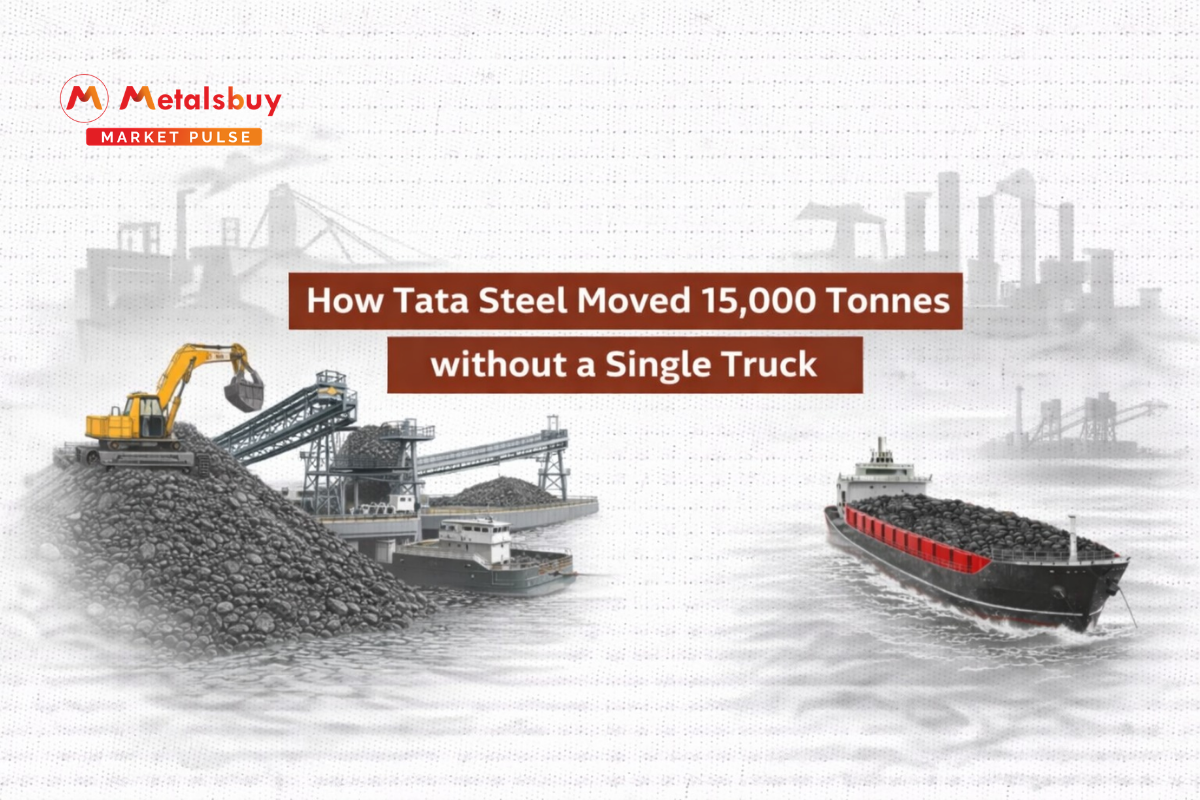
The heavy industries sector in India has long grappled with the logistical bottleneck of the Siliguri Corridor. Often referred to as the "Chicken's Neck," this narrow 22-kilometer-wide strip of land forces all overland traffic bound for the Northeast into a severe state of congestion. However, corporate supply chain strategy is currently undergoing a massive realignment toward maritime alternatives. Recently, Tata Steel executed a landmark operational maneuver by transporting a massive 1,500 metric tonne consignment of industrial materials from Kolkata to Guwahati entirely via inland waterways. Delivered successfully to Larsen & Toubro at the Pandu port, this shipment bypasses traditional asphalt and rail networks, acting as a powerful commercial proof-of-concept for the economic viability of the Indo-Bangladesh Protocol route.
The Mechanics of the 1535-Kilometer River Journey
To understand the sheer operational scale of this shift, one must look at the exact inventory and the maritime logistics involved. The cargo originated in Kolkata and traveled approximately 1,535 kilometers through the river systems of India and Bangladesh to reach Guwahati on the Brahmaputra River in Assam.
The inventory was highly specialized and heavy-duty. It comprised 1,199 metric tonnes of granulated blast furnace slag, an essential byproduct utilized heavily in eco-friendly cement manufacturing. This slag was meticulously packed into 23,980 individual bags. Accompanying this bulk was 300 metric tonnes of TMT reinforcement bars. Rather than deploying a convoy of roughly 60 heavy commercial trucks—which would significantly increase highway wear-and-tear and traffic accident risks—the entire load was consolidated on water. The transit was executed seamlessly by a single tugboat, the MV Trishul, which navigated the river channels towing two specialized cargo barges, the D.B. Dikhu and the D.B. Ajay.
The Financial and Fuel Arithmetic of River Freight
The corporate pivot from road to river is driven by undeniable and highly attractive financial metrics. According to recent logistics data compiled by the World Bank and the Indian government, the operating cost for inland water transport currently stands at an incredibly efficient Rs 1.06 to Rs 1.20 per ton-kilometer. This is highly competitive when stacked against rail transport, which costs approximately Rs 1.36 to Rs 1.41 per ton-kilometer. More importantly, it offers a dramatic discount compared to road transport, which demands a premium average of Rs 2.28 to Rs 2.58 per ton-kilometer. For resource-intensive sectors like steel and construction, migrating bulk cargo to waterways virtually halves the base transportation expenditure.
Beyond raw freight rates, the fuel math strongly favors the maritime network. A single liter of fuel on inland waterways can move one tonne of cargo across an impressive 215 kilometers. In stark contrast, the exact same liter of diesel moves a tonne just 95 kilometers by rail and a mere 24 kilometers by heavy truck. This translates directly into a massive reduction in greenhouse gas emissions. Official environmental estimates indicate that inland waterway transport minimizes noise, soil, and air pollution significantly better than highway trucking, while reducing surface land occupation to negligible levels compared to the construction of extensive highway networks.
Infrastructure Capital and the 180 MMT Milestone
Tata Steel's successful voyage to Guwahati is not an isolated event; it is supported by a decade of aggressive government capital expenditure. Since 2014, the Ministry of Ports, Shipping and Waterways has injected over Rs 6,434 crore into waterway infrastructure, focusing on fairway maintenance, dredging, and building multi-modal terminals.
The result of this investment is a dramatic expansion of the navigable network. India's operational national waterways have increased from just five stretches covering 2,716 kilometers in 2014 to an impressive 32 operational waterways spanning 5,155 kilometers today. This physical expansion has triggered an exponential surge in cargo volumes. In the 2013-14 fiscal year, India's inland waterways handled a modest 18.07 million metric tonnes. By early 2026, that figure has skyrocketed to over 180.07 million metric tonnes, representing a compounded annual growth rate of 20.89 percent over the last twelve years.
Policy Catalysts Driving Corporate Adoption
To accelerate this transition and de-risk the initial shift for private enterprise, the government recently activated the Jalvahak scheme. Backed by a targeted budget of Rs 95.42 crore, this policy provides a direct 35 percent operating cost incentive to cargo owners who shift their freight from land to scheduled waterway routes. Furthermore, the recent extension of the national tonnage tax regime to inland vessels simplifies corporate tax structures dramatically. By basing tax liabilities on ship tonnage rather than fluctuating annual profits, vessel operators are given the financial predictability required to scale their fleets.
Strategic Horizon for Northeast Connectivity
The successful docking at Guwahati sets a tangible precedent for fast-moving consumer goods, agriculture, and automotive sectors eyeing the eastern economic corridor. Looking forward, the Maritime Amrit Kaal Vision 2047 lays down clear, aggressive logistics benchmarks. The primary macroeconomic objective is to elevate the modal share of inland waterway freight from its current stagnation of around 2 percent up to a healthy 5 percent. In absolute volume, the state is targeting over 200 million metric tonnes by 2030, eventually breaching the 500 million metric tonne threshold by 2047.
By executing this highly efficient river run to Assam, Tata Steel has demonstrated that India's domestic waterway systems are fully operational and capable of supporting complex, heavy industrial supply chains. This establishes a clear, profitable blueprint for how bulk freight will move across the subcontinent in the coming decades.