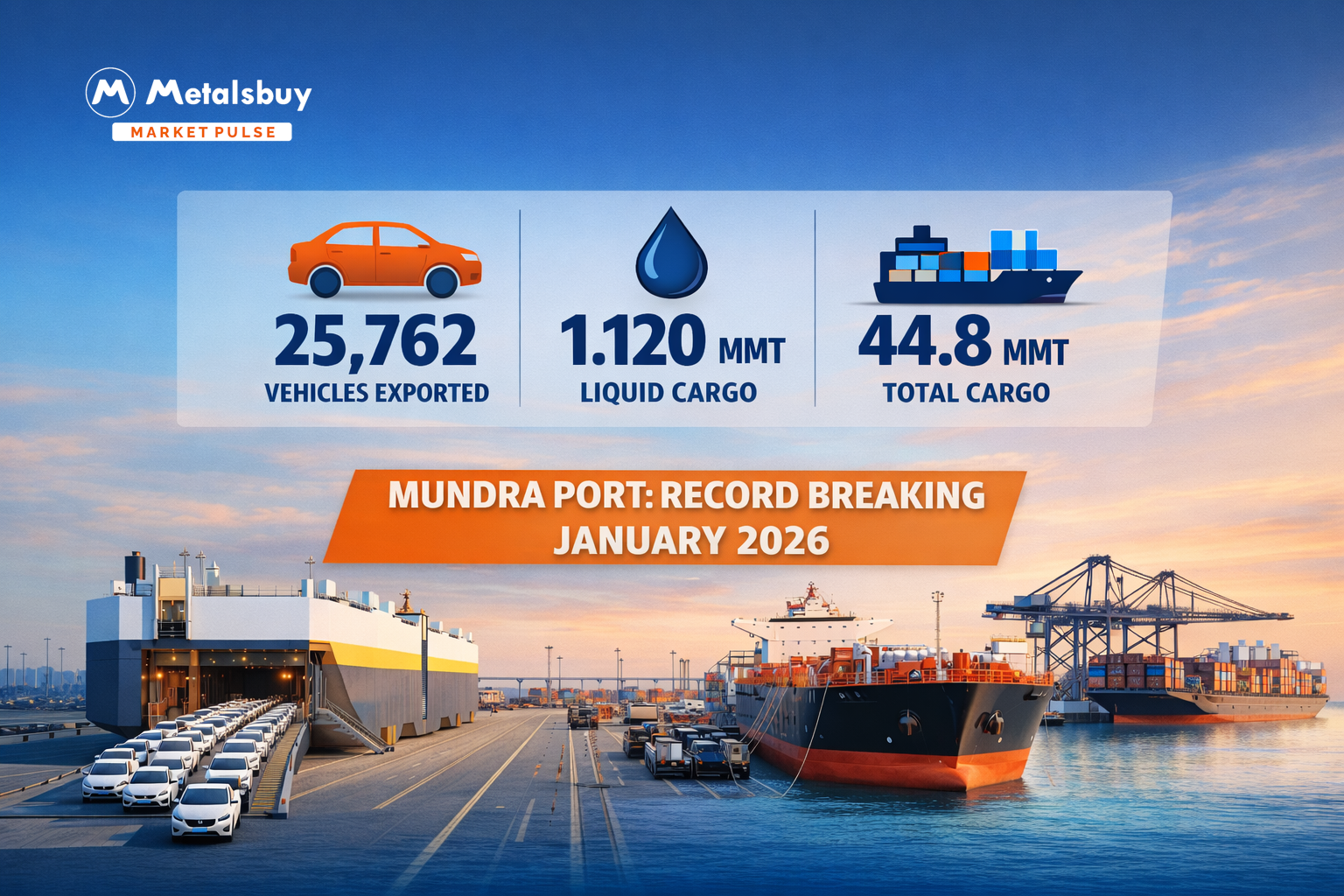
In a definitive signal of India’s escalating role in global supply chains, Mundra Port, the flagship entity of Adani Ports and Special Economic Zone (APSEZ), shattered two significant operational ceilings in January 2026. The facility logged its highest-ever monthly automobile exports of 25,762 units alongside a record-breaking liquid cargo throughput of 1.120 Million Metric Tonnes (MMT).
These individual terminal victories were pivotal in driving APSEZ’s consolidated cargo volume to 44.8 MMT for the month, registering a robust 12% year-on-year growth.
The Milestone: A Month of Broken Records
The data coming out of Mundra for the first month of 2026 paints a picture of robust trade velocity, characterized by specific numeric breakthroughs:
- Automobile Exports: The port shipped 25,762 vehicles, effectively eclipsing the previous monthly record set nearly two years prior in May 2024. This figure represents a sharp recovery and acceleration in the auto-logistics domain.
- Liquid Cargo: The liquid terminal processed 1.120 MMT of cargo (spanning crude, chemicals, and vegetable oils). This performance surpassed the previous high recorded just one month earlier in December 2025, indicating a sequential growth trend rather than a sporadic spike. The liquid segment across APSEZ grew by a striking 21% YoY.
- Container & Overall: While specific records were set in niche segments, the overall container volumes across APSEZ also saw a 16% YoY increase, contributing to the massive 44.8 MMT total.
The Drivers: Why Did This Surge Happen?
The record-breaking numbers are the result of a convergence of three critical factors: heightened global demand, specific operational breakthroughs, and strategic terminal management.
- The Global Appetite for "Made in India"
The surge in auto exports is directly linked to the aggressive expansion of Indian automakers into emerging and established markets. Major OEM players like Maruti Suzuki and Toyota have increasingly utilized Mundra’s dedicated terminals. The January data reveals a widening export footprint, with shipments destined for diverse regions including Africa, Europe, East Asia, Australia, and the Middle East. This geographic diversification has been crucial in pushing volumes beyond the 25,000-unit threshold.
- Operational Efficiency: The 5,701-Vehicle Feat
Volume cannot be managed without efficiency. A standout event in January was the loading of 5,701 vehicles onto a single vessel—a new record for the port, narrowly beating the previous single-vessel high of 5,622 units set in November 2025.
However, the true USP (Unique Selling Proposition) of this operation was the speed: the port achieved a Gross Handling Rate of 145 vehicles per hour. This metric is critical for shipping lines, as faster turnaround times directly translate to lower port stay costs and higher vessel utilization rates.
- Dedicated Infrastructure &RoRo Dominance
Mundra’s advantage lies in its specialized infrastructure. The dedicated Roll-on/Roll-off (RoRo) terminal at the Adani Mundra Container Terminal (CT2) allows for the seamless movement of vehicles, preventing bottlenecks. Simultaneously, the liquid terminal’s ability to handle multiple cargo streams—energy products, industrial chemicals, and edible oils—allowed it to scale up to the 1.120 MMT figure without compromising safety.
Future Outlook: Implications for FY27 and Beyond
The performance in January 2026 serves as a bellwether for the upcoming fiscal year (FY27).
Scaling Toward 1 Billion Tonnes: For APSEZ, which now operates 15 domestic ports and 4 international terminals, these monthly records are stepping stones toward its ambitious goal of handling 1 billion tonnes of cargo annually by 2030. The sustained 12% growth rate in total cargo suggests that Indian ports are successfully capturing transshipment volumes that might have previously gone to foreign hubs.
The Auto-Export Corridor: The January data solidifies Gujarat’s status as the auto-export hub of India. With the Union Budget 2026-27 emphasizing multimodal connectivity, the link between northern manufacturing clusters and Mundra is set to strengthen. We can expect the port to frequently breach the 25,000-unit monthly mark as rail freight corridors improve efficiency.
Economic Resilience: Finally, these numbers offer a counter-narrative to global recessionary fears. The robust movement of industrial liquids (energy and chemicals) indicates strong industrial activity, while record auto exports suggest that Indian manufacturing is competitive on the global stage.
In summary, Mundra Port’s January performance is more than just a logistical win; it is a clear indicator that India’s maritime infrastructure is ready to shoulder the weight of a $5 trillion economy.