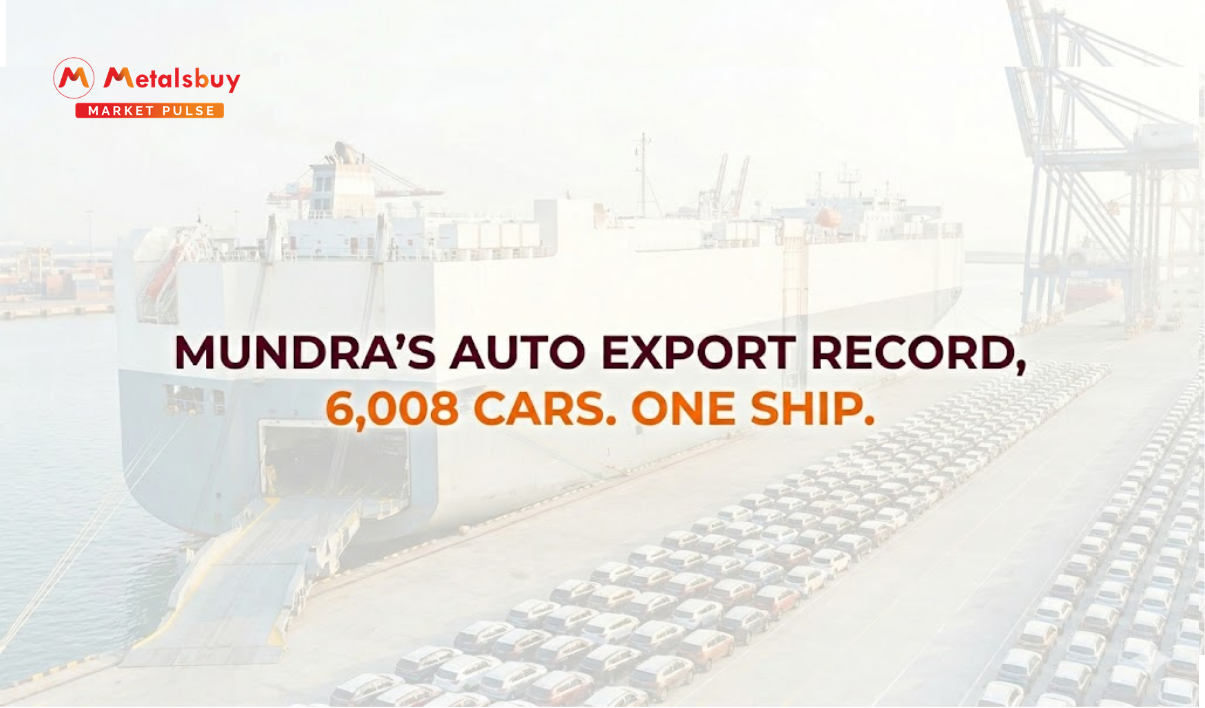
The recent departure of the 199-meter Norwegian-flagged vessel MV NOCC ADRIATIC from Gujarat’s western coastline marked a definitive turning point for Indian maritime logistics. Loaded with an unprecedented 6,008 cars, the 19,256-tonne deadweight vehicle carrier established a new national benchmark, officially cementing Mundra Port as India’s largest automobile export hub. Operated by Adani Ports and Special Economic Zone (APSEZ), this logistical feat highlights a rapid recalibration of global supply chains, where India is advancing from a regional manufacturing base to a high-volume global export gateway.
Engineering Uninterrupted Maritime Logistics
Loading over six thousand vehicles onto a single ship demands precision infrastructure and flawless operational timing. Traditional deep-sea ports frequently face bottlenecks caused by tidal cycles, which dictate exactly when massive ocean-going vessels can safely dock and load. Mundra Port bypasses these natural constraints entirely through its state-of-the-art Roll-on/Roll-off (RoRo) terminal.
The facility’s distinct operational edge lies in its specialized floating pontoon and link span systems. This engineering framework permits continuous, 24-hour loading operations irrespective of ocean tides. Vehicles are driven directly from holding yards onto the vessel decks, eliminating the need for complex, time-consuming crane maneuvering. This directly reduces transit damage risks, drastically lowers vessel turnaround times, and cuts overall handling costs. This specific RoRo facility already maintains a robust baseline, having facilitated the export of over 2,29,000 vehicles in the previous year. The April 2026 mega-shipment of 6,008 units represents a direct operational scale-up, proving the terminal can smoothly absorb intense, concentrated export demands from automotive giants like Maruti Suzuki and Toyota.
Quantifying the 5.3 Million Unit Export Surge
Mundra’s rapid rise is deeply intertwined with a massive structural boom within the Indian automotive sector. Recent figures published by the Society of Indian Automobile Manufacturers (SIAM) outline the sheer scale of this manufacturing resurgence. During the 2024-25 financial year, India’s overall automobile exports surged by an impressive 19%, reaching a total of 5.35 million units.
Passenger vehicles acted as a significant driver of this momentum, witnessing a nearly 15% increase to hit 7.7 lakh exported units. Simultaneously, the two-wheeler segment experienced a massive 21.4% jump, crossing the 4.19 million unit mark. Automakers are aggressively capitalizing on a revival of demand in emerging markets. Data shows that countries like South Africa, Saudi Arabia, and Mexico remain top destinations, showing a voracious appetite for highly durable, fuel-efficient Indian compact cars and utility vehicles.
With industry leaders like Maruti Suzuki committing ₹45,000 crore to expand domestic production—and explicitly aiming to triple their global exports by 2030—the volume of vehicles requiring outbound logistics is multiplying rapidly. Mundra Port, strategically linked via extensive rail and road networks to key manufacturing corridors in Delhi-NCR, Rajasthan, and Gujarat, serves as the critical funnel for this national output.
The 500.8 MMT Milestone and Compounding Execution
The automotive success narrative at Mundra is mirrored by APSEZ’s broader cargo handling achievements across the country. At the close of the 2025-26 financial year, the port operator officially breached a historic threshold, handling 500.8 million metric tonnes (MMT) of total cargo, representing a robust 11% year-on-year growth. The momentum continues to compound at a remarkable rate; in March 2026 alone, the network processed a record 46 MMT of cargo.
Industry analysts are closely watching the accelerated pace of APSEZ’s capacity expansion. The company took 16 years to hit its first 100 MMT milestone. The subsequent 100-million-tonne additions were achieved in drastically compressed timeframes: five years, then three years, and the final two 100 MMT milestones took just two years each. Backed by a commanding 28% market share of India's total port cargo volumes, an integrated fleet of 129 vessels, and a sprawling logistics network of over 25,000 trucks, APSEZ has set a firm target to handle 1 billion tonnes by 2030. This private sector growth perfectly complements the national maritime expansion, with India's major ports collectively handling a record 915.17 MMT of cargo in FY26.
A Resilient Horizon for Global Trade
Multinational corporations are actively hunting for resilient, high-capacity, and cost-effective alternatives to historically concentrated global manufacturing centers. India’s strategic response—pairing aggressive domestic manufacturing incentives like the Production Linked Incentive (PLI) scheme with continuous, relentless port infrastructure upgrades—is bearing measurable fruit.