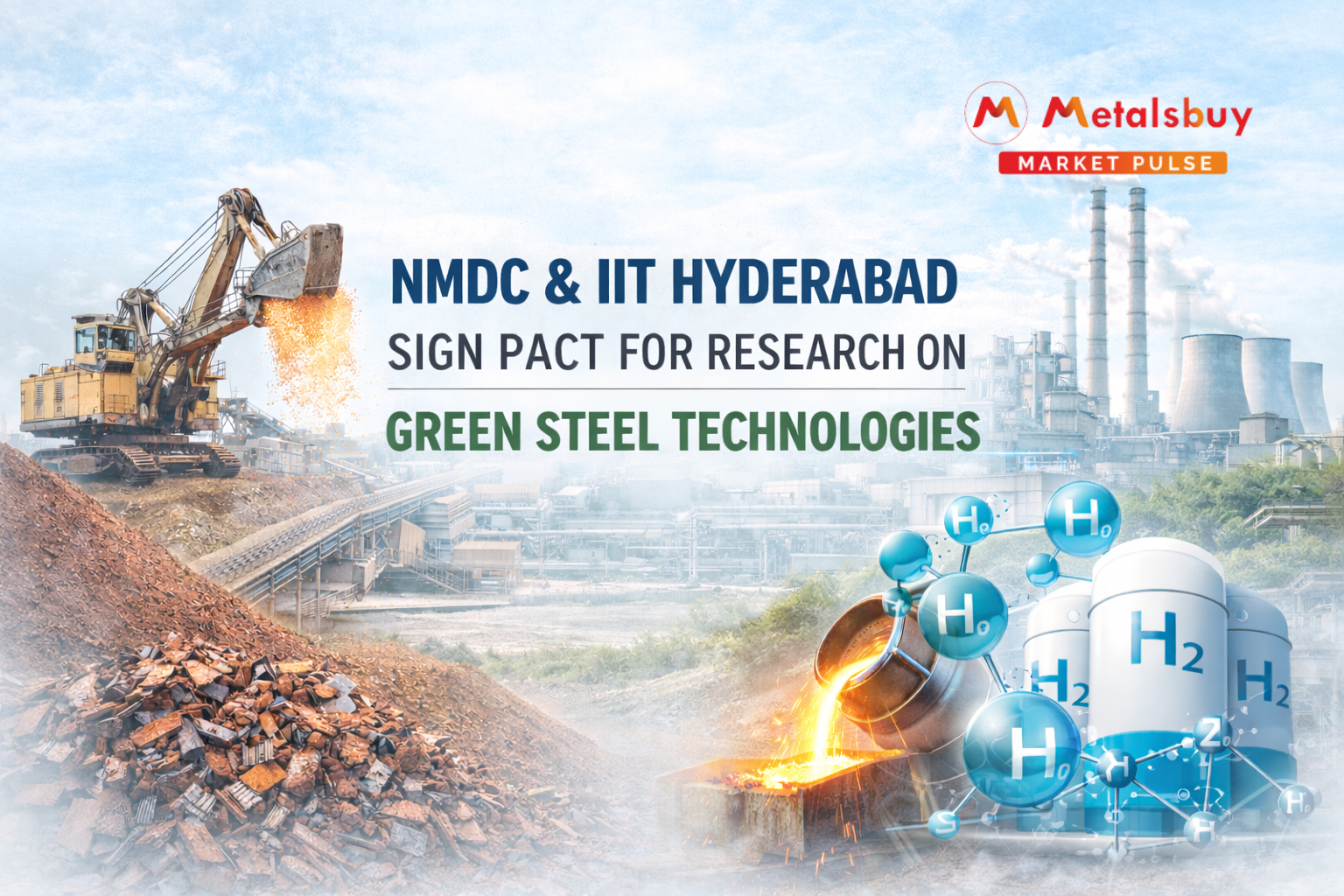
India’s mining major NMDC Limited has entered into a research partnership with Indian Institute of Technology Hyderabad to advance green steel technologies, marking another strategic step toward decarbonising India’s iron and steel value chain.
The collaboration aims to develop sustainable steelmaking pathways, optimise raw material utilisation, and explore next-generation low-carbon production technologies aligned with India’s climate commitments.
1. Strategic Context: Why This Partnership Matters
India is the world’s second-largest steel producer, with crude steel output exceeding 140 million tonnes annually. However, nearly 70 percent of production still relies on coal-intensive blast furnace-basic oxygen furnace (BF-BOF) routes.
Steel contributes roughly 10–12 percent of India’s industrial carbon emissions. With growing regulatory and export pressure around carbon intensity — especially from Europe and advanced economies — Indian producers are under increasing obligation to reduce emissions per tonne of steel.
NMDC, as India’s largest iron ore producer with annual output capacity exceeding 45 million tonnes, plays a foundational role in the upstream value chain. Any technological advancement at the raw material level can materially influence the carbon footprint of downstream steelmaking.
This partnership signals that decarbonisation is no longer confined to steel producers alone — miners are now actively integrating into the green transition narrative.
2. Research Focus Areas
The collaboration is expected to focus on:
-
Hydrogen-based ironmaking pathways
-
Improved beneficiation and pelletisation for higher efficiency
-
Utilisation of low-grade ores with lower energy intensity
-
Carbon capture integration possibilities
-
Optimisation of agglomeration technologies
India’s ore profile contains a significant share of fines and variable-grade material. Enhancing beneficiation efficiency can improve blast furnace productivity and reduce coke consumption per tonne of hot metal.
Research-driven optimisation at this stage could potentially reduce energy intensity by 5–10 percent over time, depending on process integration.
3. Green Steel: Global and Domestic Drivers
Globally, green steel investments are accelerating:
-
Europe is scaling hydrogen-based direct reduced iron (DRI) projects.
-
Carbon Border Adjustment Mechanisms (CBAM) are tightening reporting requirements.
-
Automotive OEMs are increasingly demanding low-carbon steel procurement.
Domestically, India’s National Steel Policy envisions 300 million tonnes of steel capacity by 2030. If expansion follows traditional coal-based pathways, emissions intensity will rise significantly unless cleaner technologies are integrated early.
India’s hydrogen mission and renewable power expansion create a long-term opportunity to integrate green hydrogen into steelmaking. However, cost remains a barrier, green hydrogen production costs must fall substantially to achieve commercial viability.
Research collaborations such as this aim to bridge that gap.
4. Market Implications for Steel and Raw Material Players
For Metalsbuy participants, the NMDC–IIT Hyderabad partnership carries medium-to-long-term implications:
-
Beneficiation improvements could influence pellet demand dynamics.
-
Higher-grade ore optimisation may impact premium structures.
-
Potential hydrogen-based pilot projects could alter DRI capacity planning.
-
Increased R&D focus may accelerate policy support or incentives.
While immediate price impact is unlikely, structural shifts in raw material quality and carbon benchmarking may begin influencing procurement strategies over the next 3–5 years.
5. The Bigger Picture
India’s green steel transition will require alignment across:
-
Iron ore mining
-
Pelletisation and beneficiation
-
Steelmaking route diversification
-
Renewable energy integration
-
Hydrogen infrastructure
The NMDC–IIT Hyderabad collaboration reflects a shift from incremental compliance to structured innovation.
For India to remain competitive in export markets and meet climate commitments, upstream research and process redesign will be as critical as downstream technology upgrades.
Conclusion
The agreement between NMDC and IIT Hyderabad marks a strategic move toward embedding research-led sustainability into India’s steel value chain. While commercial-scale transformation will take time, early-stage technological groundwork could determine how competitive and carbon-efficient India’s 300-million-tonne steel ambition ultimately becomes.
For traders, manufacturers, and raw material suppliers, the green transition is no longer theoretical — it is becoming a structural factor in future cost curves and competitiveness.