KEY NUMBERS
- Technology Launch: EAF Ultimate Move
- Developer: Primetals Technologies
- Primary Focus: Lower-Cost & Flexible Electric Steelmaking
- Key Advantage: Reduced Capex & Maintenance Requirements
- Operational Benefit: Shorter Tap-to-Tap Time
- Processing Capability: Flexible Scrap + Hot Metal Charging
- Productivity Features: Single-Bucket Charging & Slag-Free Tapping
MARKET ANALYSIS
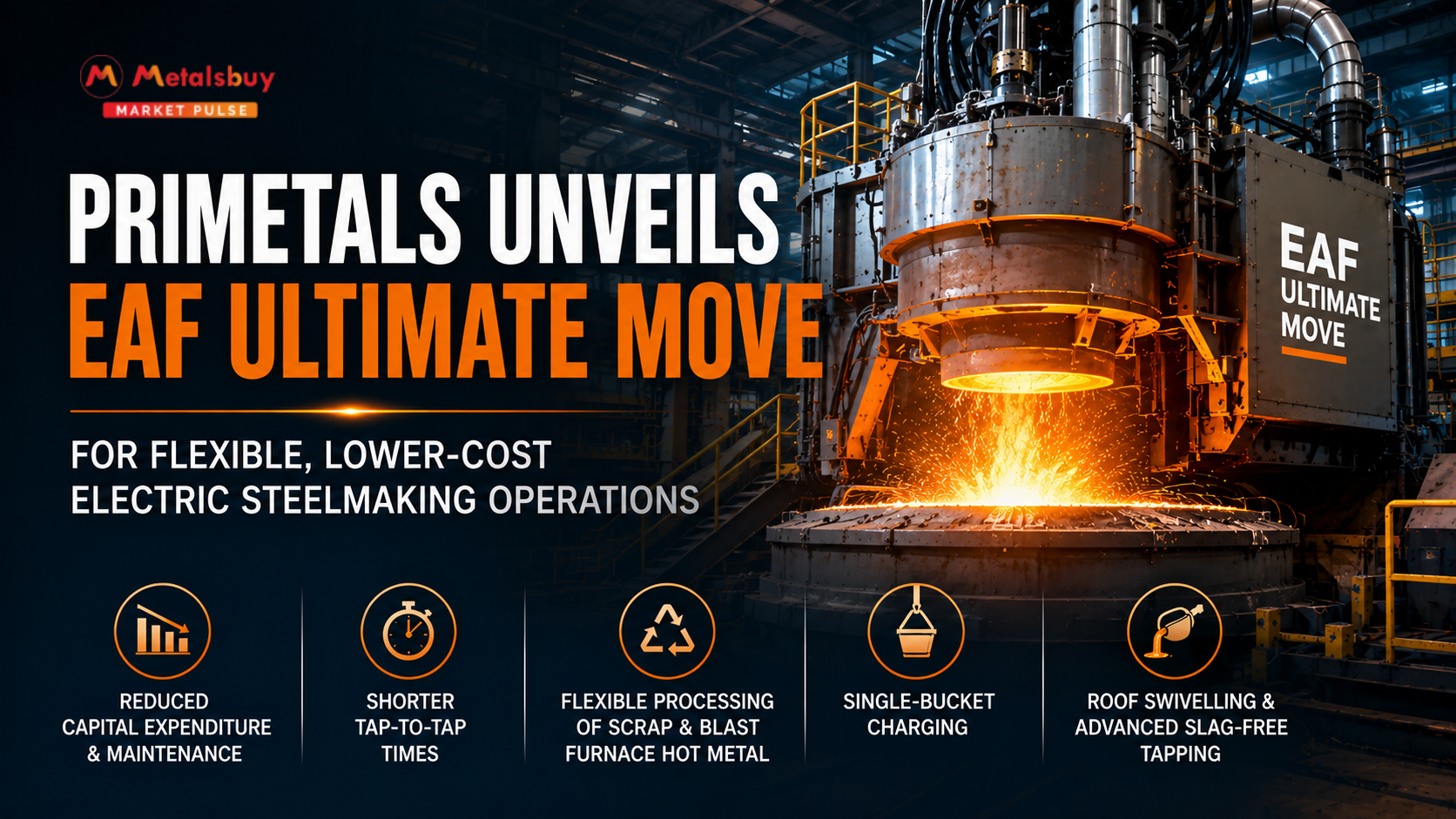
Primetals Technologies has unveiled its latest electric arc furnace (EAF) solution named “EAF Ultimate Move,” aimed at improving operational flexibility, reducing production costs, and enhancing efficiency for steel manufacturers. The newly introduced system has been designed to address some of the major operational challenges faced by modern electric steelmaking facilities, including rising production costs, maintenance intensity, energy efficiency pressures, and the growing need for process flexibility.
The launch comes at a time when the global steel industry is increasingly shifting focus toward electric arc furnace-based production routes. Compared to conventional blast furnace steelmaking, EAF technology generally offers lower emissions intensity, greater operational flexibility, and stronger compatibility with scrap recycling and cleaner energy integration. As steelmakers globally continue exploring decarbonisation strategies, advanced EAF technologies are becoming strategically important for future steel production models.
According to Primetals Technologies, the EAF Ultimate Move has been engineered to reduce capital expenditure requirements while simultaneously improving plant productivity and operational reliability. One of the key highlights of the system is its ability to minimise plant footprint and simplify furnace operations, which can help steel producers optimise space utilisation and lower infrastructure-related costs. In an increasingly competitive steel market environment, such operational efficiencies are becoming critical for maintaining profitability.
A major operational advantage of the new system is its focus on reducing tap-to-tap time, which directly impacts production efficiency and throughput. Faster furnace cycles can significantly improve overall plant productivity by enabling higher steel output without proportionately increasing operational complexity or energy consumption. For steelmakers operating in high-cost environments, even moderate reductions in processing time can generate meaningful improvements in operating margins.
Another notable aspect of the EAF Ultimate Move is its flexibility in raw material processing. The technology supports multiple charging combinations involving steel scrap and blast furnace hot metal, giving steelmakers greater adaptability depending on raw material availability and market economics. This flexibility could become increasingly valuable at a time when global scrap markets continue witnessing periodic supply tightness and pricing volatility.
The system also introduces several productivity-focused engineering features such as single-bucket charging, roof swivelling mechanisms, and advanced slag-free tapping systems. These features are aimed at reducing downtime, simplifying operational handling, improving furnace availability, and enhancing process efficiency. In large-scale steelmaking operations, reducing maintenance interruptions and operational delays can significantly strengthen plant performance over the long term.
The launch additionally reflects the broader transformation currently underway within the global steel industry. Steel producers across Europe, North America, Asia, and the Middle East are increasingly investing in electric steelmaking technologies to improve competitiveness and align with future environmental regulations. Rising pressure to reduce carbon emissions is accelerating investments into EAFs, direct reduced iron (DRI), hydrogen-ready systems, scrap recycling infrastructure, and energy-efficient production technologies.
Electric arc furnaces are also becoming increasingly important because of their compatibility with renewable energy integration and circular economy models. Unlike traditional blast furnace operations that rely heavily on coking coal, EAFs can operate using recycled steel scrap and electricity, helping reduce carbon intensity under suitable energy conditions. This has made EAF expansion a central part of many global green steel transition roadmaps.
However, despite the long-term advantages of electric steelmaking, the transition remains complex for many emerging economies and integrated steel producers. High electricity costs, scrap availability constraints, power infrastructure limitations, and capital investment requirements continue acting as major barriers to rapid EAF adoption in several markets. Technologies that improve flexibility and lower operational costs may therefore become increasingly important in accelerating industry-wide adoption.
The development is particularly relevant for India and other rapidly growing steel markets where long-term steel demand continues rising strongly. As steelmakers expand capacity while also preparing for future sustainability requirements, flexible EAF technologies may gradually become more integrated into the broader steel production mix alongside conventional blast furnace operations.
INDUSTRY IMPACT
The launch of EAF Ultimate Move signals the growing importance of advanced steelmaking technologies within the global metals industry. Steel producers are increasingly focusing not only on expanding capacity but also on improving operational efficiency, reducing emissions intensity, and enhancing cost competitiveness. Technology providers capable of delivering flexible and efficient production solutions are therefore likely to play a more strategic role in the future steel ecosystem.
The development may also accelerate investments into electric steelmaking infrastructure across multiple regions. As steelmakers face rising pressure from environmental regulations, carbon pricing mechanisms, and sustainability-linked financing conditions, EAF-based production routes are expected to gain further momentum. Advanced systems that lower capital costs and improve productivity could make EAF adoption more commercially attractive for a broader range of steel producers.
For the raw material ecosystem, the increasing focus on electric steelmaking could gradually reshape demand patterns across steel scrap, DRI, electricity, natural gas, and renewable energy-linked infrastructure. Over time, this may influence investment flows across recycling systems, energy infrastructure, and downstream steel processing operations globally.
At the same time, traditional blast furnace steelmaking is unlikely to disappear immediately, particularly in high-growth economies with expanding steel demand. Instead, the global steel industry may increasingly move toward hybrid production models where blast furnace operations coexist alongside expanding EAF capacities depending on raw material economics, energy availability, and market conditions.
WHAT TO WATCH NEXT
One of the key areas to monitor will be the pace at which steelmakers adopt next-generation EAF technologies such as the EAF Ultimate Move. Adoption levels will likely depend on factors including electricity availability, energy pricing, scrap market conditions, financing costs, and regulatory pressures surrounding emissions reduction. Steel producers operating in regions with supportive energy infrastructure and sustainability incentives may move faster toward advanced EAF integration.
Another important factor will be the evolution of global steel decarbonisation policies and environmental regulations. Carbon border taxes, green steel standards, emissions trading systems, and ESG-linked financing requirements are increasingly influencing investment decisions across the steel sector. As these policies become stricter, technologies capable of improving energy efficiency and reducing carbon intensity may gain stronger market traction.
Raw material dynamics will also remain critical for the future of electric steelmaking. Availability and pricing of steel scrap, DRI, natural gas, and electricity will directly affect the commercial viability of EAF operations across different regions. Any major shifts in scrap trade flows or energy markets could significantly influence the competitiveness of electric steel production.
Industry participants will additionally watch how integrated steelmakers balance conventional blast furnace operations with expanding EAF investments over the coming years. Many large steel producers are likely to adopt phased transition strategies rather than fully replacing existing infrastructure immediately. This gradual evolution could shape the global steel production mix for the next decade.
MARKET OUTLOOK
The global steel industry is entering a phase where technology, sustainability, and operational efficiency are becoming as important as production scale itself. Steelmakers are increasingly prioritising investments that improve flexibility, lower emissions, optimise costs, and strengthen long-term competitiveness. Advanced EAF systems are expected to play a major role in this transformation as the industry gradually moves toward cleaner production pathways.
Over the medium term, electric steelmaking capacity is likely to continue expanding globally, particularly in regions with strong scrap availability and supportive energy infrastructure. However, the pace of transition will vary significantly across markets depending on energy economics, industrial policy support, and raw material access. Technologies that improve operational flexibility and reduce investment intensity may therefore gain increasing strategic importance.
For emerging steel markets such as India, the future is likely to involve a combination of conventional blast furnace growth alongside increasing adoption of electric steelmaking technologies. As environmental pressures rise and green steel discussions intensify globally, companies that successfully integrate efficiency-focused and lower-emission technologies could gain stronger long-term advantages within the evolving steel landscape.