KEY NUMBERS BOX
- India Crude Steel Output FY25: ~152 Million Tonnes
- Steel Capacity Target by FY31: 300 Million Tonnes
- Long-Term Steel Capacity Vision: 500 Million Tonnes by 2047
- Steel Sector Share in India’s GHG Emissions: 10–12%
- Budget Allocation for CCUS Pilots: ₹20,000 Crore
- Green Hydrogen Allocation for Steel Sector: ₹455 Crore
- Green Steel Benchmark: <2.2 tCO₂e per tonne of finished steel
MARKET ANALYSIS
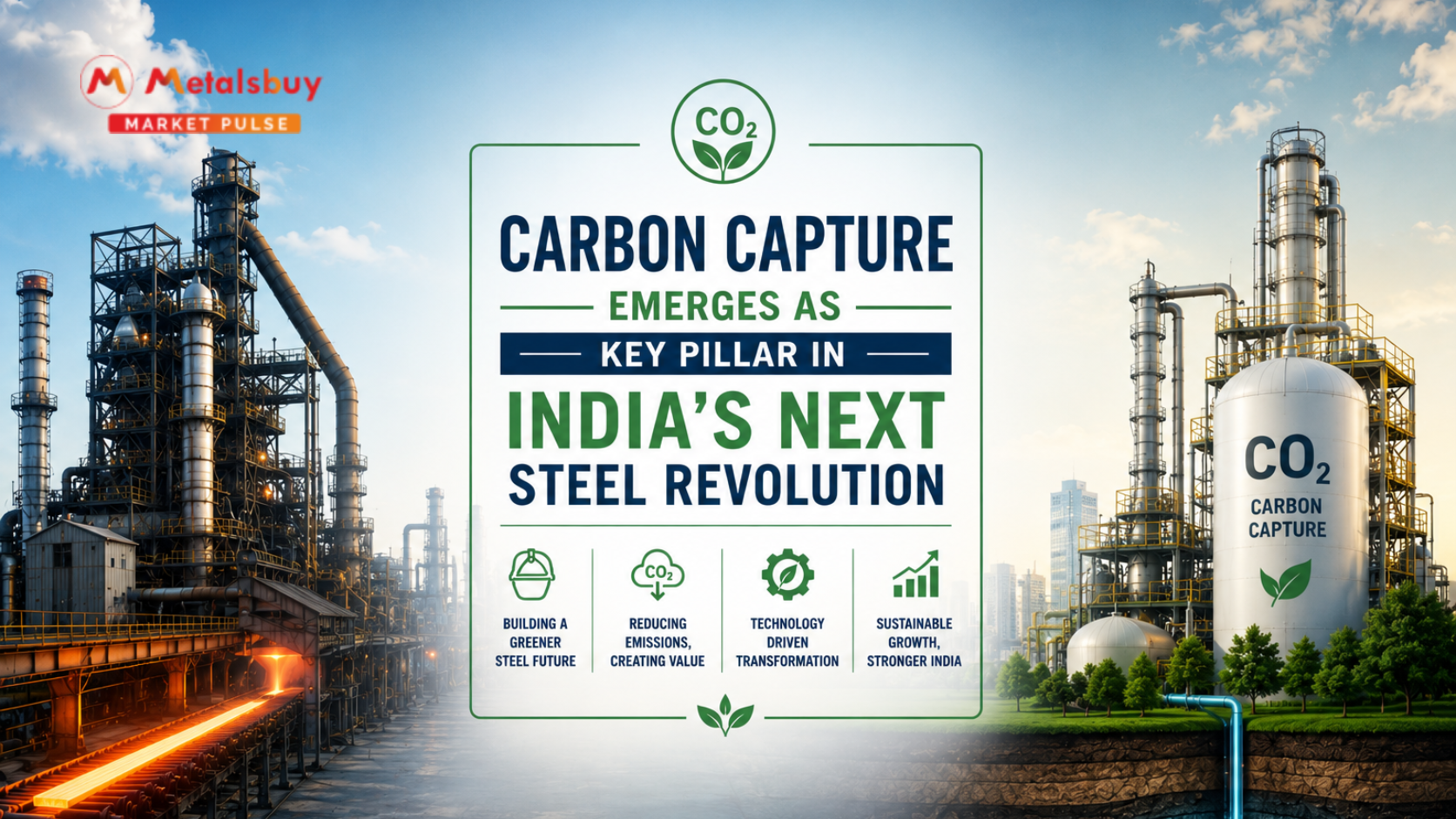
India’s steel industry is entering a transformative phase where decarbonisation and industrial expansion are increasingly moving together as parallel priorities. Prime Minister Narendra Modi recently highlighted the strategic importance of carbon capture technologies in shaping the future of India’s steel sector by sharing an article written by Union Steel Minister H.D. Kumaraswamy. The article outlined how carbon capture, utilisation and storage (CCUS) could become a major pillar in India’s long-term steel decarbonisation strategy while supporting continued industrial growth and global competitiveness.
India currently stands as the world’s second-largest crude steel producer with output of around 152 million tonnes during FY 2024-25. Under the National Steel Policy 2017, the country aims to increase crude steel capacity to 300 million tonnes by FY 2030-31, while the longer-term vision targets nearly 500 million tonnes of steelmaking capacity by 2047. These ambitions are directly linked to India’s infrastructure expansion, manufacturing growth, urbanisation, transportation development, renewable energy projects, and industrialisation roadmap.
However, the steel industry remains one of the most emissions-intensive sectors globally due to heavy dependence on blast furnace and coal-based direct reduced iron (DRI) production routes. India’s steel sector alone contributes nearly 10–12% of the country’s greenhouse gas emissions because coal continues to remain the dominant reducing agent and energy source in steel production. As India simultaneously pursues industrial expansion and its Net Zero 2070 commitment, balancing steel growth with sustainability is becoming an increasingly important strategic challenge.
Against this backdrop, carbon capture technologies are emerging as one of the most practical near-term solutions for reducing emissions from existing steelmaking infrastructure. Unlike greenfield technologies that may require completely new production ecosystems, CCUS systems can be integrated into existing blast furnaces and DRI operations to capture carbon dioxide emissions before they are released into the atmosphere. This makes CCUS particularly relevant for India, where a large installed base of conventional steelmaking assets is expected to remain operational for decades.
The Indian government has already started building policy support around this transition. In the Union Budget 2026-27, the government allocated ₹20,000 crore over five years for piloting carbon capture, utilisation and storage technologies across multiple hard-to-abate sectors including steel. The initiative aims to accelerate technology deployment, establish technical standards, develop infrastructure for carbon transport and storage, and support large-scale demonstration projects.
Simultaneously, the Ministry of Steel has also received ₹455 crore under the National Green Hydrogen Mission to pilot hydrogen-based steelmaking technologies. The government has additionally introduced a green steel taxonomy framework that defines emission intensity benchmarks for low-carbon steel production. Steel products emitting less than 2.2 tonnes of CO₂ equivalent per tonne of finished steel are expected to qualify under the green steel classification system, which could eventually help create demand for cleaner steel across construction, manufacturing, and infrastructure sectors.
The increasing focus on carbon capture is also linked to rising global climate-related trade regulations. International markets, especially Europe, are gradually introducing carbon-linked import frameworks such as the Carbon Border Adjustment Mechanism (CBAM), which may impose additional costs on carbon-intensive imports. Early adoption of CCUS technologies could therefore help Indian steel producers remain competitive in export markets while simultaneously improving ESG positioning and attracting climate-aligned investments.
Another important aspect of CCUS adoption is the potential creation of entirely new industrial ecosystems around carbon transport, storage, utilisation, engineering services, monitoring systems, and carbon management infrastructure. Large-scale deployment of carbon capture systems could create opportunities for technology providers, infrastructure developers, energy companies, engineering firms, and industrial service providers over the coming years. The transition may therefore extend beyond emissions reduction and become a broader industrial opportunity for India’s manufacturing ecosystem.
At the same time, the transition toward lower-carbon steelmaking is expected to remain gradual rather than immediate. Challenges related to technology costs, infrastructure readiness, energy availability, carbon storage systems, financing mechanisms, and operational scalability continue to remain significant. However, India’s current policy direction indicates that the steel sector is likely to increasingly combine conventional production growth with phased integration of cleaner technologies over the coming decade.
INDUSTRY IMPACT
India’s increasing focus on carbon capture technologies signals a major structural shift in the long-term direction of the steel industry. Rather than slowing industrial expansion, policymakers are attempting to integrate sustainability into future growth strategies. This could reshape investment priorities across steelmaking, energy infrastructure, engineering services, and industrial technology sectors over the coming years.
The development may also accelerate investments into green steel infrastructure and low-carbon industrial ecosystems within India. Companies involved in carbon capture engineering, industrial gas handling, storage infrastructure, renewable energy integration, and hydrogen-linked technologies could witness rising business opportunities as the steel sector gradually transitions toward lower-emission production pathways.
For Indian steel producers, early adoption of CCUS technologies may become strategically important from both regulatory and export competitiveness perspectives. As global buyers increasingly prioritise low-carbon supply chains, steelmakers capable of demonstrating emissions reduction progress may gain stronger positioning in international markets and ESG-focused investment ecosystems.
The policy push additionally reflects how India is attempting to balance industrial growth ambitions with climate commitments rather than treating them as conflicting objectives. This approach may help the country continue expanding manufacturing capacity while gradually improving environmental performance across energy-intensive sectors.
WHAT TO WATCH NEXT
One of the key areas to monitor will be how quickly CCUS pilot projects move from policy announcements to commercial-scale implementation. The pace of execution, technology selection, infrastructure development, and industrial adoption will determine how effectively carbon capture can contribute toward reducing emissions from India’s steel sector. Successful pilot projects may accelerate broader industry-wide adoption over the medium term.
Another critical factor will be the economics of carbon capture technologies in the Indian market. Installation costs, operational expenses, carbon storage infrastructure, financing mechanisms, and policy incentives will heavily influence the commercial viability of CCUS projects. Government support and public-private partnerships are likely to remain crucial during the early adoption stages.
Market participants will also closely monitor the evolution of global carbon regulations and trade frameworks. Policies such as CBAM and sustainability-linked procurement standards could significantly influence how aggressively steelmakers invest in low-carbon technologies. Export-oriented steel producers may increasingly prioritise emissions reduction strategies to maintain international competitiveness.
The integration of carbon capture with renewable energy, hydrogen-based steelmaking, and energy efficiency improvements will additionally remain an important area to watch. The long-term success of India’s steel decarbonisation journey may depend on how effectively multiple clean technologies are combined into scalable industrial solutions rather than relying on a single pathway alone.
MARKET OUTLOOK
India’s steel industry is likely entering a new phase where growth, competitiveness, and sustainability are becoming increasingly interconnected. While conventional blast furnace production will continue playing a major role in meeting rising steel demand, cleaner technologies such as CCUS and green hydrogen are expected to gradually become more integrated into future steelmaking strategies. This transition could fundamentally reshape the structure of the Indian steel sector over the coming decades.
The government’s policy direction indicates that India does not intend to slow industrial growth in pursuit of climate goals. Instead, the focus appears to be on modernising heavy industries through phased adoption of cleaner technologies while maintaining manufacturing competitiveness and infrastructure expansion momentum. This balanced approach could become one of the defining themes of India’s industrial strategy.
Over the long term, companies that successfully combine operational scale with lower-emission production systems may gain significant competitive advantages in both domestic and global markets. As carbon-conscious procurement standards rise globally, the ability to produce cleaner steel without compromising cost competitiveness could become a major differentiator within the global steel industry itself.