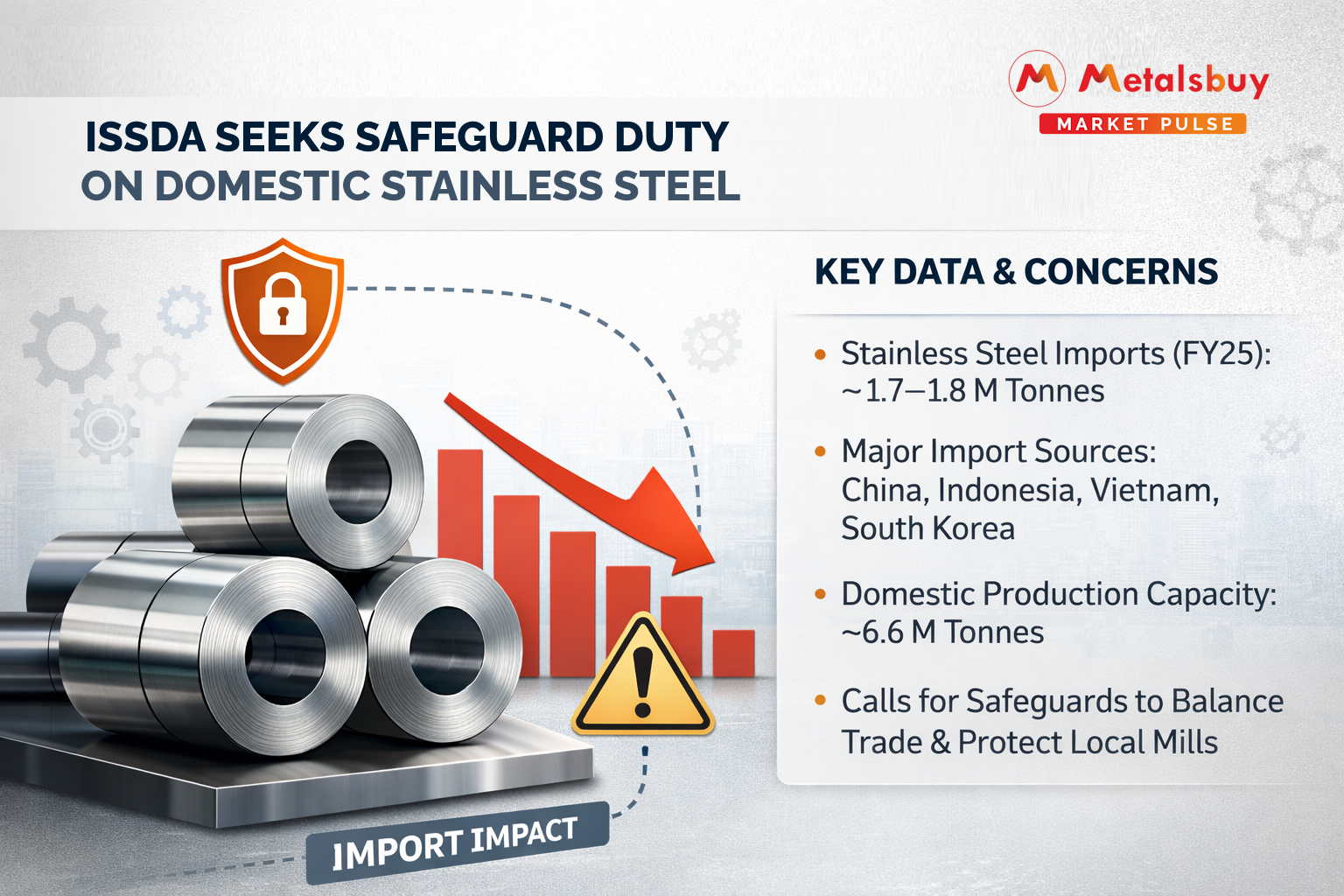
The Indian Stainless Steel Development Association (ISSDA) has urged the government to consider safeguard measures, including safeguard duties, to protect domestic stainless steel producers following the conclusion of the India–EU Free Trade Agreement (FTA).
While welcoming the trade pact as a landmark step in India’s global trade integration, ISSDA cautioned that unrestricted or accelerated import inflows from the European Union (EU) could adversely impact domestic manufacturers unless adequate protective mechanisms are put in place.
Industry Welcomes Trade Deal, Flags Import Risks
ISSDA stated that the India–EU FTA opens long-term opportunities for Indian industry through improved market access and global integration. However, it stressed that stainless steel is a capital-intensive and margin-sensitive sector, making it vulnerable to sudden import surges once tariff concessions come into effect.
The industry body noted that European stainless steel producers enjoy technological advantages, scale efficiencies, and government support mechanisms, which could result in price pressures for Indian manufacturers once duties are reduced or eliminated.
Key Data Points of Interest
-
India’s stainless steel production capacity: ~6.6 million tonnes per annum
-
Domestic consumption (FY25 estimate): ~4.5–4.7 million tonnes
-
Stainless steel imports into India (FY25): ~1.7–1.8 million tonnes
-
Major import sources: China, Indonesia, Vietnam, South Korea
-
EU share in global stainless steel exports: ~15–18%
-
India–EU combined share of global GDP: ~25%
ISSDA highlighted that import dependence has already increased in recent years, and any additional duty-free or concessional inflows under the FTA could intensify competitive pressure on local mills.
Call for Safeguard Mechanism, Not Trade Barriers
The association clarified that it is not opposing the FTA, but is seeking a balanced trade framework. It has recommended the use of WTO-compliant safeguard instruments that can be triggered in case of:
-
Sudden surge in stainless steel imports
-
Serious injury or threat to domestic producers
-
Price undercutting due to lower-cost imports
Safeguard duties, unlike anti-dumping duties, are temporary measures designed to give domestic industry time to adjust to changing trade dynamics.
Policy Context
India has previously used safeguard duties in the steel sector to counter import surges, including proposals for temporary duties of up to 12% on select steel products during periods of market stress. The stainless steel industry believes a similar approach may be required once FTA-linked tariff reductions begin.
ISSDA said it will closely examine the fine print of the India–EU FTA and continue engaging with policymakers to ensure domestic stainless steel manufacturing remains competitive, sustainable, and aligned with India’s broader industrial goals.
Outlook
As India moves toward deeper trade integration with Europe, the stainless steel sector is expected to remain under close policy watch. The industry’s immediate focus will be on calibrated implementation of the FTA, ensuring that trade liberalisation does not come at the cost of domestic manufacturing viability.