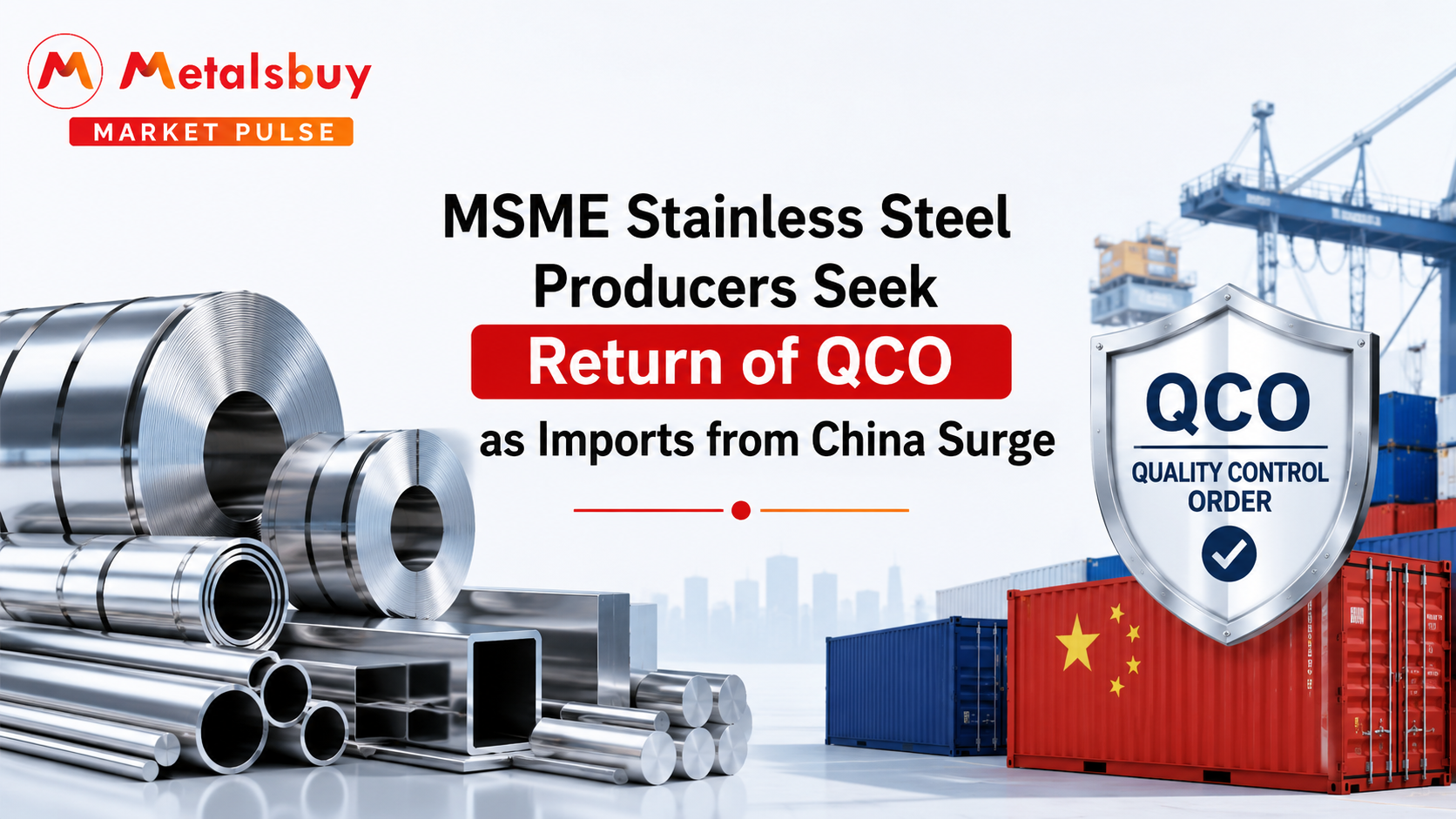
Key Numbers
-
Stainless Steel Imports (April 2026): 101,252 Tonnes
-
Year-on-Year Growth in Imports: 65%
-
QCO Suspension Date: 27 April 2026
-
Industry Demand: Reintroduction of Mandatory Quality Control Order (QCO)
-
Primary Concern: Rising low-priced stainless steel imports from China
Market Analysis
MSME Stainless Steel Sector Raises Fresh Concerns Over Import Surge
India's small and medium-scale stainless steel manufacturers have urged the Ministry of Steel to reinstate the mandatory Quality Control Order (QCO) following a sharp increase in stainless steel imports after its suspension. The representation has been jointly submitted by the Stainless Steel Induction Furnace Association and the Stainless Steel Re-Rollers Association, which argue that the relaxation has resulted in a rapid inflow of low-priced imports, particularly from China, placing significant pressure on domestic MSME manufacturers.
According to the associations, the current market environment is becoming increasingly challenging for smaller manufacturers that compete primarily in commodity and value-added stainless steel products. They contend that the sudden increase in imports is affecting plant utilisation, pricing discipline and profitability across the MSME segment, which collectively accounts for a significant share of India's downstream stainless steel manufacturing ecosystem.
Suspension of QCO Was Intended to Ease Compliance
The Ministry of Steel suspended the mandatory QCO for specified stainless steel products through an order issued on 27 April 2026. The objective was to reduce compliance challenges faced by manufacturers and improve the availability of specialised stainless steel grades that were not readily available from domestic producers. Under the earlier QCO framework, only Bureau of Indian Standards (BIS)-certified products could be manufactured, imported, stored or sold in the Indian market, requiring overseas suppliers to obtain BIS approval before exporting to India.
While the exemption was designed to improve supply chain flexibility, industry bodies now argue that it has also made it easier for lower-priced imported material to enter the domestic market. They believe that this has created an uneven competitive environment for Indian MSMEs, many of which operate with higher production costs and comparatively smaller economies of scale.
Imports Jumped 65% in April
Industry associations have cited official trade data indicating that India's stainless steel imports reached 101,252 tonnes in April 2026, representing a 65 percent increase compared with the same month last year. Although imports help bridge supply gaps and provide specialised grades unavailable domestically, manufacturers argue that the recent increase has been concentrated in products where Indian capacity already exists, intensifying competition for local producers.
The concern extends beyond pricing alone. MSME producers believe that sustained import pressure could discourage future investment in downstream stainless steel manufacturing, affecting employment generation and capacity expansion. Smaller units generally operate with narrower margins and are therefore more vulnerable to prolonged periods of aggressive import competition.
Quality Standards and Trade Policy Must Remain Balanced
Quality Control Orders have become an important policy instrument for the Indian government across several industrial sectors. Their primary purpose is to ensure that products sold in the domestic market comply with prescribed Indian Standards while improving consumer safety and product quality. In the case of imported products, BIS certification also establishes traceability and quality assurance before material enters the Indian market.
However, QCOs also influence trade flows by increasing compliance requirements for overseas manufacturers. As a result, policymakers must carefully balance the objective of maintaining high quality standards with ensuring adequate raw material availability for domestic manufacturing. The stainless steel sector represents one of the clearest examples of this policy balancing act, where quality assurance, trade competitiveness and industrial growth are closely interconnected.
Chinese Imports Continue to Influence Market Dynamics
China remains one of the world's largest stainless steel producers and exporters, supported by extensive manufacturing capacity and integrated supply chains. Competitive pricing from Chinese suppliers has made imported stainless steel attractive for many Indian buyers, particularly when domestic availability is limited or prices remain elevated.
At the same time, Indian manufacturers have repeatedly expressed concerns regarding the impact of lower-priced imports on domestic industry. Similar discussions have emerged across several steel product categories over the past year, resulting in safeguard measures, anti-dumping investigations and industry requests for stronger trade protection. The latest representation from stainless steel MSMEs reflects this broader trend of domestic producers seeking policy support as global competition intensifies.
Domestic Manufacturing Capacity Remains Central to Long-Term Competitiveness
The current debate extends beyond import volumes alone. Strengthening India's stainless steel manufacturing ecosystem will ultimately depend on continuous investments in technology, product diversification, production efficiency and quality enhancement. While temporary trade measures may provide relief during periods of market disruption, sustained competitiveness will require domestic producers to expand capacity and develop higher-value products capable of competing in both domestic and export markets.
India's stainless steel consumption continues to grow steadily, supported by infrastructure development, food processing, railways, architecture, automotive applications and consumer durables. As demand expands, the long-term objective remains creating a manufacturing ecosystem capable of meeting domestic requirements while maintaining global competitiveness.
Industry Impact
The request to reinstate the mandatory QCO highlights the growing concerns of India's stainless steel MSMEs regarding rising imports and competitive pressures. Any policy decision regarding the reintroduction of quality control requirements could influence import patterns, procurement strategies and pricing across the stainless steel value chain. Downstream manufacturers, importers and domestic producers will all be closely monitoring the government's response in the coming weeks.
Outlook
The Ministry of Steel is expected to review industry representations before taking any decision regarding the future of the suspended QCO. While no policy changes have been announced, the discussion reflects the broader challenge of balancing domestic manufacturing interests with supply chain flexibility and international trade commitments.
For the stainless steel industry, long-term competitiveness will depend not only on trade protection but also on continued investments in quality, efficiency and product innovation. As India's manufacturing sector expands, maintaining a balanced policy framework that supports both producers and downstream users will remain essential.
Disclaimer: This analysis is based on publicly available industry reports and official information regarding the Quality Control Order. Any future policy decision regarding the QCO will be subject to government review and notification.