KEY NUMBERS
-
Partnership Focus: Manufacturing Competitiveness & Innovation
-
Key Participants: AM/NS India and IIT Roorkee
-
Core Areas: Advanced Steel Technologies, Process Optimisation, R&D
-
Strategic Objective: Industry-Academia Collaboration
-
Talent Development Focus: Industry-Ready Workforce Creation
-
Innovation Theme: Technology-Led Manufacturing Growth
-
Long-Term Goal: Strengthening India's Global Manufacturing Position
-
Industry Impact: Enhanced Research and Product Development Capabilities
MARKET ANALYSIS
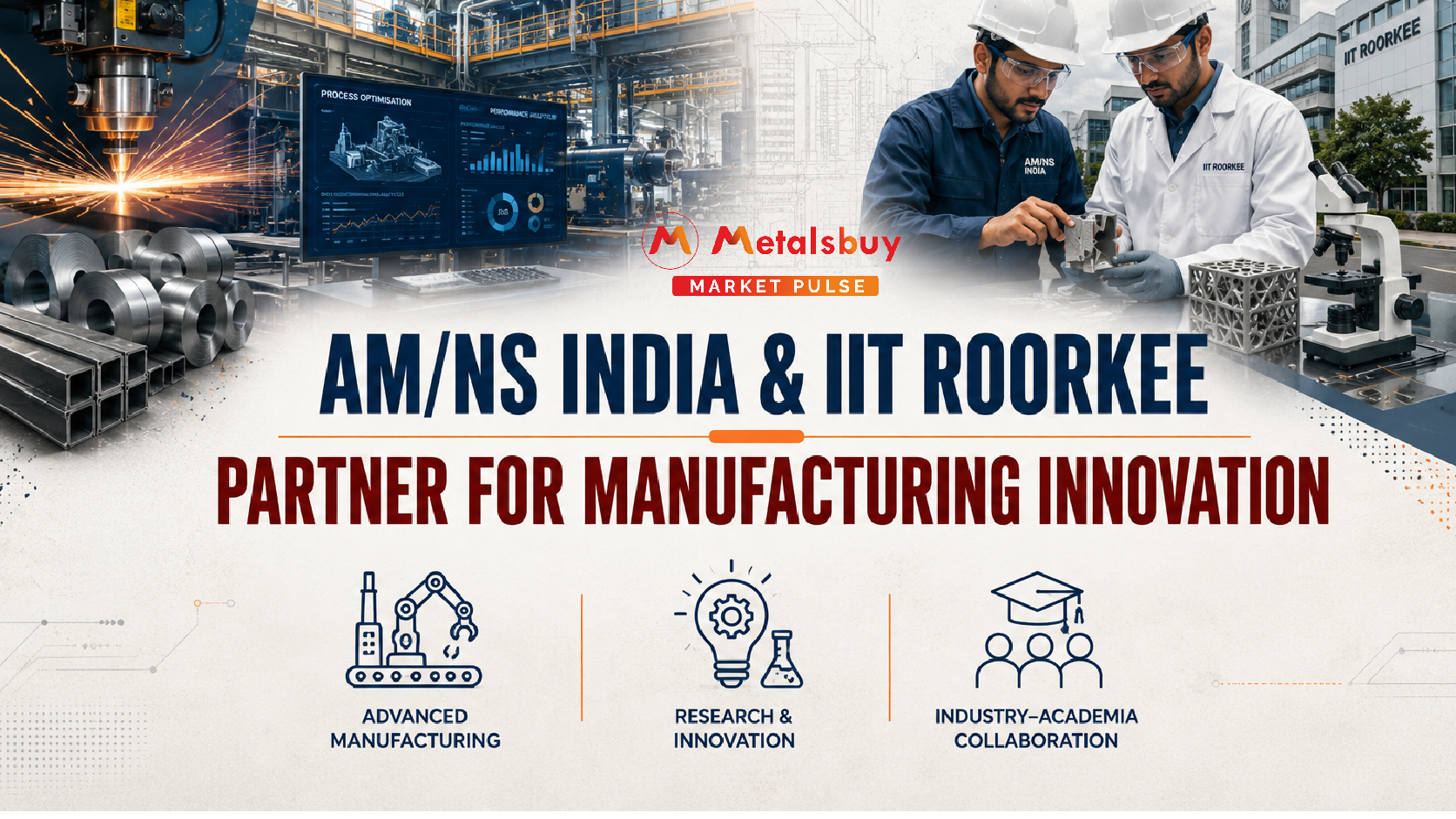
India's manufacturing sector is entering a new phase where competitiveness is increasingly being determined not only by production capacity but also by innovation, technology adoption, and the ability to develop future-ready talent. Against this backdrop, the collaboration between AM/NS India and IIT Roorkee reflects a growing trend of deeper engagement between industry and academia aimed at strengthening India's industrial ecosystem.
The partnership seeks to combine industrial expertise with academic research capabilities to address challenges and opportunities across manufacturing, steel technology, process efficiency, and workforce development. As industries become more technology-intensive and globally competitive, collaborations of this nature are expected to play a critical role in driving innovation-led growth.
For India's steel sector, the initiative arrives at an important time. The country continues expanding its steelmaking capacity while simultaneously targeting higher-value products, improved efficiency, sustainability, and global competitiveness. Achieving these objectives will require continuous innovation and access to highly skilled technical talent.
WHY INDUSTRY-ACADEMIA COLLABORATION MATTERS
Globally, many of the most successful manufacturing economies have built strong links between universities and industry. Research institutions provide access to scientific expertise, emerging technologies, and innovation capabilities, while industries contribute practical challenges, commercial applications, and large-scale implementation opportunities.
In India, such collaborations are becoming increasingly important as manufacturers seek to move beyond cost competitiveness and focus on technology-driven differentiation.
The partnership is expected to create opportunities for joint research, product development, process improvements, and technology commercialization. These efforts can help manufacturers improve operational efficiency, reduce costs, enhance product quality, and accelerate innovation cycles.
For the steel industry specifically, technological advancements are becoming essential as producers compete in increasingly demanding domestic and international markets. Customers today require specialized grades, higher performance standards, improved sustainability metrics, and advanced manufacturing solutions.
Industry-academia partnerships can help bridge this gap by translating research into practical industrial applications.
ADVANCED STEEL TECHNOLOGIES TAKE CENTER STAGE
One of the most significant aspects of the collaboration is its focus on advanced steel technologies.
The steel industry is undergoing a transformation driven by evolving customer requirements, digital manufacturing, automation, artificial intelligence, advanced materials, and sustainability initiatives. Producers are investing heavily in technology to improve productivity, reduce emissions, optimize resource utilization, and develop next-generation products.
Research-led innovation can play a crucial role in achieving these objectives.
Areas such as advanced metallurgy, process automation, quality enhancement, digital monitoring systems, energy efficiency, and low-carbon steelmaking are expected to become increasingly important over the coming decade.
As India aims to become a global manufacturing hub, domestic steelmakers will need to continuously improve their technological capabilities to remain competitive against international producers.
Collaborations with leading institutions can help accelerate this transition.
BUILDING THE NEXT GENERATION OF INDUSTRIAL TALENT
Another important pillar of the partnership is workforce development.
India's manufacturing sector is expected to create significant demand for highly skilled engineers, metallurgists, data specialists, automation experts, and manufacturing professionals over the coming years. However, one of the recurring challenges faced by industry has been the gap between academic learning and industrial requirements.
The collaboration aims to address this challenge by creating stronger links between classroom education and real-world industrial applications.
Students will benefit from greater exposure to manufacturing challenges, research projects, industry practices, and emerging technologies. At the same time, companies gain access to a talent pipeline better aligned with future industry needs.
This approach not only improves employability but also strengthens the overall competitiveness of India's manufacturing ecosystem.
As advanced manufacturing technologies become more prevalent, the importance of industry-ready talent is expected to grow significantly.
SUPPORTING INDIA'S MANUFACTURING AMBITIONS
The partnership also aligns with broader national objectives aimed at strengthening domestic manufacturing capabilities.
India has set ambitious targets across sectors such as steel, engineering, automotive, defence, infrastructure, renewable energy, and advanced manufacturing. Achieving these goals will require continuous innovation, stronger research ecosystems, and greater collaboration between industry and educational institutions.
The government's focus on initiatives such as Make in India, Atmanirbhar Bharat, National Education Policy reforms, and industrial modernization further reinforces the importance of such collaborations.
Research-driven manufacturing can help improve productivity, reduce import dependence, enhance export competitiveness, and support the development of globally competitive industrial capabilities.
Partnerships that foster innovation and skill development therefore have implications far beyond a single company or institution.
IMPLICATIONS FOR THE STEEL INDUSTRY
For the steel sector, the collaboration represents a positive step toward building a stronger innovation ecosystem.
The industry is currently facing multiple challenges and opportunities, including decarbonization, digital transformation, raw material efficiency, advanced product development, and evolving customer requirements.
Research partnerships can help accelerate solutions in these areas while improving the industry's ability to adapt to future market demands.
The emphasis on process optimization is particularly important because even incremental efficiency improvements can generate substantial benefits in large-scale steel operations. Similarly, advancements in material science can create opportunities for developing higher-value steel products that command stronger margins.
Over the long term, such initiatives may contribute to strengthening India's position as both a major steel producer and an emerging center for steel technology innovation.
MARKET OUTLOOK
The collaboration between AM/NS India and IIT Roorkee highlights an increasingly important trend shaping the future of Indian manufacturing—innovation through partnership.
As the manufacturing landscape becomes more technology-driven, successful companies will increasingly be those capable of combining industrial scale with research excellence, digital capabilities, and skilled talent.
The steel industry's future competitiveness will depend not only on production capacity but also on innovation, productivity, sustainability, and technological leadership.
By bringing together academic expertise and industrial experience, partnerships like this have the potential to create long-term value for the manufacturing sector while supporting India's broader ambition of becoming a globally competitive industrial powerhouse.