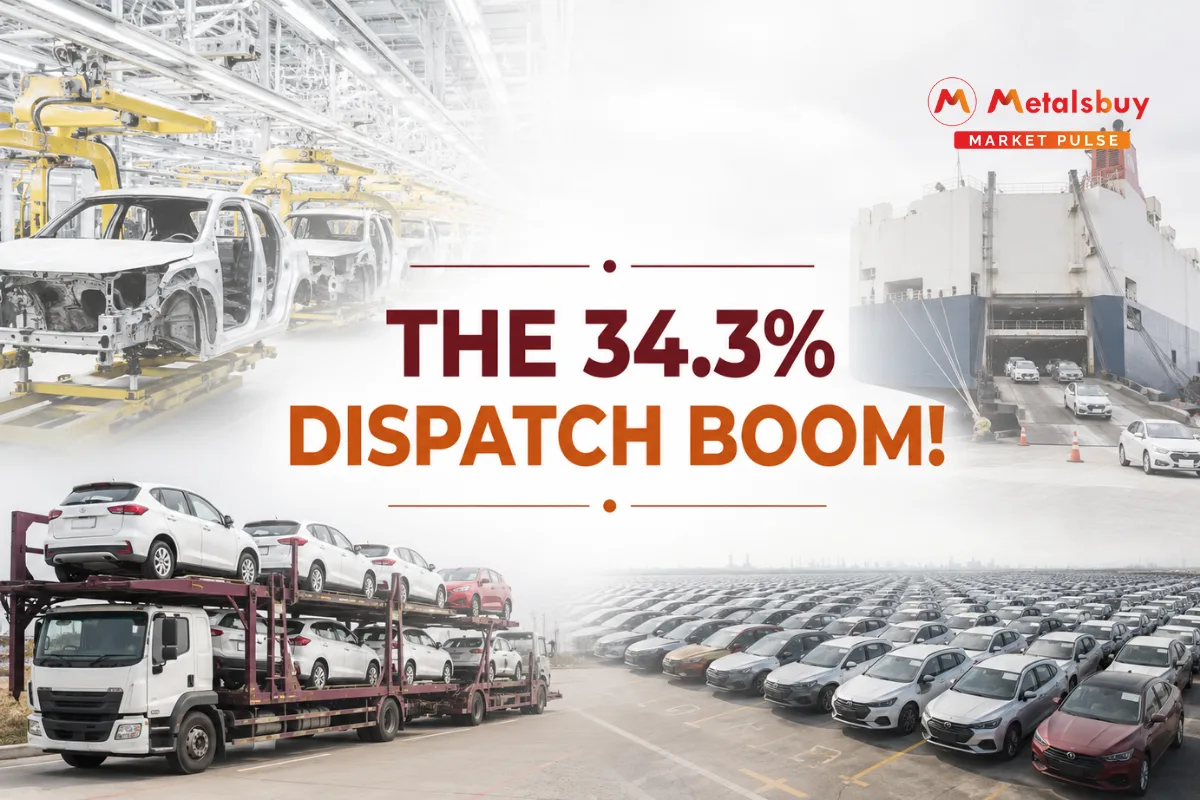
India's automotive industry is experiencing a historic surge, with domestic passenger vehicle dispatches to dealers skyrocketing by 34.3% year-on-year in July. This unprecedented growth, reported by the Society of Indian Automobile Manufacturers (SIAM), signals robust consumer confidence and a remarkably strong start to the festive season.
KEY NUMBERS
- Passenger Vehicles: 4,57,810 units (Up 34.3% YoY from 3,40,772 units)
- Two-Wheelers: 19,23,483 units (Up 22.6% YoY from 15,69,120 units)
- Three-Wheelers: 92,560 units (Up 33.4% YoY from 69,403 units)
- Total Retail Sales (All Segments): 25,91,138 units (Up 26% YoY, per FADA)
- Projected PV Market Size (5 Years): 6.1-6.3 million units per annum (Maruti Suzuki estimate)
MARKET ANALYSIS
The Indian auto industry has delivered its strongest-ever July performance, characterized by robust double-digit growth across all major segments. This is not merely a post-pandemic recovery bounce; it represents sustained positive momentum that has been building over several months. The 34.3% jump in passenger vehicles to nearly 4.58 lakh units is particularly striking, indicating strong underlying demand even before the traditional festive peak.
This growth is being driven by several converging factors. A revival in rural demand is playing a crucial role, particularly in the two-wheeler segment, which saw sales surge past 1.9 million units. Furthermore, consumer preferences are shifting. Buyers are increasingly looking beyond basic metrics like mileage and EMI, prioritizing features, safety, and technology, which is driving up the average selling price and boosting revenue for automakers. The growing popularity of Sports Utility Vehicles (SUVs) continues to be a major engine of growth for the passenger vehicle segment, while a renewed interest in small cars is providing additional volume at the entry level.
WHAT IT MEANS FOR THE BROADER ECONOMY
The automotive sector is a critical bellwether for the broader Indian economy, and its robust performance has far-reaching positive implications.
- Manufacturing and Supply Chain Boost: The surge in auto production translates directly to increased demand for raw materials like steel, aluminum, and plastics, as well as a massive boost for the auto components industry. This creates a positive ripple effect through the manufacturing sector.
- Employment Generation: Higher production volumes necessitate an expansion of the workforce, both directly on the factory floor and indirectly across the supply chain, logistics, and dealership networks.
- Increased Tax Revenue: The growth in vehicle sales will significantly boost government revenues through GST and other levies, providing more fiscal room for infrastructure development and public spending.
MARKET OUTLOOK
The outlook for the Indian automotive industry remains exceptionally bright. As the industry enters the festive season, expectations are high for continued strong consumer sentiment and sustained sales momentum.
Industry leaders remain highly optimistic about the medium-to-long-term prospects. Maruti Suzuki, India's largest carmaker, projects that the domestic passenger vehicle market will grow to between 6.1 and 6.3 million units annually over the next five years. This represents an increase of roughly one-third over the 4.64 million cars sold in the country in FY26.
This optimistic forecast is predicated on the continued economic expansion of India, rising disposable incomes, and the ongoing shift toward personal mobility. Furthermore, the industry is undergoing a significant technological transformation. Manufacturers are aggressively expanding production capacities, introducing new models with advanced features, and gearing up for the electric vehicle (EV) transition. For instance, Kia plans to expand its India plant capacity to target 410,000 units by 2030, while Hyundai aims to have one million connected cars on Indian roads by 2027.
While challenges such as supply chain bottlenecks and inflationary pressures persist, the underlying fundamentals of the Indian auto market remain exceptionally strong. The record-breaking sales in July serve as a powerful testament to the resilience and growth potential of this vital sector, signaling a period of sustained expansion ahead.