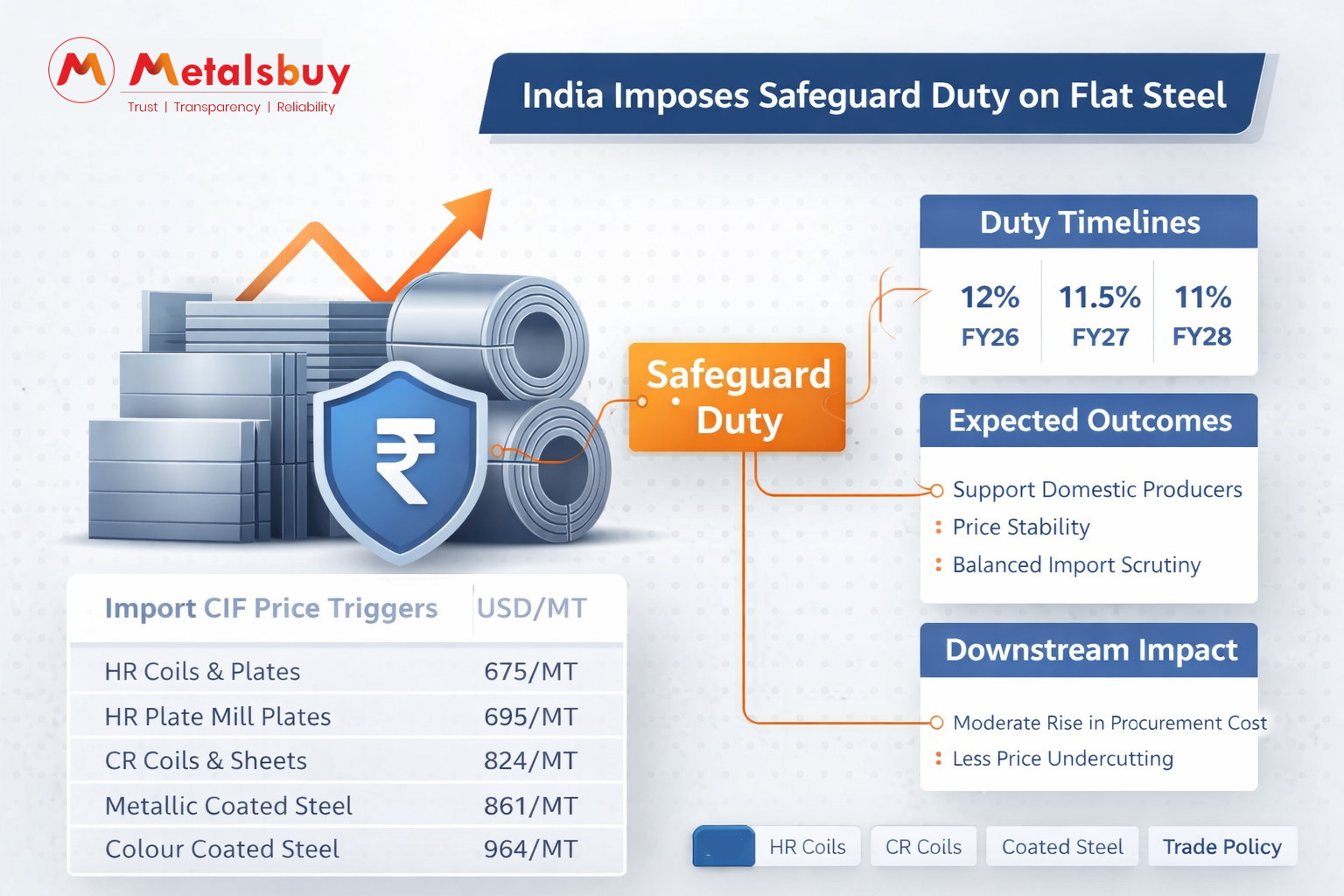
The Government of India has imposed a safeguard duty on select flat steel products imported at prices below specified threshold levels, marking a significant intervention to protect domestic steelmakers from a sharp surge in low-priced imports.
The decision follows an investigation by the Directorate General of Trade Remedies (DGTR), which found that rising imports of flat steel products were causing material injury to domestic producers. The provisional safeguard duty has come into effect from 21 April 2025 for a period of 200 days, with a defined long-term duty structure extending over three financial years.
Products Covered Under the Safeguard Measure
The safeguard duty applies to a wide range of flat steel products, including:
-
Hot Rolled (HR) coils, sheets and plates
-
Cold Rolled (CR) coils and sheets
-
Metallic coated steel (including galvanised, zinc-aluminium, aluminium-zinc)
-
Colour-coated steel coils and sheets
The duty is triggered when imports land below the specified CIF threshold prices, as notified by the government.
Indicative CIF Trigger Prices (USD/MT)
| Product Category | CIF Price Threshold |
|---|---|
| HR coils, sheets & plates | 675 |
| HR plate mill plates | 695 |
| CR coils and sheets | 824 |
| Metallic coated steel | 861 |
| Colour coated steel | 964 |
Duty Structure
While the provisional duty applies immediately, the final safeguard duty has been structured for three years, providing medium-term protection to the domestic industry:
-
12% in FY26
-
11.5% in FY27
-
11% in FY28
This phased reduction indicates the government’s intent to allow gradual market adjustment rather than permanent protectionism.
Market Outlook: What Changes Now?
1. Relief for Domestic Steel Producers
The safeguard duty is expected to improve price stability for Indian steel mills, particularly integrated and large flat steel producers. Over the past year, domestic prices had come under pressure due to aggressive imports, especially from Asian markets where excess capacity and lower production costs prevailed.
With the duty in place:
-
Import arbitrage is likely to reduce
-
Domestic mills may regain pricing power
-
Inventory liquidation pressure could ease
This is expected to support margin recovery, especially in HR and CR segments.
2. Impact on Imports and Trade Flows
Imports priced below the CIF thresholds will become economically unviable, leading to:
-
A decline in low-priced spot imports
-
Greater scrutiny of contract-based shipments
-
Potential shift in sourcing to higher-grade or value-added products
However, imports will not disappear entirely, as high-quality and niche grades not produced domestically may continue to enter the country.
3. Implications for Downstream Consumers
For downstream industries such as:
-
Auto components
-
Consumer durables
-
Appliances and infrastructure
Steel procurement costs may see moderate upward pressure, particularly in the near term. However, the government appears to have balanced producer protection with consumer interests by:
-
Applying price-based triggers instead of blanket duties
-
Limiting the duty to a safeguard mechanism rather than anti-dumping
This reduces the risk of sharp inflationary impact on end-users.
4. Secondary Steel Market Reaction
The secondary steel market is likely to witness:
-
Improved demand sentiment
-
Better realizations for CR, coated and value-added products
-
Reduced price undercutting from imported material
However, secondary players remain sensitive to raw material costs and power tariffs, which will continue to influence overall market dynamics.
Strategic Implications for the Indian Steel Industry
In the medium term, the safeguard duty supports:
-
Capacity utilisation improvement at domestic mills
-
Investment confidence in flat steel expansion projects
-
Alignment with India’s broader industrial and manufacturing growth objectives
At the same time, the gradual tapering of duty signals that Indian producers are expected to enhance competitiveness, improve efficiency, and prepare for eventual exposure to global pricing dynamics.
Metalsbuy Outlook
The safeguard duty is expected to stabilise the domestic flat steel market in the near to medium term, particularly through FY26. While it offers immediate relief from import pressure, long-term sustainability will depend on cost optimisation, product diversification, and demand growth from infrastructure, automotive and manufacturing sectors.
Close monitoring of import volumes, domestic price movement, and downstream demand trends will be critical in assessing the effectiveness of this policy intervention.