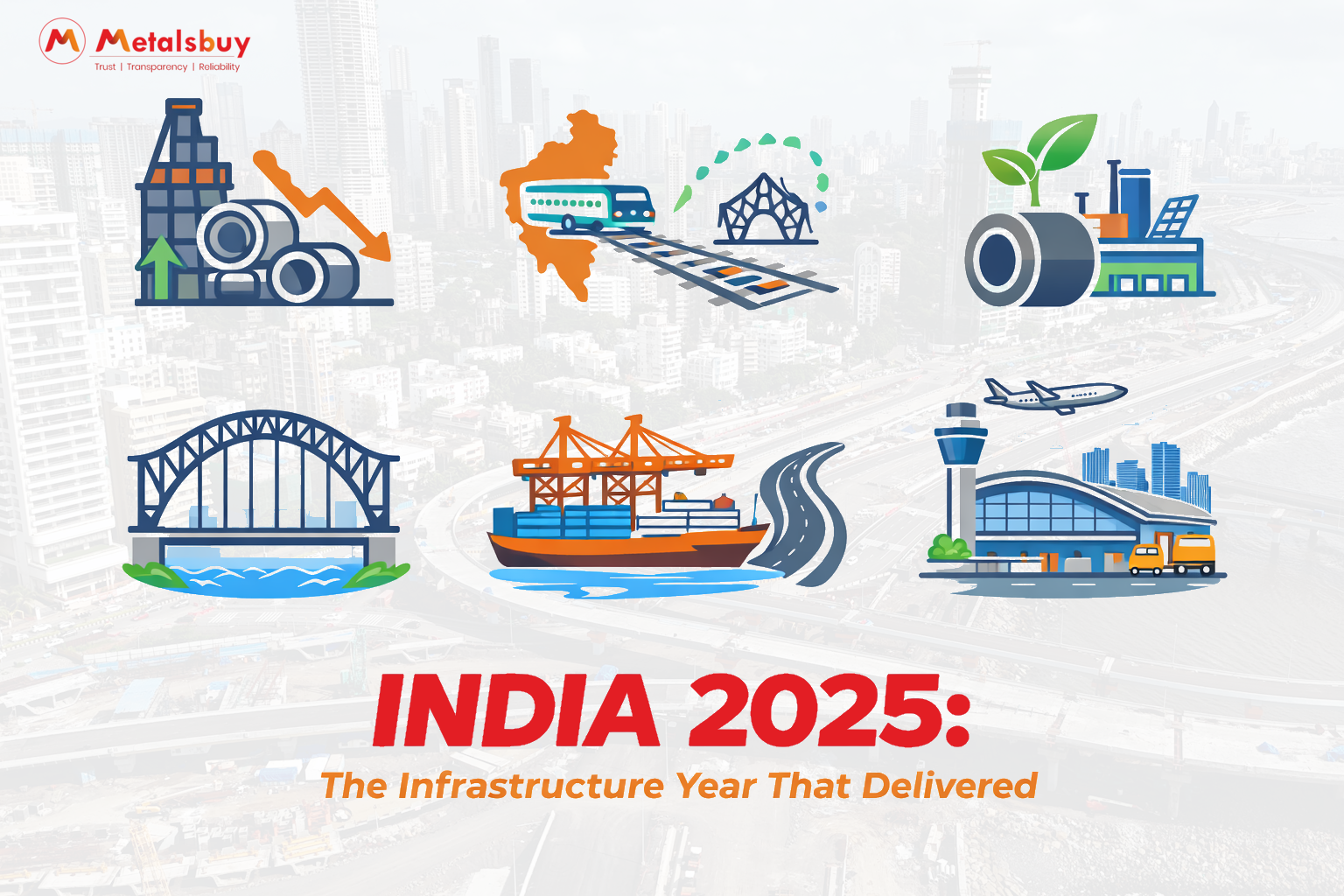
For years, India’s infrastructure story revolved around intent, allocation, and announcement. 2025 marked the shift from promise to performance. Across steel, transport, railways, ports, and capital expenditure, the year stood out not for isolated milestones, but for execution at scale.
What unfolded in 2025 was not incremental progress, it was systemic delivery.
Steel: Capacity, Capability, and Confidence
India’s steel sector entered 2025 on a structurally stronger footing. Installed steelmaking capacity expanded to around 205 million tonnes, while crude steel production reached 151.1 million tonnes in FY25, reinforcing India’s position as a global steel heavyweight.
Equally important was the progress on per-capita steel consumption, which reached 100 kg, a critical stepping stone toward the 160 kg target by FY31 under the National Steel Policy. This consumption growth reflects the real economy, infrastructure, housing, transport, and manufacturing, absorbing steel at scale.
Strategic partnerships further strengthened the sector’s long-term outlook. Proposed joint ventures such as the JSW–POSCO integrated steel project and investments like the JSW–JFE CRGO steel expansion (₹5,845 crore) signal a shift toward higher-value, technology-driven steelmaking. These are not just capacity additions; they are capability upgrades.
Policy support complemented industry momentum. The PLI Scheme for specialty steel (Phase 1.1) gained traction, encouraging domestic production of advanced grades and reducing reliance on imports a critical step for energy, power, and strategic sectors.
Green Steel: From Concept to Early Scale
While green steel remains an emerging segment, 2025 laid early groundwork. India’s green steel capacity is projected to reach around 4.5 million tonnes by FY30, supported by pilot projects, renewable integration, and policy discussions around carbon-efficient steelmaking.
The shift is gradual, but directionally clear sustainability is moving from boardroom ambition to industrial planning.
Infrastructure Icons: Projects That Changed Geography
Several long-awaited infrastructure projects crossed from construction to commissioning in 2025, reshaping connectivity and logistics.
-
The Chenab Rail Bridge, now the world’s highest railway arch bridge, became operational a landmark achievement in engineering and strategic connectivity.
-
Mizoram was connected to India’s national railway network for the first time, ending decades of isolation and opening new economic corridors in the Northeast.
-
The Z-Morh Tunnel in Jammu & Kashmir enabled all-weather access to critical regions, strengthening both civilian mobility and strategic logistics.
-
The Vizhinjam deep-water port emerged as a key maritime asset, enhancing India’s transshipment and container handling capability.
-
Navi Mumbai International Airport (Phase 1) moved closer to operational readiness, easing congestion pressures on India’s busiest aviation hub.
These projects were steel-intensive, capital-heavy, and execution-sensitive and their delivery underscored institutional capacity to handle complexity.
Railways and Mobility: Execution Over Expansion
India’s rail infrastructure saw steady execution rather than headline-driven expansion. Nearly 99% of the broad-gauge network is now electrified, improving efficiency, lowering fuel costs, and reducing emissions.
Progress continued on the Mumbai–Ahmedabad High-Speed Rail corridor, while new mobility solutions such as Vande Metro services reflected a shift toward regional and suburban connectivity not just long-distance prestige projects.
Together, these developments point to a rail strategy focused on reliability, speed, and system efficiency.
Capex Reality: Spending That Translated into Assets
The foundation behind this delivery push was capital expenditure. The FY26 Union Budget allocated ₹11.21 lakh crore toward capex, equivalent to roughly 3.1% of GDP, the highest allocation India has ever committed.
More importantly, execution matched intent. Capex translated into assets on the ground rather than remaining locked in approvals and tenders. This consistency is now feeding into broader macro momentum, with India adding roughly $1 trillion to GDP every 12–18 months on its path toward long-term economic goals.
The 2025 Legacy: From Blueprint to Reality
What makes 2025 structurally important is not any single project or statistic. It is the convergence of:
-
Steel capacity expansion and value-addition
-
Landmark connectivity projects reaching completion
-
Record capital allocation translating into physical assets
-
Policy frameworks aligning with industrial execution
This convergence turned infrastructure from an enabler into a growth driver.
Outlook: What 2026 Must Deliver
As India steps into 2026, the challenge shifts from creation to continuity. Sustaining execution velocity, managing margin pressures in steel and construction, and ensuring demand keeps pace with capacity will define the next phase.
The benchmark has been set. 2025 proved that India can deliver at scale. The years ahead will determine how consistently that delivery becomes the norm.