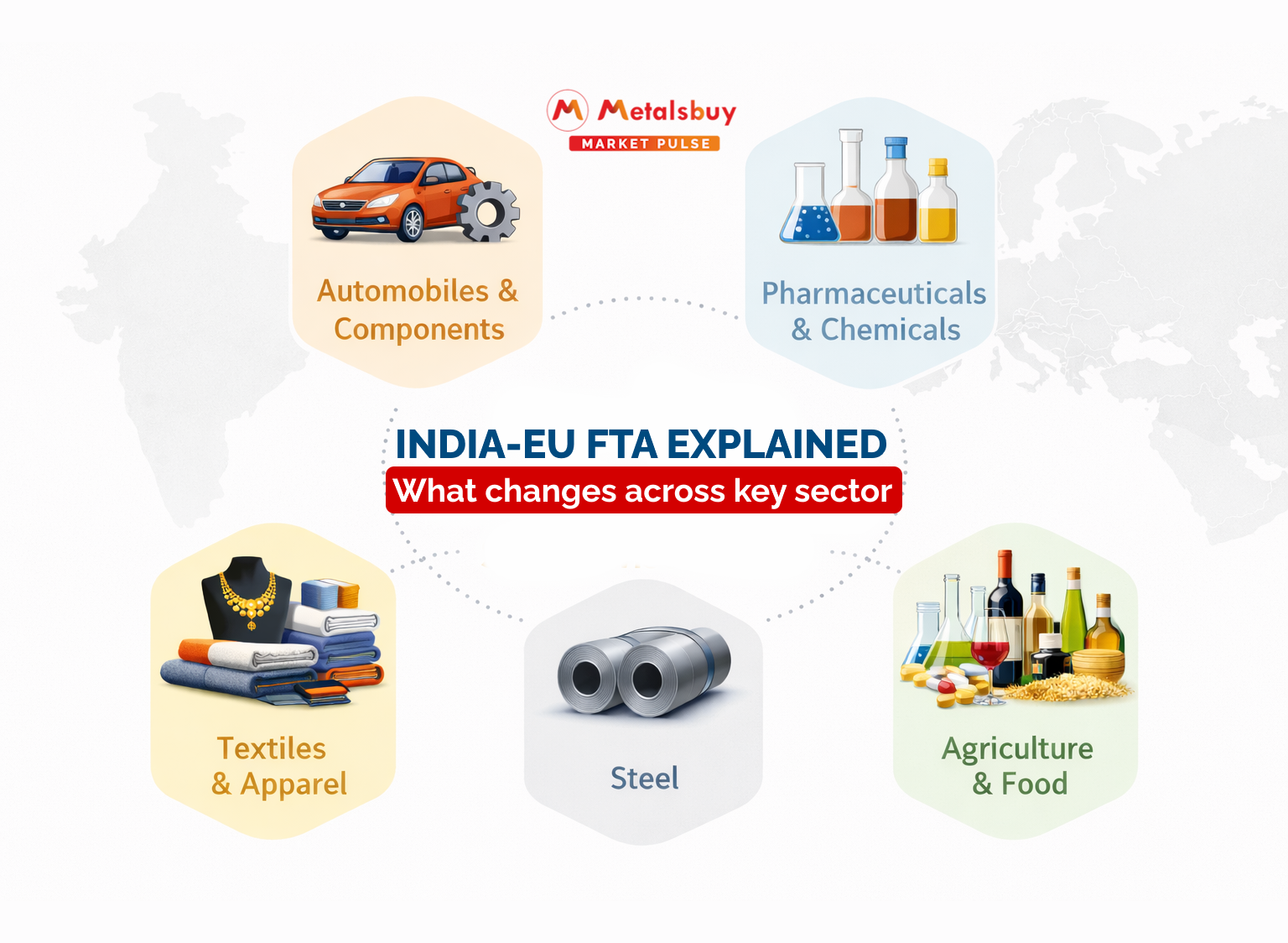
India and the European Union have formally concluded negotiations on a comprehensive Free Trade Agreement (FTA), announced on 27 January 2026 after nearly two decades of discussions. Official statements confirm that the agreement covers approximately 96–97% of bilateral merchandise trade, with tariff reductions and market access commitments to be implemented in a phased manner, subject to ratification.
From a Metalsbuy analytical standpoint, the agreement provides clearer visibility into how key industrial and manufacturing sectors are expected to evolve under a more integrated India–EU trade framework.
1. Automobiles and auto components
Confirmed changes
-
India has agreed to substantially reduce import tariffs on EU-origin passenger vehicles, which were previously among the highest globally.
-
Tariff reductions will be implemented over a multi-year transition period.
-
Automotive components and parts are also covered under the tariff liberalisation schedule.
Confirmed impact
-
The cost structure for EU vehicle imports into India will change structurally under a rules-based framework.
-
Financial markets reacted immediately after the announcement, indicating a reassessment of competitive intensity in the Indian auto sector.
Metalsbuy outlook
For the automobile and auto component sector, the agreement is expected to result in:
- Higher competitive pressure in premium and mid-sized vehicle segments, particularly where EU brands have technological or brand advantages.
- Greater focus on product differentiation, localisation strategies, and platform upgrades among Indian manufacturers.
- Increased integration of Indian auto component suppliers into EU-linked supply chains, supported by clearer tariff regimes.
Overall, the sector is expected to move toward higher efficiency, improved quality benchmarks, and deeper integration with global automotive value chains.
2. Textiles, apparel, leather, and gems & jewellery
Confirmed changes
- The EU will eliminate or sharply reduce tariffs on Indian exports including textiles, garments, leather products, gems, and jewellery.
- These sectors were explicitly identified as beneficiaries during official announcements.
Confirmed impact
-
Indian exporters gain preferential tariff access to the EU market.
-
The agreement strengthens India’s competitive position in labour-intensive manufacturing.
Metalsbuy outlook
For these export-oriented sectors, the agreement is expected to:
- Support capacity expansion and scaling of production to meet EU demand.
- Encourage formalisation and consolidation, as exporters align with EU quality, traceability, and compliance requirements.
- Strengthen India’s role as a reliable sourcing hub for EU buyers seeking diversification.
The outlook for these sectors is positive, driven by improved market access and long-term trade certainty.
3. Pharmaceuticals, chemicals, and industrial machinery
Confirmed changes
- Tariffs will be reduced or eliminated on pharmaceuticals, chemicals, and industrial machinery.
- Regulatory cooperation provisions are included for technically governed sectors.
Confirmed impact
- Indian exporters benefit from improved access to the EU market.
- EU suppliers gain predictable tariff pathways into India for industrial goods.
Metalsbuy outlook
For pharmaceuticals, chemicals, and machinery:
- Reduced tariffs are expected to improve price competitiveness and trade volumes in both directions.
- Regulatory cooperation enhances predictability in approvals and compliance, especially for complex products.
- Machinery manufacturers are likely to benefit from stronger cross-border equipment movement, supporting industrial modernisation.
These sectors are expected to see steady growth under a more predictable and transparent trade framework.
4. Agriculture, food products, wines, and spirits
Confirmed changes
-
India will reduce tariffs on EU wines, spirits, olive oil, and processed food products.
-
Sensitive agricultural sectors such as dairy and selected cereals remain protected.
Confirmed impact
- EU exporters gain structured access to India’s premium food and beverage market.
- Liberalisation in agriculture remains selective rather than comprehensive.
Metalsbuy outlook
For agri-food and beverage sectors:
- EU producers are expected to expand distribution and brand presence in India’s urban and premium consumption markets.
- Indian agri-processing segments remain insulated in sensitive categories while facing gradual exposure in value-added products.
- Investment in processing, storage, and distribution infrastructure is expected to increase in line with higher product flows.
The sector outlook reflects controlled liberalisation combined with market expansion in premium categories.
5. Services, investment, and business mobility
Confirmed changes
- The FTA includes chapters on services trade, investment protection, and business cooperation.
- These provisions establish legal and institutional frameworks rather than immediate numerical commitments.
Confirmed impact
- Improved predictability for cross-border services delivery and investments.
- Stronger legal clarity for long-term industrial and manufacturing-linked services.
Metalsbuy outlook
For services and investment:
- The agreement is expected to encourage longer-term capital commitments, particularly in manufacturing-adjacent services.
- Professional services linked to engineering, logistics, and industrial operations are likely to benefit from clearer operating frameworks.
- Cross-border collaboration between Indian and EU firms is expected to deepen under a more stable legal environment.
The outlook points to incremental but durable growth in services aligned with goods trade.
6. Steel sector — confirmed framework and positive outlook
Confirmed changes
- Steel products are included under the FTA’s goods framework, with no blanket exclusion.
- The agreement does not override or dilute the EU’s Carbon Border Adjustment Mechanism (CBAM).
- EU trade defence measures and environmental compliance requirements remain fully applicable.
Confirmed impact
- Tariff liberalisation and environmental compliance operate as parallel regulatory mechanisms.
- Indian steel exports to the EU continue under existing emissions reporting and carbon-cost obligations.
- The agreement provides long-term policy clarity for steel trade between India and the EU.
Metalsbuy outlook
For the steel sector, the agreement is expected to:
- Improve policy predictability, enabling producers to plan investments with greater confidence.
- Encourage a stronger focus on quality, traceability, and standards compliance in export-oriented production.
- Support the positioning of Indian steel within a rules-based global trade system, rather than ad-hoc market access.
- Favour organised producers with the ability to meet environmental and technical requirements consistently.
Overall, the outlook for the steel sector is constructive, grounded in clarity rather than short-term disruption.
7. Implementation and transition
Confirmed status
- The agreement has been politically concluded and announced.
- Legal review and ratification processes in India and the EU are pending.
- Tariff reductions will be implemented in phased stages.
Metalsbuy outlook
The phased implementation is expected to:
- Allow sectors to adjust gradually to new tariff and market access conditions.
- Reduce the risk of abrupt market disruption.
- Enable structured alignment of trade, pricing, and sourcing strategies.
Conclusion
The India–EU Free Trade Agreement introduces confirmed, sector-specific structural changes across automobiles, manufacturing, agriculture, services, and steel. By preserving environmental and regulatory frameworks while expanding tariff liberalisation, the agreement promotes predictability, discipline, and long-term planning.
For each sector, the outlook reflects measured adjustment rather than disruption, reinforcing the role of rules-based trade in shaping future India–EU economic engagement.