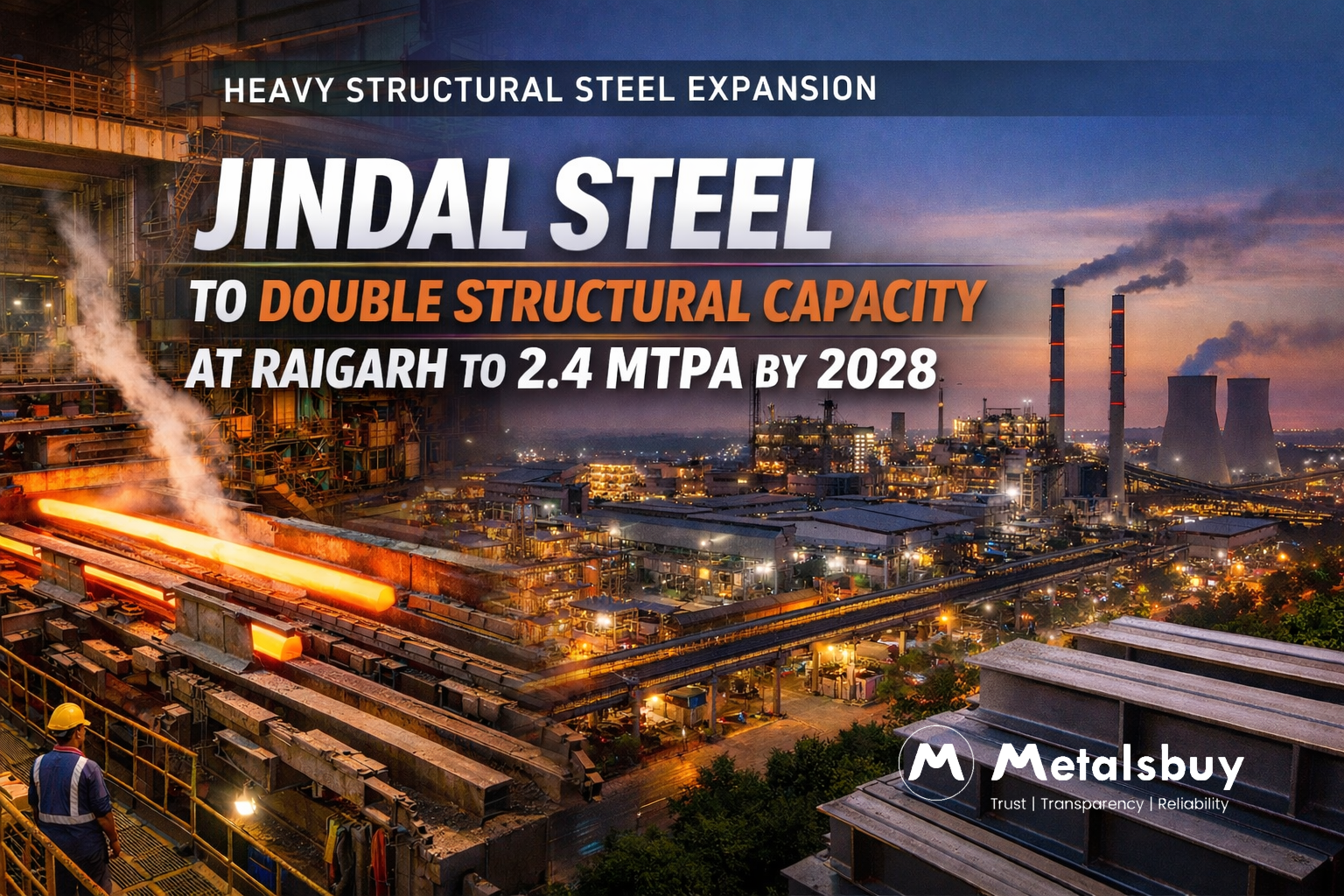
Jindal Steel has outlined a major expansion plan at its Raigarh facility in Chhattisgarh, aiming to double its structural steel capacity from 1.2 million tonnes per annum (MTPA) to 2.4 MTPA by 2028. The move reinforces the company’s strategic focus on heavy and ultra-heavy structural sections, a segment seeing rising demand from infrastructure, energy, and industrial projects.
What is confirmed
According to company disclosures and industry reports, the expansion will involve:
-
Setting up a new, dedicated structural steel mill at Raigarh
-
Doubling installed structural steel capacity to 2.4 MTPA
-
Enhancing product capability to manufacture larger parallel flange sections, including ultra-heavy sizes
The target commissioning timeline is 2028, with the expansion planned as part of Raigarh’s integrated steel manufacturing ecosystem.
Product capability upgrade: the key differentiator
Currently, Jindal Steel’s Raigarh mill produces parallel flange structural sections catering to a wide range of construction and industrial requirements. Post-expansion, the facility is expected to:
-
Offer significantly larger section depths
-
Enable production of very heavy structural sections used in:
-
long-span bridges
-
metro and railway infrastructure
-
power transmission and renewable energy projects
-
refineries and large industrial plants
-
This capability upgrade is strategically important, as availability of ultra-heavy structural sections in India remains limited, often forcing EPC players to rely on imports for specialised requirements.
Why Raigarh matters in Jindal’s strategy
Raigarh is one of Jindal Steel’s key integrated manufacturing locations. Expanding structural steel capacity at this site allows the company to:
-
Leverage existing upstream steelmaking infrastructure
-
Improve rolling flexibility and product mix
-
Strengthen its position in project-grade steel supply, where consistency, size capability, and delivery timelines are critical
Rather than being a volume-only expansion, the project appears focused on capability enhancement in higher-value structural products.
Market context: why heavy structural steel is gaining importance
India’s infrastructure build-out is increasingly skewed towards:
-
larger bridges and elevated corridors
-
metro rail networks
-
renewable energy evacuation infrastructure
-
complex industrial and logistics projects
These applications require heavier and more complex structural sections, with tighter engineering specifications. Domestic supply augmentation in this segment is therefore seen as strategically important for reducing supply bottlenecks and improving execution certainty for large projects.
Competitive and supply-side implications
Once operational, the expanded Raigarh facility could:
-
Improve domestic availability of heavy and ultra-heavy structural sections
-
Reduce lead times for large project orders
-
Increase competition in a segment currently dominated by a limited number of suppliers
However, actual market impact will depend on:
-
ramp-up efficiency post-commissioning
-
consistency in quality for larger section sizes
-
alignment with EPC and infrastructure project cycles
Metalsbuy Outlook
Jindal Steel’s decision to double structural steel capacity at Raigarh signals a long-term bet on India’s infrastructure and energy transition rather than a short-term capacity play. The emphasis on heavy and ultra-heavy structural sections positions the company closer to the evolving needs of EPC contractors and industrial developers.
If executed as planned by 2028, the expansion could meaningfully strengthen domestic supply capability in a niche but critical segment of the steel market—one where capability, reliability, and execution matter more than sheer volume.
Key data points (verified)
| Parameter | Details |
|---|---|
| Location | Raigarh, Chhattisgarh |
| Current structural steel capacity | 1.2 MTPA |
| Target capacity | 2.4 MTPA |
| Expansion approach | New dedicated structural steel mill |
| Target timeline | By 2028 |