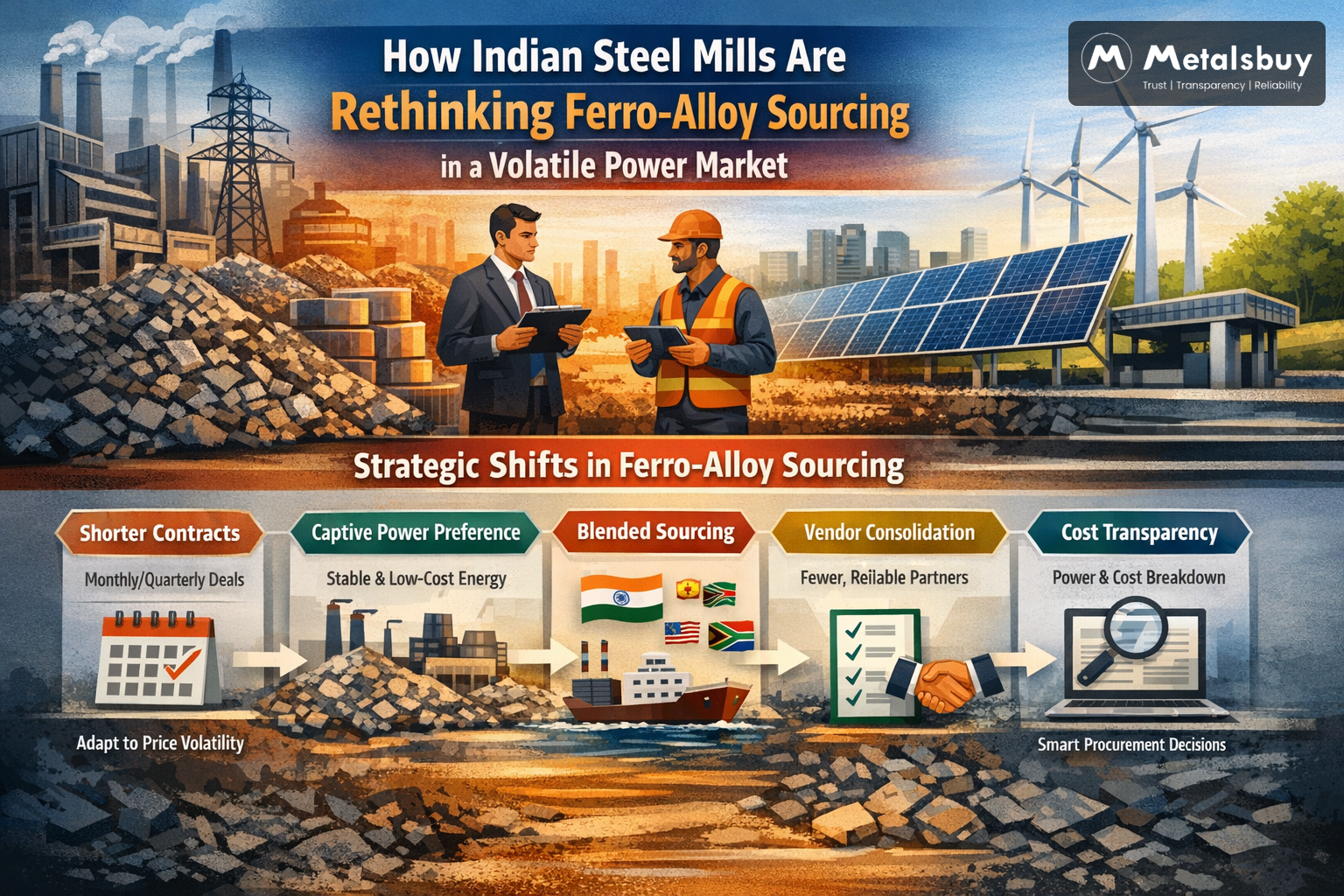
When Power Becomes the Single Biggest Variable
In India’s ferro-alloy industry, power has always been important. But in the current cycle, it has become decisive.
Ferro-alloy production is inherently energy-intensive. For most Indian producers, electricity accounts for 35–45% of total production costs, and in some cases even higher during peak tariff periods. Over the last few years, this cost head has turned increasingly volatile due to:
-
Repeated upward revisions in state grid tariffs
-
Higher cross-subsidy and wheeling charges for open-access power
-
Withdrawal or dilution of state-level power incentives
-
Rising compliance and environmental costs linked to power sourcing
At the same time, ferro-alloy prices, particularly for SiMn and FeMn have struggled to keep pace with cost inflation due to weak export realisations and cautious domestic steel margins.
This mismatch between rising input costs and constrained selling prices has forced steel mills to fundamentally reassess how they source ferro-alloys. What was once a routine procurement activity is now evolving into a strategic, risk-managed function.
Why the Traditional Annual Contract Model Is Breaking Down
For years, annual ferro-alloy contracts were the backbone of steel mill procurement. They offered predictability fixed volumes, broadly stable pricing, and assured supply.
However, the assumptions behind this model no longer hold.
The problem with long-term pricing today:
-
Power tariffs can change multiple times within a financial year
-
Fuel linkages (coal, pet coke) are increasingly unstable
-
Producers themselves lack long-term visibility on their cost curves
Locking into annual prices under such conditions exposes mills to two major risks:
-
Overpaying when market conditions soften
-
Supply disruption if producers find contracted prices unviable
How mills are responding:
Steel mills are increasingly shifting towards:
-
Quarterly contracts with defined price reset mechanisms
-
Monthly or bi-monthly spot purchases for a portion of volumes
-
Split sourcing across multiple suppliers instead of full dependence on one
Strategic benefit:
This approach allows mills to:
-
Align procurement prices more closely with real-time cost movements
-
Avoid being locked into structurally uncompetitive contracts
-
Retain negotiation leverage throughout the year
Important insight: This shift is most aggressive among secondary and mid-sized steel producers, where margin buffers are thin and procurement agility is critical for survival.
Captive Power Has Moved from Advantage to Necessity
In earlier cycles, captive power was seen as a competitive edge. Today, it is increasingly treated as a minimum qualification criterion.
What steel mills now look for:
Procurement teams no longer evaluate suppliers purely on delivered alloy prices. They assess:
-
Share of captive vs grid power
-
Nature of captive power (coal, hydro, WHRB, renewables)
-
Historical volatility in landed power costs
-
Ability to sustain production during grid instability
Why this matters:
Producers dependent largely on grid power face:
-
Sudden tariff shocks
-
Curtailment risks
-
Unpredictable cost escalations
In contrast, captive-powered producers can:
-
Offer more stable price bands
-
Commit to volumes with greater confidence
-
Absorb short-term cost spikes without renegotiation
India-specific context:
States such as Odisha and Chhattisgarh continue to dominate ferro-alloy capacity precisely because of:
-
Proximity to raw materials
-
Legacy captive power infrastructure
-
Better ability to manage energy costs over cycles
For steel mills, sourcing from such producers increasingly represents risk mitigation, not just cost optimisation.
Emergence of Blended Sourcing as a Risk Management Tool
Indian steel mills are moving away from binary sourcing decisions (domestic vs import). Instead, a blended sourcing model is becoming common.
How blended sourcing works:
-
A stable domestic supplier base ensures continuity and quality consistency
-
Imports are used tactically when international prices undercut domestic offers
Typical import origins:
-
Bhutan – structurally lower power costs
-
Malaysia and South Africa – occasional arbitrage opportunities
Why imports remain supplementary:
Despite price advantages at times, imports come with challenges:
-
Longer lead times
-
Higher working capital requirements
-
Quality variation risks
-
Currency and freight volatility
As a result, steel mills use imports primarily to:
-
Benchmark domestic prices
-
Apply negotiation pressure
-
Hedge against temporary domestic supply tightness
Key takeaway: Imports are a pricing reference tool, not a strategic replacement for domestic sourcing.
Supplier Consolidation: Fewer Vendors, Deeper Relationships
Another clear trend is vendor rationalisation.
Steel mills are deliberately reducing the number of ferro-alloy suppliers they work with.
Why mills prefer fewer suppliers:
-
Simplified compliance and audits
-
Better volume leverage in negotiations
-
Improved logistics coordination
-
Higher supply reliability
What mills now expect from preferred suppliers:
-
Ability to supply multiple alloy grades
-
Consistent quality across batches
-
Transparency in cost drivers
-
Financial and operational resilience
Market impact:
-
Smaller, standalone producers without scale or cost visibility are finding it harder to retain mill approvals
-
Larger, more efficient producers are gaining higher share of mill procurement baskets
This consolidation is quietly reshaping the ferro-alloy supply landscape in India.
Pricing Discussions Are Becoming More Technical and Data-Driven
Perhaps the most fundamental change lies in how pricing discussions are conducted.
Earlier negotiations were largely transactional focused on prevailing market prices and recent benchmarks.
Today, steel mills are asking deeper, more technical questions:
-
How is your power sourced and priced?
-
What portion of your costs are fixed versus variable?
-
How sensitive is your pricing to tariff changes?
Why this shift matters:
Steel mills want to distinguish between:
-
Temporary price spikes
-
Structural cost increases
Suppliers who can clearly articulate their cost structure gain:
-
Faster approvals
-
Greater trust
-
Higher probability of long-term engagement
Opaque pricing, on the other hand, is increasingly viewed as a risk.
What This Means for Ferro-Alloy Producers
For ferro-alloy producers, the implications are significant.
Competing purely on headline price is no longer sufficient. To remain relevant, producers must:
-
Invest in power cost stability
-
Improve operational efficiency
-
Offer flexible pricing mechanisms
-
Communicate cost drivers transparently
Those who adapt will benefit from:
-
Longer relationships with mills
-
Higher volume commitments
-
Reduced volatility in offtake
Those who don’t risk gradual exclusion from preferred supplier lists.
Why Procurement Platforms Are Gaining Relevance
As sourcing becomes more complex, steel mills increasingly need:
-
Faster price discovery
-
Access to verified suppliers
-
Comparable cost structures
Platforms like Metalsbuy play a growing role by:
-
Connecting mills with cost-competitive, compliant producers
-
Improving market transparency
-
Supporting smarter, data-backed procurement decisions
In volatile cost environments, information and access become strategic assets.
Ferro-Alloy Sourcing Is Now a Strategic Function
India’s ferro-alloy sourcing landscape is undergoing a structural shift. Power volatility has transformed procurement from a routine buying exercise into a strategic risk management function.
Steel mills that adapt their sourcing models by embracing flexibility, transparency, and diversification—will be better positioned to manage cost volatility. Ferro-alloy producers who align with these expectations will continue to find relevance in an increasingly selective market.