Despite steady demand from the steel sector and promising growth forecasts, Indian ferro-alloy producers and traders increasingly face structural challenges that make selling profitable material harder than it seems. The issue today isn’t a lack of demand, it’s the complex commercial realities shaping how alloy sales actually happen.
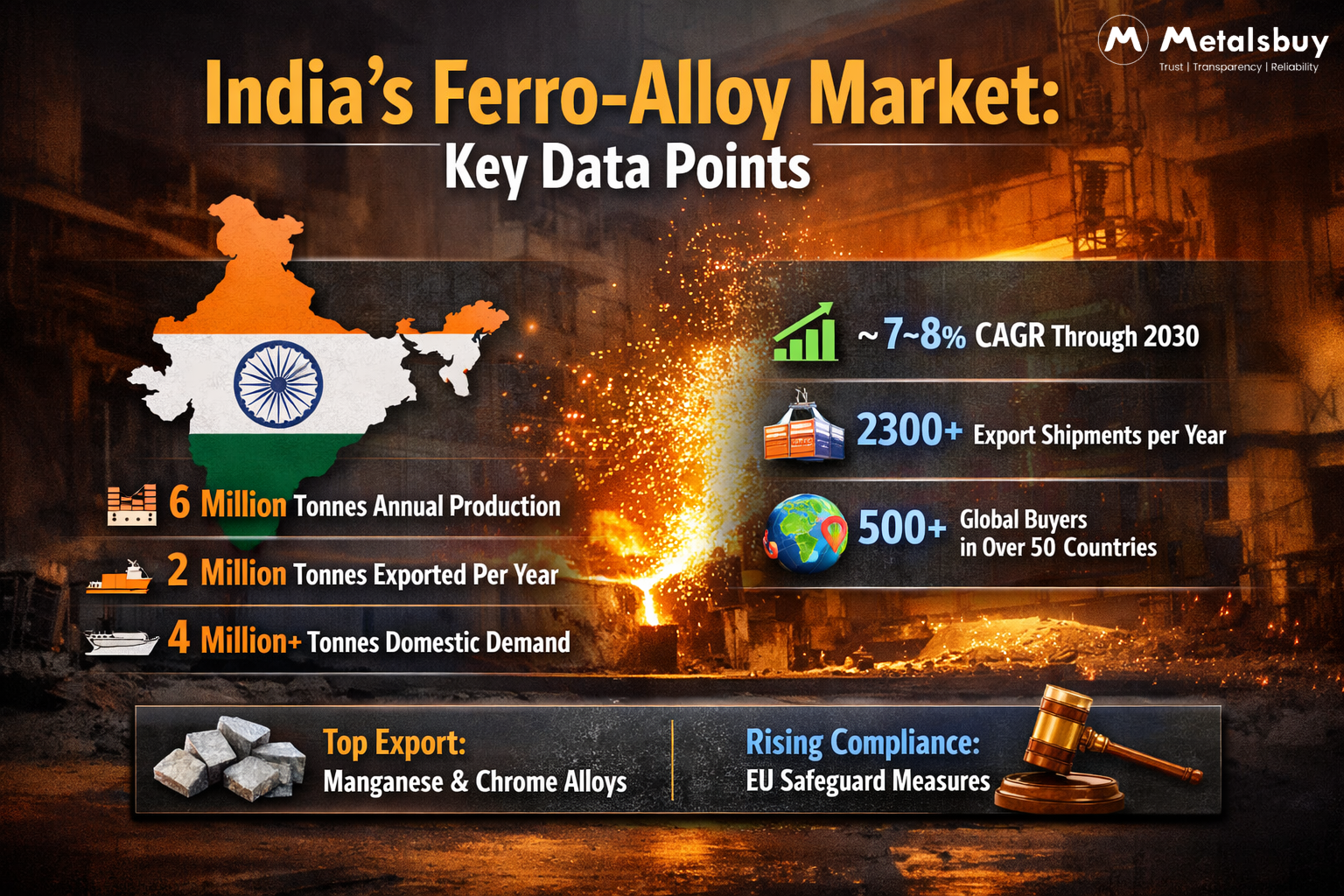
According to industry reports, India’s ferro-alloy demand is over 4 million tonnes domestically, with production around 6 million tonnes and roughly 2 million tonnes exported annually and demand is expected to grow at a 7–8% CAGR through 2030 driven by steel output growth.
Export Undercutting Has Compressed Margins Across Markets
India is one of the world’s leading exporters of manganese alloys and a top supplier of chrome alloys, with production volumes that have nearly doubled in recent years (capacity rising to ~8 million tonnes in 2025 from ~4.3 million tonnes in FY20).
However, this export strength has also created intense intra-market competition. Buyers in Southeast Asia, the Middle East, and Europe now routinely:
-
Solicit multiple Indian quotes for the same requirement
-
Benchmark significant price differences even on minor cost variations
-
Push aggressively on final landed price
This has turned exports into a volume game, where producers often give up margin just to keep shipments moving especially when competitors are willing to undercut to secure tonnage.
This pressure shows even in shipment data: Indian exporters made more than 2,300 shipments to over 500 buyers worldwide in a 12-month period, with export volumes growing year-on-year.
Spot Pricing Expectations Clash With Long-Term Cost Structures
Many buyers today prioritise spot price deals with very short validity windows (often as little as one or two weeks). But Indian producers typically operate with medium- to long-term cost commitments, including:
-
Power contracts
-
Raw material sourcing
-
Workforce and furnace utilisation planning
This mismatch causes sellers to either:
-
Accept price volatility as a risk
-
Push production without a firm margin
-
Constantly adjust prices right up to shipment
In volatile markets, this increases inventory risk and erodes strategic planning, forcing smaller producers especially to rely on short turnaround cycles.
Quality Is Acknowledged But Price Sensitivity Dominates Decisions
Buyers often recognise the importance of quality attributes such as:
-
Consistency in alloy composition
-
Lower fines generation
-
Better performance in steelmaking processes
Yet in most purchasing decisions, lowest landed price still dominates. Even when premium material offers better long-term performance, buyers tend to favour cheaper alternatives:
-
Premium producers struggle to capture consistent price advantages
-
Lower-cost material wins short-term orders
-
Value differentiation erodes over time
With China, South Africa, and other origins competing, this price–quality squeeze has become more visible and it directly impacts species like ferro manganese, silico manganese and ferrochrome.
Longer Payment Cycles Heighten Financial Strain
Producers increasingly report that pricing isn’t the only hurdle payments are slower and more conditional. Especially in exports:
-
Importers push for extended payment terms
-
Letters of Credit become stricter
-
Post-shipment acceptance bottlenecks emerge
This slows cash realisation and increases financing costs, straining working capital. In a high interest rate environment, this matters more smaller and mid-sized players feel the pressure acutely.
Compliance and Documentation Are Adding Hidden Selling Costs
Selling ferro-alloys today isn’t just about product and price it also includes a growing administrative and compliance burden.
More buyers, especially in Europe and developed markets, expect:
-
Rigorous export documentation
-
Third-party inspection certifications
-
Traceability and sustainability reporting
These requirements increase time and cost per shipment. Delays due to paperwork errors or compliance issues can shift cash flows and affect scheduled deliveries, which in turn impacts seller reputations.
Importantly, India’s ferro-alloy exports to the EU are now under scrutiny with India seeking formal WTO consultations after new safeguard measures were imposed on certain ferroalloy imports.
The Bigger Picture: Selling Ferro-Alloys Requires More Than Demand
While India’s industry has strong fundamentals production of ~5.2 million tonnes of ferro-alloys with exports around ~2.6 million tonnes converting demand into profitable sales has become structurally harder.
Producers can no longer rely solely on:
-
Strong domestic demand
-
Large export volumes
Instead, success depends on:
-
Smarter pricing strategies
-
Better credit risk management
-
Compliance infrastructure
-
Selective market targeting
Where the Industry Is Heading
Looking ahead, ferro-alloy sellers who adapt will likely:
-
Diversify export markets to reduce dependence on a few buyers
-
Invest in quality and differentiation rather than purely cost
-
Use data and market insights to time offers and mitigate risk
-
Improve contract structures to protect margins
In a market growing at a 7–8% CAGR, the competitive landscape will reward those who sell with strategy, not just production capacity.