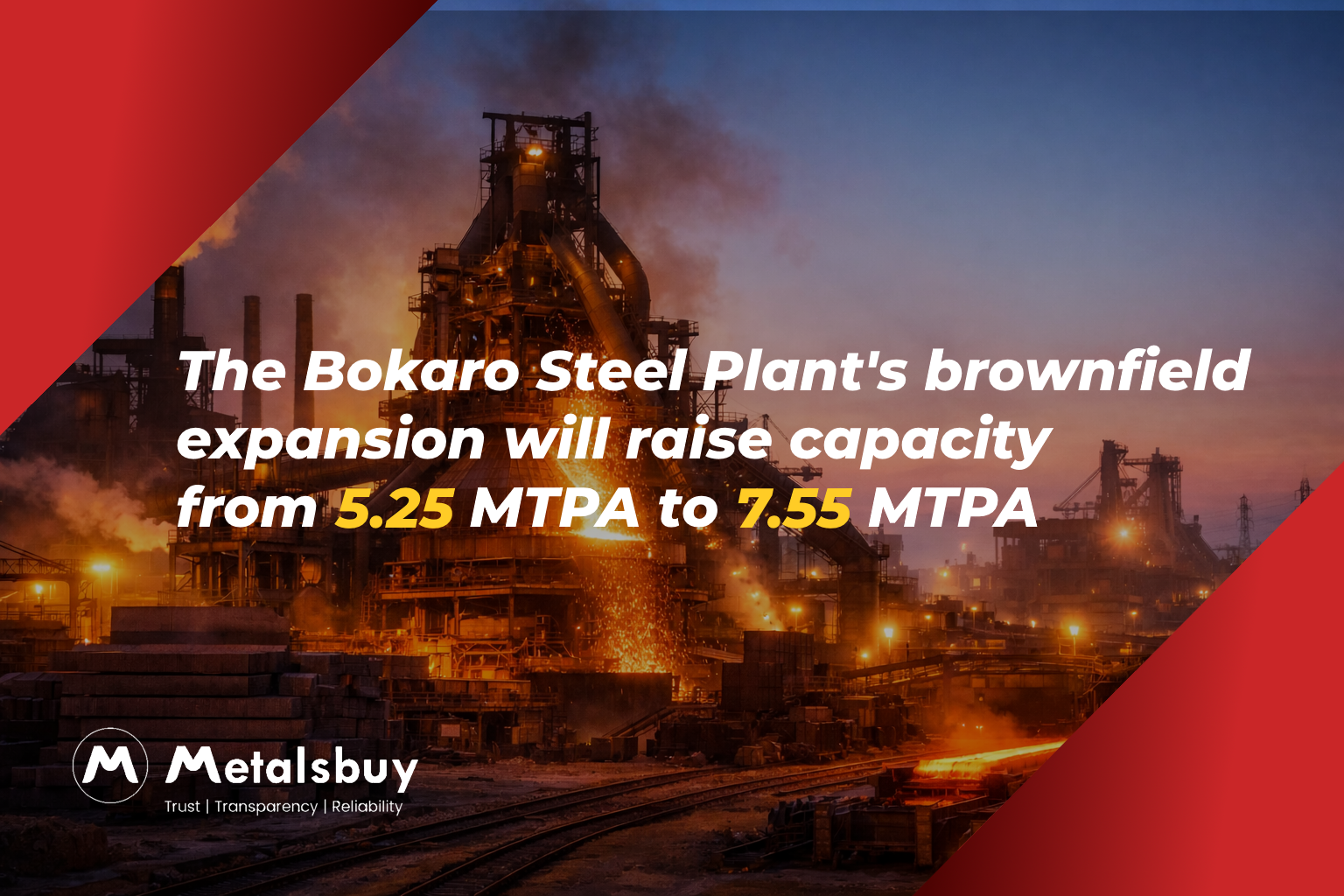
The Bokaro Steel Plant (BSP), operated by Steel Authority of India Limited (SAIL), is set to play a renewed strategic role in India’s steel growth roadmap through a proposed brownfield expansion that will raise its crude steel capacity from 5.25 million tonnes per annum (MTPA) to 7.55 MTPA. The proposed addition of 2.3 MTPA is currently under discussion and, if executed, would mark one of the most significant capacity upgrades at a legacy public-sector steel facility in eastern India.
The expansion aligns with India’s broader objective of strengthening domestic steelmaking capabilities under the National Steel Policy, while also contributing to regional industrial development in Jharkhand.
Capacity Expansion: Scale and Investment Intensity
According to publicly reported information, the Bokaro brownfield expansion is expected to involve an investment of approximately ₹20,000 crore. The proposed upgrade includes modernisation and augmentation of upstream and downstream steelmaking infrastructure, with reports indicating the addition of:
-
A new large-capacity blast furnace
-
Expanded sintering and coke-making facilities
-
Thin slab casting and direct rolling capabilities
-
Supporting auxiliary units for improved efficiency and output stability
Based on the reported figures, the implied capital intensity of the expansion works out to ~₹8,700 crore per incremental MTPA, reflecting the high cost structure typically associated with integrated steelmaking projects that involve blast furnaces, coke ovens, and sinter plants.
This level of capital deployment underlines that the Bokaro expansion is not merely a marginal debottlenecking exercise but a structurally significant capacity enhancement aimed at extending the plant’s long-term operational relevance.
Strategic Relevance in India’s Steel Landscape
India has set an ambitious target of achieving 300 million tonnes of crude steel capacity by 2030–31, as outlined in the National Steel Policy (2017). While the Bokaro expansion alone represents less than 1% of this national target, its strategic importance lies in the nature of capacity being added.
As an integrated steel plant, Bokaro contributes to upstream steel availability, which is critical in a market that periodically faces pressure from rising imports, raw material volatility, and supply-side disruptions. Strengthening integrated public-sector capacity provides a stabilising counterweight during cyclical downturns and supports domestic value chains in railways, infrastructure, and manufacturing.
India produced approximately 151 million tonnes of crude steel in FY2024–25, with installed capacity estimated at around 200 million tonnes, indicating that further capacity additions remain essential to bridge the gap toward 2030 targets.
Regional Impact: Employment and Industrial Ecosystem
The Bokaro expansion is expected to generate substantial economic benefits for Jharkhand and the surrounding industrial belt. Publicly cited estimates suggest:
-
~2,500 direct employment opportunities
-
~10,000 indirect jobs across construction, logistics, services, and ancillary industries
Beyond direct employment, large-scale integrated steel expansions typically stimulate demand for transport services, industrial gases, refractories, maintenance contractors, and local MSMEs, reinforcing the regional manufacturing ecosystem.
Jharkhand, already a mineral-rich state, stands to benefit from deeper industrial integration rather than remaining primarily a raw material supplier.
Execution Risks and Key Watchpoints
While the expansion plan is strategically aligned, execution remains the critical variable. Media reports have highlighted certain challenges that could influence timelines, including:
-
Infrastructure dependencies, particularly related to long-term water availability arrangements
-
Input-side constraints, such as metallurgical coke availability, which has emerged as a broader concern for Indian steelmakers
-
Market cyclicality, where fluctuations in steel demand and import pressure could impact utilisation rates during ramp-up phases
These factors underscore that the success of the Bokaro expansion will depend not only on capital allocation but also on coordinated planning around utilities, logistics, and raw material security.
Outlook
From an industry perspective, the Bokaro Steel Plant expansion represents a strategic reinforcement of India’s public-sector steel backbone. If executed on schedule with enabling infrastructure in place, the project can contribute meaningfully to domestic steel self-reliance, regional employment, and long-term supply stability.
However, as with all large integrated steel projects, the transition from announcement to sustained high utilisation will determine the true economic and strategic returns of the investment.
Sources:
-
Economic Times – Coverage on Bokaro Steel Plant brownfield expansion plans and proposed investment
-
Business Standard – Reports on capacity expansion discussions at Bokaro Steel Plant
-
Ministry of Steel, Government of India – National Steel Policy 2017
-
Press Information Bureau (PIB) – Policy statements on India’s 300 MT steel capacity target
-
Reuters – India steel production and capacity data for FY2024–25
-
Times of India – Reporting on infrastructure-related challenges linked to Bokaro expansion