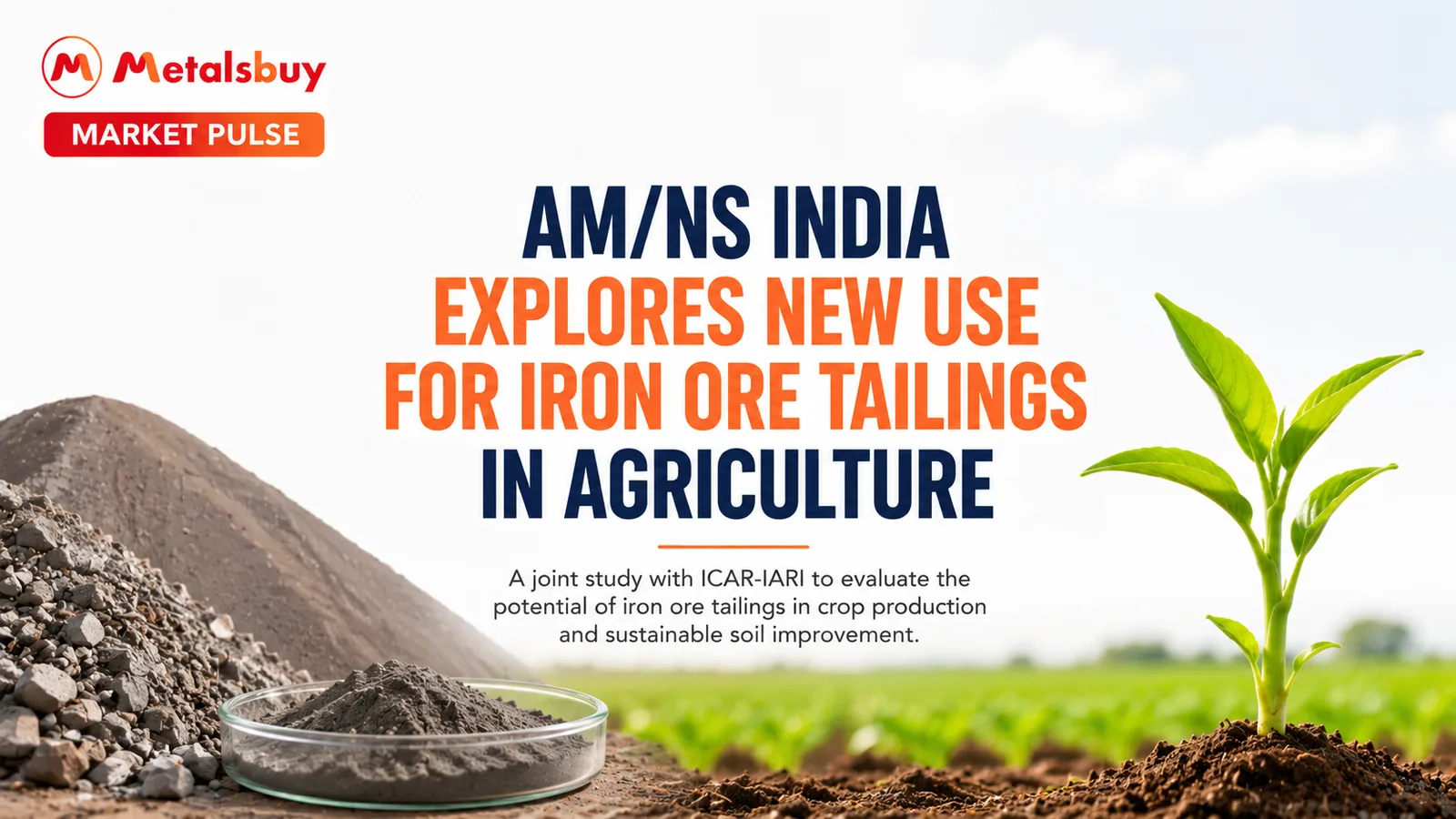
Iron ore beneficiation leaves behind a large quantity of tailings. For mining companies, managing and storing this material is a long-term responsibility. Now, a new research collaboration is looking at whether some of these tailings could eventually find a use outside the mining sector, in agriculture.
AM/NS India and ICAR-IARI have signed an MoU to carry out long-term studies on the possible use of iron ore tailings in agricultural applications. The work will be conducted over multiple crop seasons at research facilities in New Delhi and Kirandul, where the company's iron ore beneficiation operations are located. The important word here is research. The project is not suggesting that mining tailings are ready to be used directly on farms. The purpose is to first understand whether they can be used safely, in what form, and under what conditions.
Why are iron ore tailings being looked at?
Tailings generated during iron ore beneficiation are not chemically uniform waste. Preliminary studies have found naturally occurring materials including silica, iron oxides, alumina, calcium, magnesium and other trace elements in them.
That is what has led researchers to explore their possible agricultural value. Earlier studies initiated in 2024 reportedly examined their suitability for crops including paddy, wheat and vegetables and produced encouraging early observations. But early results are one thing; proving that a material is safe and useful over several crop cycles is something else entirely. The new phase of research is therefore much broader than simply checking whether crops grow after the material is applied.
The long-term questions still need answers
The joint study will look at crop response and nutrient availability, but it will also examine phytotoxicity, leaching behaviour and the wider environmental impact. These are probably the most important parts of the exercise. A material may contain minerals that are useful to plants, but that alone does not make it suitable for agricultural use. Researchers will need to understand how those minerals behave in soil, whether unwanted elements move into groundwater, and whether repeated application has any negative effect on crops or soil quality.
The studies are expected to run across multiple seasons. That makes sense because agricultural applications cannot really be judged from a single crop cycle. Soil behaviour changes over time, and the longer-term impact is what will determine whether there is any practical use for the material.
There could be a mining-side benefit as well
If a safe agricultural application is eventually established, it could address another issue faced by the mining industry: the long-term storage of tailings. Tailings ponds and storage facilities require land, monitoring and continued management. Finding a scientifically validated use for even a portion of this material could reduce the volume that needs to remain in long-term storage.
But this should not be confused with a quick solution to the tailings problem. Mining produces tailings in large volumes, and agricultural use, even if successful, may only absorb a part of the total material generated. Still, the idea is worth exploring because it shifts the discussion from simply managing a by-product to understanding whether some value can be extracted from it.
There is also an agricultural angle
India imports a significant quantity of fertiliser and fertiliser-related inputs. Any locally available material that can safely contribute useful mineral nutrients to soil could be relevant in the longer term. The research will reportedly also examine whether iron ore tailings can help address iron deficiency in poor or degraded soils and potentially improve the iron content of agricultural produce. Those are ambitious possibilities, and they will need proper scientific backing before any commercial or large-scale application can be considered.
For now, the more practical takeaway is that a mining by-product is being studied for a possible second life rather than being viewed only as material that needs permanent storage.
Too early for conclusions, but an interesting direction
There is no guarantee that iron ore tailings will eventually become an agricultural input. The project itself acknowledges the need for detailed scientific validation, particularly around environmental safety. But that is what makes this collaboration more interesting than a routine sustainability announcement. It is attempting to answer a fairly practical question with long-term research.
If the results are positive, it could open another path for the use of mining by-products. If they are not, the research will still provide clearer data on the limitations and risks involved. Either way, the answer will not come quickly. Multiple crop seasons, soil studies and environmental assessments are planned before any conclusion can be drawn. For now, this remains an experiment with potential and one that could eventually connect two industries that rarely intersect: mining and agriculture.