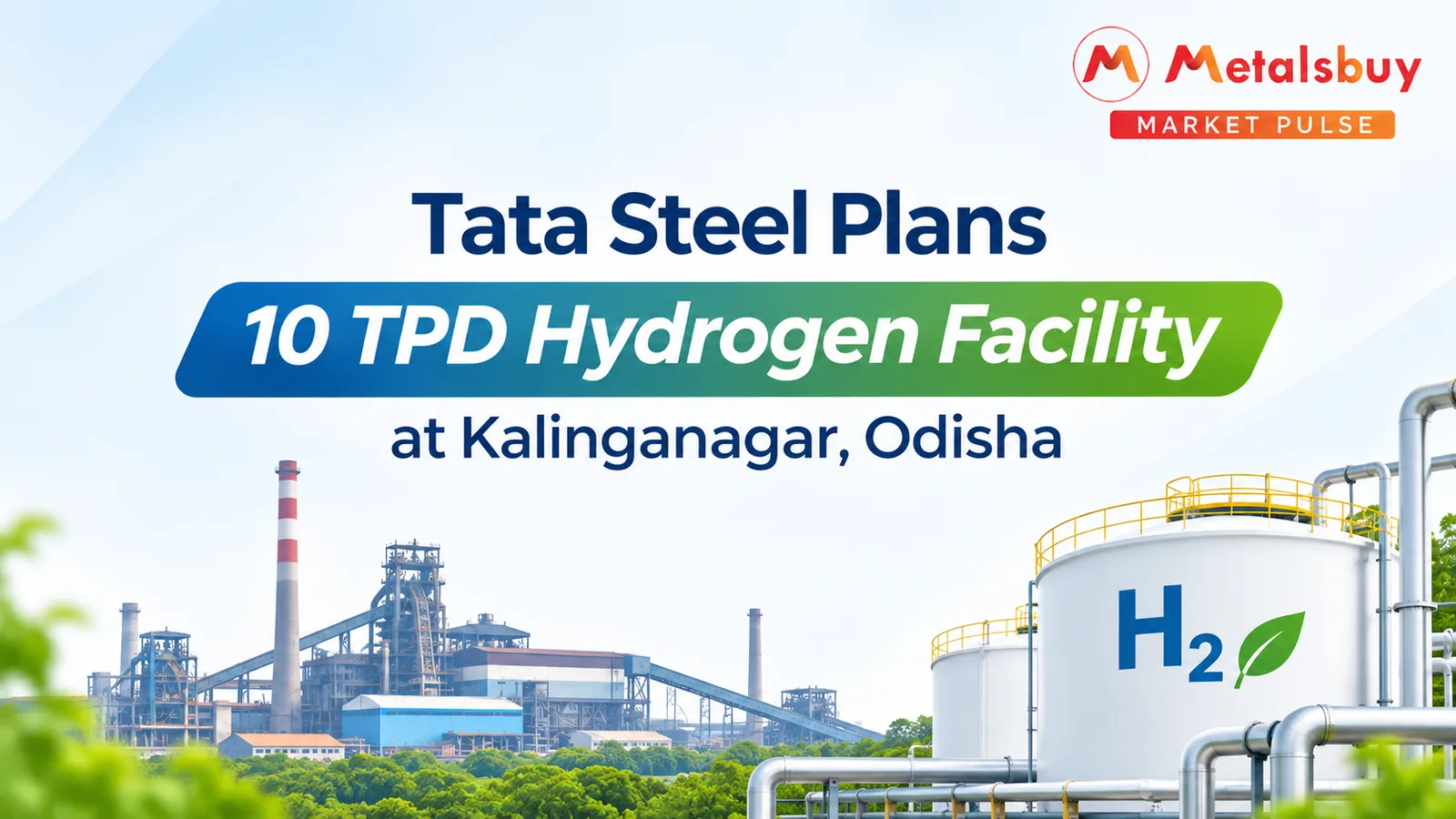
The company partners with US-based Utility Global to evaluate a hydrogen production project in Odisha, exploring technology that could reduce emissions while utilising existing steelmaking infrastructure.
According to Tata Steel's official announcement on November 18, the two companies will undertake joint Front-End Engineering and Design (FEED) studies to assess the project's technical and commercial feasibility before seeking a final investment decision from Tata Steel's Board. The facility is planned with a hydrogen production capacity of 10 tonnes per day (TPD) and would be India's first project of its kind using the proposed technology at an integrated steelworks.
The project will use Utility Global's proprietary H2Gen technology, which is designed to produce hydrogen from water by harnessing residual energy available in industrial off-gases. At Kalinganagar, the proposed process will utilise a mixture of blast furnace gas and basic oxygen furnace gas, both generated during conventional steel manufacturing. Instead of relying on electricity for hydrogen production, the technology employs an electrochemical process that makes use of the energy contained in these industrial gas streams.
Technology Offers an Alternative Approach to Hydrogen Production
Hydrogen has emerged as an important area of technological development for steelmakers seeking to reduce their dependence on carbon-intensive production processes. However, the cost of hydrogen production and the infrastructure required for its adoption remain significant challenges, particularly for integrated steel plants operating through the blast furnace-basic oxygen furnace route.
The proposed H2Gen system offers a different approach by integrating hydrogen generation with existing steelmaking operations. Utility Global states that its technology can produce a concentrated carbon dioxide stream alongside hydrogen, potentially making subsequent carbon capture easier. At Kalinganagar, the hydrogen could be injected back into the blast furnace, where it may help reduce the requirement for conventional carbon-based reducing agents.
This approach is particularly relevant for existing integrated steel plants because it explores opportunities to reduce emissions without immediately replacing major steelmaking assets. Nevertheless, the actual environmental and commercial benefits will depend on the performance of the technology under operating conditions, including hydrogen production efficiency, integration costs and the resulting reduction in emissions.
Utility Global has previously demonstrated its technology using blast furnace gas at a steelmaking facility in Canada. The proposed Kalinganagar installation would represent its largest announced industrial H2Gen deployment globally, according to the company. However, the project remains subject to engineering evaluation and Tata Steel's final investment approval, and no commissioning schedule or investment amount has been announced.
Part of Tata Steel's Broader Decarbonisation Strategy
The hydrogen initiative forms part of Tata Steel's wider efforts to develop lower-carbon steelmaking technologies across its operations. The company has committed to achieving net-zero emissions by 2045 and has been examining various approaches to improve energy efficiency, utilise industrial by-products and reduce the carbon intensity of its production processes.
In September 2026, Tata Steel commissioned a coke oven gas injection project at its Meramandali facility in Odisha, another initiative aimed at improving resource utilisation within conventional steelmaking operations. The company has also undertaken trials involving hydrogen, coal bed methane and biochar injection in blast furnaces. Earlier, in 2021, Tata Steel commissioned a facility at Jamshedpur designed to capture carbon dioxide from blast furnace gas.
These initiatives demonstrate the company's interest in developing technologies that can be integrated into existing industrial operations. Rather than depending on a single technological pathway, Tata Steel is evaluating multiple approaches to decarbonisation, including alternative reducing agents, carbon capture and more efficient utilisation of gases generated during steel production.
The Kalinganagar project is particularly relevant because hydrogen production is being considered within an operating integrated steelmaking environment. Successful implementation could provide practical information about the feasibility of using industrial off-gases to support hydrogen-based processes at larger manufacturing facilities.
Metalsbuy Market Pulse Analysis
Tata Steel's proposed hydrogen facility highlights an emerging opportunity for integrated steelmakers to derive additional value from gases already generated during production. Conventional steel plants produce substantial quantities of process gases, and technologies capable of utilising their residual energy may offer alternative routes towards improving resource efficiency and reducing emissions.
For India's steel industry, the commercial feasibility of such technologies will be an important consideration. Many integrated steel facilities rely heavily on blast furnace-based production, making solutions compatible with existing infrastructure potentially relevant to their decarbonisation strategies. However, it remains necessary to establish whether such systems can deliver measurable emissions reductions at a competitive cost under actual operating conditions.
The development could also create opportunities for industrial technology providers involved in gas processing, hydrogen production, process integration and carbon management. The extent of these opportunities will depend on project approval, technology performance and the ability to replicate successful installations across other steelmaking facilities.
It is equally important to distinguish hydrogen produced through this process from renewable electricity-based green hydrogen. The proposed technology uses water and industrial off-gases, and its overall carbon footprint would depend on the complete production process and treatment of the associated carbon dioxide stream.
The Kalinganagar project could represent an important technological step for Indian steelmaking, but its long-term significance will depend on whether the proposed system demonstrates commercially viable hydrogen production and measurable emissions reductions at industrial scale.
— Metalsbuy Market Pulse | Industry Intelligence & Market Analysis