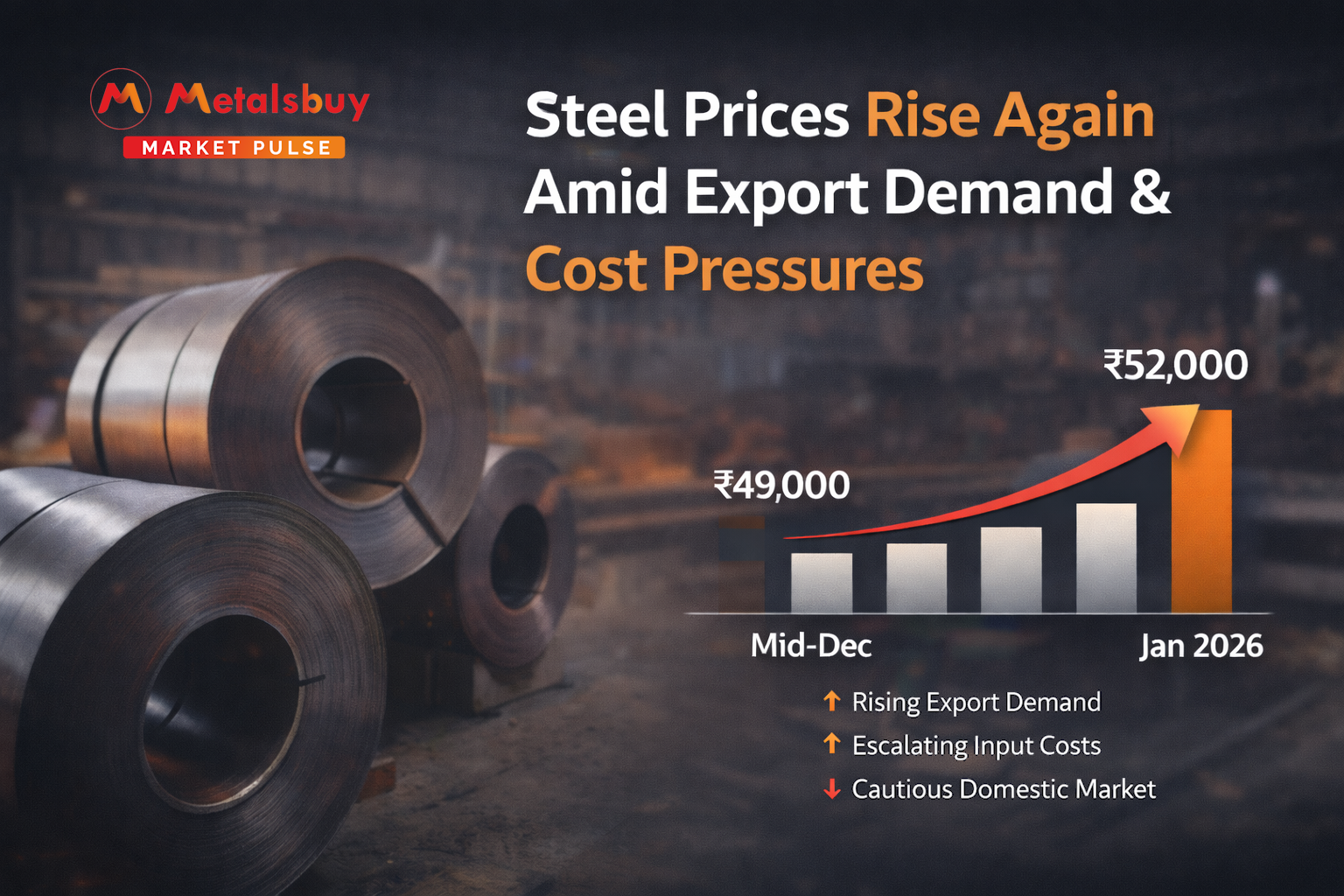
Steel prices in the domestic market have been raised once again, supported by stronger export demand and sustained pressure from higher input costs. The latest round of increases came into effect late last week, with prices of flat steel products moving higher across distribution channels.
Market data indicates that hot-rolled coil (HRC) prices were increased by ₹500–750 per tonne, marking the second upward revision this month. Industry participants expect prices of other steel products to follow, as mills continue to push through cost-led increases.
Since mid-December, HRC prices have cumulatively risen by ₹3,000–5,250 per tonne, taking distributor-level prices to around ₹50,500–51,750 per tonne. At the dealer level, prices have reportedly climbed further, touching close to ₹52,000 per tonne in select markets.
Steelmakers maintain that current price levels remain relatively modest when viewed against the sharp escalation in raw material costs over the past two years, particularly for imported coking coal. A weaker rupee has further amplified cost pressures, limiting the scope for price stability.
Exports Lend Key Support
Export momentum continues to play a critical role in supporting domestic steel prices. Research assessments point to a notable rise in outbound shipments, aided by advance buying from overseas consumers ahead of the implementation of the Carbon Border Adjustment Mechanism (CBAM).
During April–November 2025, India’s steel exports, including stainless steel, are estimated to have increased to around 7.7 million tonnes, reflecting a year-on-year growth of approximately 19%. Shipments to the European Union recorded particularly strong growth, driven by pre-CBAM procurement by buyers seeking to mitigate future compliance costs.
The export uptrend has helped steelmakers offset muted domestic demand and maintain operating rates despite challenging market conditions at home.
Capacity Additions and Demand Outlook
The industry has added close to 15 million tonnes of capacity over the past three to four quarters, with additional expansion expected through the end of FY26. However, analysts note that rising domestic consumption, supported by infrastructure spending and manufacturing activity, is likely to absorb a significant portion of the incremental supply.
Looking ahead, demand growth is expected to strengthen in FY27, supported by increased metal usage across construction, infrastructure, and industrial segments. With no major capacity additions slated for the early part of FY27 and gradual ramp-ups thereafter, the risk of sharp oversupply appears limited.
Price Sustainability in Focus
While global steel prices remain under pressure, domestic market fundamentals suggest limited downside in the near term. Easing supply overhang, steady export demand, and ongoing cost pressures are expected to provide a floor to prices, even as volatility persists.
Overall, the recent price hike reflects a balancing act between rising costs, export-led support, and cautious domestic demand, positioning the steel market for a period of measured firmness rather than aggressive upside.