KEY HIGHLIGHTS
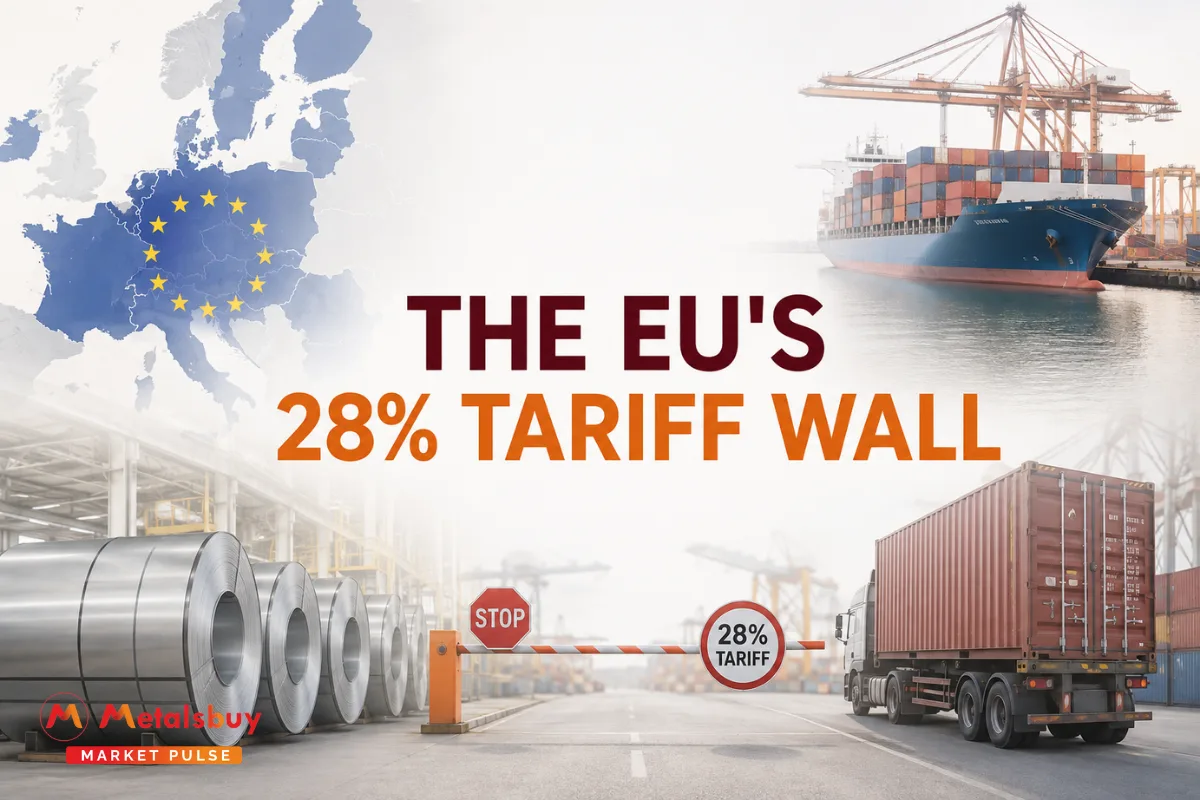
- Proposed Duties: Tariffs ranging strictly between 5.6 percent and 28.0 percent have been proposed across five distinct exporting nations.
- Japanese Exporters: Nippon Steel and other Japanese manufacturers face the highest proposed tariff bracket at 28.0 percent.
- Indian Manufacturers: Major producers including JSW Steel and Tata Steel India are subject to a uniform 9.5 percent duty.
- Turkish Mills: Tatmetal secured the lowest duty rate of 5.6 percent with Borcelik evaluated at 9.7 percent.
- Asian Markets: Vietnamese producer POSCO Vietnam is slated for a 16.0 percent duty while Taiwanese manufacturers face rates between 20.7 and 27.0 percent.
- Import Surge: Combined import volumes from the investigated countries swelled by 28 percent to hit 1.69 million metric tonnes.
- Price Dynamics: Average imported material prices experienced a sharp 34 percent decline falling to €695 per metric tonne during the investigation.
- Market Impact: European domestic market share for local producers dropped from 70 percent to 66 percent amidst a 10 percent overall consumption decline.
MARKET ANALYSIS
The European Commission has officially advanced its trade defense mechanisms by proposing definitive anti-dumping duties on certain types of cold-rolled flat steel products originating from India, Japan, Taiwan, Turkey, and Vietnam. Initiated initially in September 2025 following a comprehensive complaint filed by the European Steel Association (EUROFER), the investigation rigorously examined market conditions spanning from July 1, 2024, to June 30, 2025. Although market participants widely anticipated potential retrospective duties due to the import monitoring protocols that began in December 2025, the bloc ultimately ruled against retroactive enforcement, ensuring a balanced implementation process.
The core driver behind this sweeping regulatory action has been a significant shift in international trade volumes and fundamental pricing structures. Over the meticulously investigated timeframe, the combined volume of flat steel imports from these five specific geographic origins surged by an impressive 28 percent compared to the baseline figures recorded in 2022. This massive influx pushed total import volumes from these regions to approximately 1.69 million metric tonnes. As supply volumes expanded rapidly, pricing naturally came under immense downward pressure. The average valuation of these imported steel products contracted sharply, registering a 34 percent decrease to settle at €695 per metric tonne.
This aggressive pricing strategy allowed foreign exporters to maintain a sharp competitive edge, but it simultaneously disrupted the equilibrium of the European domestic steel ecosystem. During its financial audit, the European Commission noted highly specific price undercutting margins, highlighting disparities of 12.6 percent for Japan, 11.0 percent for India, 10.7 percent for Vietnam, 9.2 percent for Taiwan, and a variable margin ranging from 5.1 to 13.4 percent for Turkey. Such distinct margins necessitated a highly calibrated, country-specific tariff approach to restore fair trading parameters without stifling legitimate global commerce.
WHAT IT MEANS FOR THE STEEL INDUSTRY
The imposition of these carefully calculated anti-dumping duties serves as a pivotal recalibration for the global steel matrix. For the European domestic industry, this regulatory intervention provides a critical and timely shield against predatory pricing mechanisms. During the investigation phase, EU free-market flat steel consumption witnessed a notable 10 percent contraction. Concurrently, European industry sales volumes plummeted by 15 percent, causing their entrenched market share to slip from a dominant 70 percent in 2022 down to a vulnerable 66 percent. By applying these definitive duties, the European Commission is actively fostering a more equitable landscape where local manufacturers can rebuild profitability margins, stabilize operational cash flows, and confidently justify future capital expenditures required for the region's green steel transition.
From a global supply chain perspective, this development mandates a strategic pivot for international exporters. Top-tier Japanese producers, facing the steep 28.0 percent tariff barrier, will likely need to urgently re-evaluate their European export allocations and potentially pivot toward alternative, high-growth markets in Southeast Asia or the Americas. Conversely, Indian heavyweights encountering a more moderate 9.5 percent duty may choose to absorb a portion of the cost through supply chain optimizations to maintain their strategic footprint within the lucrative EU market.
Turkish producers stand out as the primary beneficiaries of this restructuring. By securing the lowest tariff bracket—specifically the 5.6 percent rate applied to Tatmetal—Turkey stands to gain a substantial competitive advantage over its Asian counterparts. Furthermore, Taiwan's China Steel Corporation faces a 20.7 percent levy, while other regional Taiwanese firms are capped at 27.0 percent, effectively pricing some out of the spot market. This tiered duty structure essentially redesigns the European import hierarchy, rewarding regions and companies with pricing models that align closer to European fair-market values. Overall, the industry is witnessing a highly positive, structural shift towards sustainable pricing architectures that prioritize long-term market stability over short-term volume dumping.
MARKET OUTLOOK
Looking ahead, the global steel trade environment is expected to become increasingly regulated, yet fundamentally more structurally sound. The latest macroeconomic insights from the Organisation for Economic Co-operation and Development (OECD) Steel Outlook emphasize that anti-dumping and countervailing frameworks will remain indispensable instruments in the global market arena. As an increasing number of nations deploy comprehensive trade measures to protect their industrial base from subsidized and unfairly priced materials, the international steel community must continuously adapt to a new era of proactive compliance and strategic market entry.
The European Union's pragmatic refusal to apply these duties retrospectively also injects a much-needed degree of confidence and predictability into the market, ensuring that importers and traders are not penalized for historical transactions executed in good faith. Moving forward, the proposed duties—which await official publication in the Official Journal of the EU—will likely trigger an immediate stabilization in European domestic flat steel spot prices. Local mills will be empowered to optimize capacity utilization rates and negotiate forward contracts from a position of renewed strength. For global stakeholders, the focus will rapidly shift toward operational efficiency, value-added product development, and navigating the evolving landscape of global trade policies. This decisive action ultimately reinforces a balanced, competitive, and forward-looking international steel economy where fair trade principles pave the way for sustainable industrial growth.