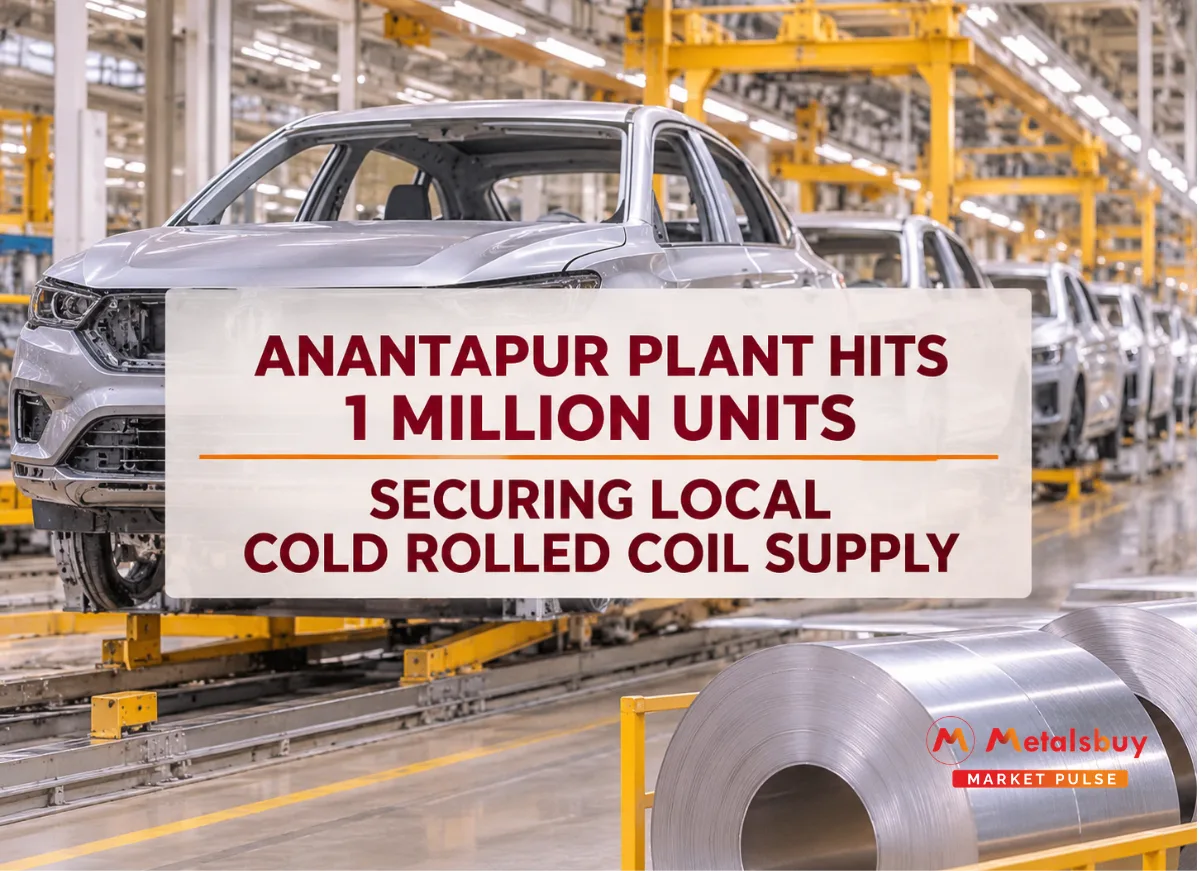
The Indian automotive and heavy manufacturing ecosystem is set to receive a monumental influx of foreign direct investment as global players aggressively double down on their local operations. South Korean automaker Kia Corporation has officially announced a massive two billion dollar capital expenditure plan to radically scale up its passenger vehicle manufacturing footprint in India over the next few years. This aggressive expansion not only highlights absolute global confidence in the Indian consumer market but also guarantees a massive, long-term order book for domestic steelmakers and auto-component vendors, perfectly cementing the nation's position as a premier global manufacturing hub.
Scaling operations to target one million units and ten percent market share
The massive financial commitment aims to drastically elevate the automaker's production baseline to meet surging domestic and export demand. Kia's trajectory in the subcontinent has been nothing short of phenomenal since it first established its massive greenfield facility in Anantapur, Andhra Pradesh. Currently, the plant operates with an installed capacity of roughly four hundred thousand units annually, churning out highly popular utility vehicles that have completely captured the imagination of the Indian middle class. With this fresh two billion dollar investment, the corporate management aims to more than double this industrial footprint.
The strategic blueprint targets an eventual production capacity of a staggering one million units per year. By scaling up to this massive volumetric threshold, Kia aims to firmly secure a ten percent share of the highly competitive Indian passenger vehicle market, a significant leap from its current standing of roughly six percent. This aggressive scaling proves that foreign multinationals are no longer treating India merely as a secondary assembly hub for emerging markets, but as a primary, high-volume manufacturing anchor for their global revenue growth. As the Indian passenger vehicle market consistently pushes past the four million annual unit mark, automakers recognize that having a massive, localized production base is the only way to retain market dominance and ensure swift vehicle deliveries.
Fueling the domestic metals and auto component supply chain
A capacity expansion of this magnitude acts as a powerful economic catalyst for primary steel producers and localized engineering vendors. From a macroeconomic perspective, manufacturing one million passenger vehicles annually translates into an insatiable appetite for high-grade raw materials. The automotive sector is one of the most intensive consumers of premium flat steel in the modern industrial landscape. Scaling up assembly lines to this new target will require hundreds of thousands of tonnes of cold-rolled coils, galvanized sheets, and advanced high-strength steel every single year.
For Indian primary steelmakers, who have recently faced immense margin pressures due to volatile global pricing and cheap Asian imports, this localized automotive boom acts as a massive financial shield. When original equipment manufacturers like Kia expand their localized procurement, it ensures that domestic steel blast furnaces and downstream rolling mills can operate at peak capacity utilization. Furthermore, this multi-billion dollar investment will force tier-one and tier-two auto component suppliers to expand their own regional facilities. This creates a highly dense, localized supply chain ecosystem around the Anantapur manufacturing belt, ensuring that the capital injected into the project circulates deeply within the domestic economy, benefiting local foundries, casting units, and logistics providers.
Accelerating the electric vehicle transition and regional job creation
The capital deployment will heavily focus on introducing next generation electric mobility while generating thousands of new regional employment opportunities. The two billion dollar capital injection is not solely dedicated to ramping up traditional internal combustion engine vehicles; a significant portion of these funds is strategically earmarked for future-proofing the automaker's product portfolio. Kia is actively preparing to roll out mass-market electric vehicles tailored specifically for the Indian consumer over the next three to four years.
Establishing localized battery pack assembly lines and electric motor manufacturing requires sophisticated industrial infrastructure and highly specialized engineering plastics, lightweight aluminum extrusions, and electrical steel. By committing this capital, the company aligns flawlessly with the Indian government's aggressive push to achieve a thirty percent electric vehicle penetration rate by the end of the decade. Beyond the technology and materials, an expansion of this sheer magnitude carries profound socioeconomic benefits for the state of Andhra Pradesh. Doubling a factory's capacity naturally leads to massive job creation. The construction and expansion phase will immediately generate thousands of civil engineering jobs, while the active, expanded assembly lines will require a permanent, highly skilled technical workforce. Ultimately, this massive foreign investment guarantees that India's ongoing economic boom is supported by world-class manufacturing, securing the nation's supply chains against global volatility.