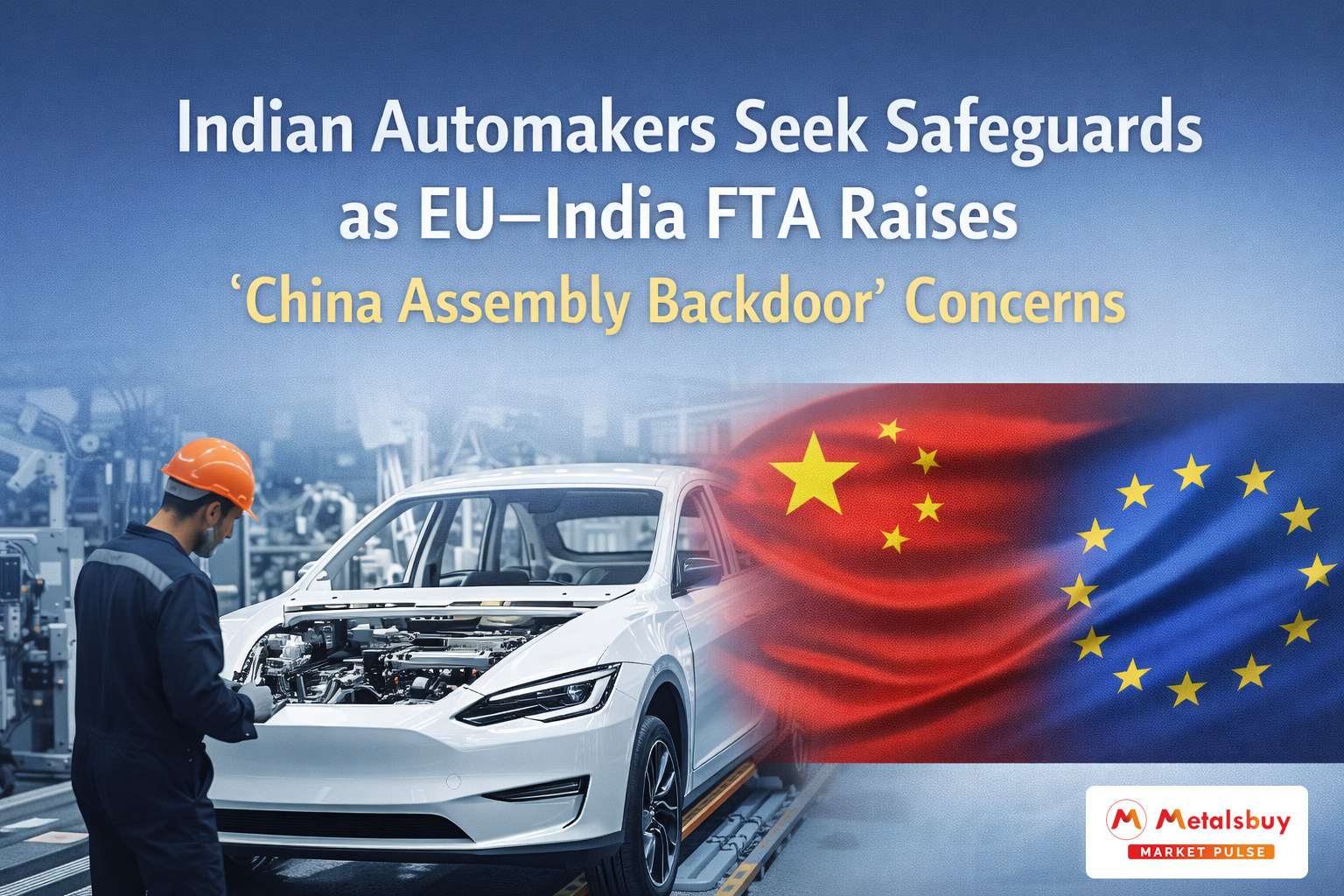
As negotiations for the long-pending EU–India Free Trade Agreement enter their final stretch, India’s automobile industry has raised red flags over a potential unintended consequence of the pact, the risk of Chinese electric vehicles (EVs) and components entering India at concessional duties via Europe.
Industry executives argue that without adequate safeguards, the agreement could create a “China assembly backdoor”, allowing Chinese manufacturers to assemble vehicles in the European Union and export them to India under preferential tariff terms, thereby undercutting domestic manufacturers.
What Is the Core Concern?
Indian automakers fear that Chinese EV manufacturers, already dominant in battery technology and cost-efficient manufacturing, could:
-
Shift final assembly operations to EU member states
-
Meet minimum processing norms required under the FTA
-
Export finished vehicles to India at significantly lower import duties
This would allow Chinese-origin products to bypass India’s current high tariff structure on fully built units (CBUs), weakening the protection currently enjoyed by domestic OEMs.
Why This Matters for India’s Auto & EV Ecosystem
India’s automobile sector is at a critical transition point, particularly in electric mobility:
-
The sector supports over 37 million jobs, directly and indirectly
-
Domestic OEMs are investing heavily in EV platforms, localisation, and battery supply chains
-
Government incentives under PLI schemes are tied to local value addition
Industry leaders warn that a sudden influx of low-cost EVs assembled in Europe could:
-
Disrupt price competitiveness of Indian-made EVs
-
Discourage fresh investments in domestic manufacturing
-
Slow down localisation of batteries, motors, and power electronics
Safeguards Demanded by Indian Automakers
To prevent misuse of the FTA, auto manufacturers and industry bodies have urged negotiators to include strong protective clauses, including:
1. Strict Rules of Origin (RoO)
-
Minimum 50% local value addition within the EU
-
Clear exclusion of mere assembly or screwdriver operations
2. Price Thresholds
-
Preferential tariffs only for vehicles priced above a certain CIF value
-
Prevents mass entry of low-cost EVs targeting the mid-market
3. Volume Caps
-
Annual limits on the number of vehicles eligible for concessional duties
-
Gradual liberalisation rather than unrestricted access
4. Product-Specific Safeguards
-
Emergency safeguard duties if imports surge beyond defined thresholds
-
Time-bound protection for India’s nascent EV ecosystem
Strategic Context: China’s Dominance in EV Supply Chains
China currently controls:
-
Over 70% of global lithium-ion battery manufacturing
-
A dominant share of cathode, anode, and rare-earth processing
-
Several global EV brands with expanding overseas assembly footprints
Indian automakers argue that without safeguards, the EU could become an assembly hub rather than a true manufacturing base — allowing Chinese firms to leverage Europe’s trade access without meaningful value creation.
Government’s Balancing Act
Indian negotiators face a delicate challenge:
-
On one hand: The EU-India FTA promises access to advanced technology, investments, and export markets
-
On the other: Premature exposure of the auto sector could undermine long-term industrial strategy
Officials are reportedly evaluating industry feedback to ensure the agreement balances trade liberalisation with industrial protection, particularly for EVs and high-employment manufacturing segments.
Potential Impact: Sector Snapshot
| Area | Likely Impact Without Safeguards |
|---|---|
| Domestic EV OEMs | Margin pressure, slower scale-up |
| Auto Ancillaries | Reduced localisation incentives |
| Consumers | Short-term price benefits, long-term dependency risk |
| Trade Balance | Higher auto import bill |
| Industrial Policy | Weakening of Make-in-India objectives |
Market Outlook: What to Watch
-
Final wording on rules of origin in the FTA
-
Whether EVs are treated as a sensitive sector
-
Introduction of phased duty reduction instead of immediate liberalisation
-
Alignment of FTA terms with India’s EV and PLI roadmap
The concerns raised by Indian automakers underscore a broader strategic issue trade agreements must not undermine domestic manufacturing at a formative stage. While the EU-India FTA holds long-term promise, industry leaders insist that robust safeguards are essential to ensure the pact does not become a conduit for indirect Chinese imports.
As negotiations approach the finish line, the final structure of automotive concessions could shape India’s EV trajectory for the next decade.