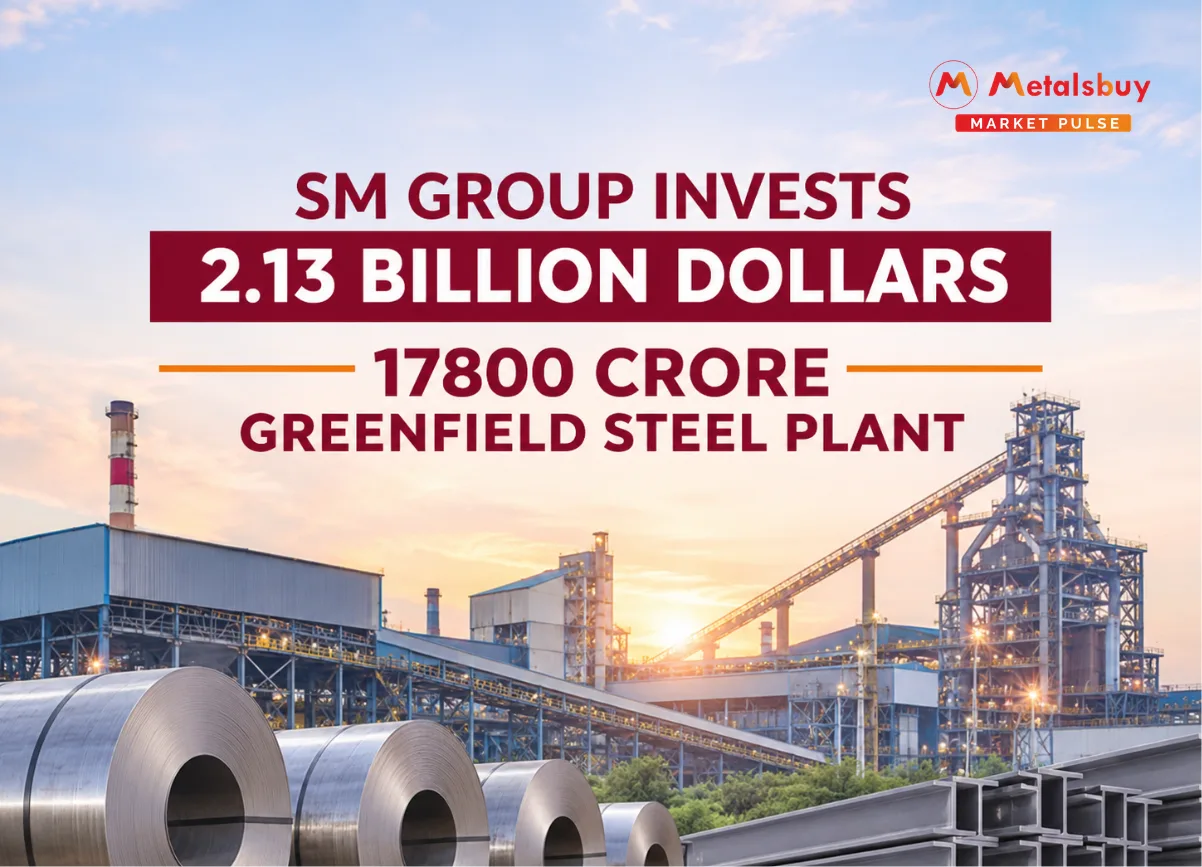
The Indian heavy manufacturing sector has secured another monumental influx of private capital, fundamentally shifting the geographic concentration of the domestic metals industry. In a landmark development for western India, the S.M. Group has officially inked a strategic pact with the state government of Maharashtra to establish a massive greenfield integrated steel mill. Backed by a staggering financial commitment of 2.13 billion dollars, this mega-project proves the immense confidence private conglomerates hold in the nation's long-term infrastructure and consumption story. By choosing to build from the ground up in a highly industrialized coastal state, the company is actively positioning itself to dominate the regional supply chain, providing a crucial localized raw material source for the booming automotive and real estate sectors.
Injecting massive capital to build integrated greenfield capacity
deploying over two billion dollars into a fresh manufacturing hub proves absolute confidence in western india's industrial growth and logistical advantages. The core of this major industrial announcement is the sheer scale and ambition of the proposed manufacturing complex. According to the memorandum of understanding signed between the corporate leadership of the S.M. Group and state industrial authorities, the enterprise will deploy approximately 2.13 billion dollars, translating to roughly ₹17,800 crore, to construct the facility from scratch.
Opting for a greenfield expansion—building an entirely new plant on undeveloped land—is a bold maneuver in the modern steel industry. While brownfield expansions at existing sites are faster, a greenfield project allows the S.M. Group to design a factory layout that is perfectly optimized for 21st-century manufacturing. The blueprints for the Maharashtra facility will inherently integrate the latest advancements in metallurgical technology, highly automated rolling lines, and advanced emission control systems. By engineering the plant to meet stringent environmental standards from day one, the company ensures that its future steel output will be globally competitive, highly energy-efficient, and structurally shielded from the carbon taxes that are currently reshaping the international metals trade.
Catering to the booming automotive and real estate sectors
establishing a massive local supply chain ensures that regional automakers and developers have uninterrupted access to premium steel without heavy freight costs. The decision to locate this massive 2.13 billion dollar asset in Maharashtra is a highly calculated strategic play driven by proximity to end-user demand. Historically, the absolute bulk of India’s primary steelmaking capacity has been heavily concentrated in the mineral-rich eastern states like Odisha, Jharkhand, and Chhattisgarh. Consequently, industries in the west had to rely on long-haul railway freight or coastal shipping to procure their base materials, exposing them to logistical delays and elevated inbound freight costs.
Maharashtra currently operates as the undisputed powerhouse of Indian manufacturing. The state houses massive automotive clusters around Pune and Aurangabad, where top-tier original equipment manufacturers run their assembly lines at absolute maximum capacity to meet surging domestic and export vehicle demand. Simultaneously, the Mumbai Metropolitan Region and surrounding urban belts are executing some of the most aggressive real estate and civil engineering projects on the subcontinent, consuming millions of tonnes of structural rebars and heavy beams. By bringing a massive integrated steel mill directly into this consumption zone, the S.M. Group will drastically slash outbound logistics costs. This proximity allows the company to offer highly competitive pricing and just-in-time delivery schedules, effectively capturing a dominant share of the lucrative western industrial market.
Driving massive regional employment and ancillary ecosystem growth
a greenfield mega project of this scale will fundamentally transform the local economy and generate thousands of highly skilled technical jobs. Beyond the corporate balance sheets and manufacturing metrics, an industrial investment of ₹17,800 crore acts as a massive socioeconomic catalyst for the host state. The development of a greenfield integrated steel mill is widely recognized as a mother industry, meaning its establishment naturally triggers the growth of a vast, interconnected economic ecosystem.
During the initial construction phase, which is expected to span several years, the project will require an army of civil engineers, heavy machinery operators, and construction laborers. Once fully operational, the plant will create thousands of direct, high-paying technical and administrative jobs. The ripple effect, however, is where the true regional value lies. A functional steel mill demands constant support from local transport and logistics fleets, mechanical maintenance contractors, and secondary scrap processors. State authorities actively courted this investment because it perfectly aligns with local industrial policies aimed at boosting micro, small, and medium enterprises. The S.M. Group’s mega-project will anchor a new industrial corridor in Maharashtra, generating sustained commercial activity and elevating the standard of living across the surrounding districts.
Supporting the national steel capacity targets for the coming decade
massive private sector investments are the absolute bedrock required to achieve the three hundred million tonne national capacity milestone. From a broader macroeconomic perspective, this 2.13 billion dollar pact is a massive victory for the central government's industrial vision. The Ministry of Steel has set an unyielding National Steel Policy target to push the country's installed crude steel capacity to a staggering 300 million tonnes per annum by the year 2030.
Achieving this monumental volumetric leap is impossible without aggressive, large-scale capital deployment from agile private sector conglomerates. While state-owned enterprises continue to expand, the injection of fresh private capital into greenfield projects like the one proposed by the S.M. Group is what truly accelerates the national timeline. As the Indian economy rapidly modernizes its infrastructure, expands its defense manufacturing, and transitions toward green energy, the baseline requirement for locally produced, high-grade steel is practically guaranteed to surge. By securing the land and regulatory approvals today, the S.M. Group is perfectly timing its market entry. Once commissioned, this massive facility in Maharashtra will ensure that India's economic engines are fueled entirely from within, securing complete industrial self-reliance for the decades to come.