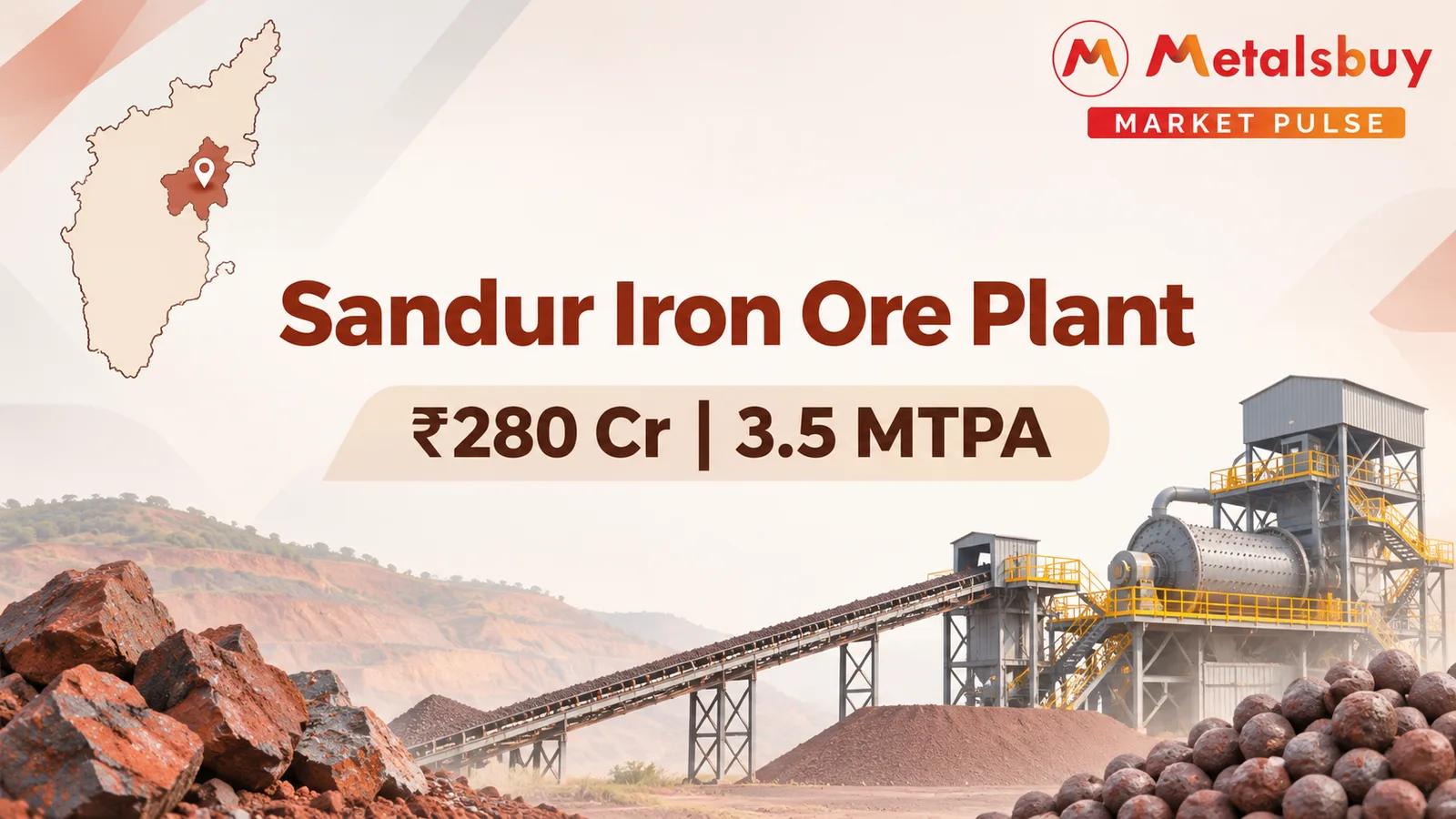
The company expects to commission its first beneficiation unit by August 2027, with plans to upgrade lower-grade iron ore for pellet manufacturing.
Bengaluru | November 20, 2026
The Sandur Manganese & Iron Ores Limited (SMIORE) has announced plans to invest approximately ₹280 crore in developing an iron ore beneficiation plant at Deogiri Village in Karnataka's Ballari district. The proposed facility, located within the company's mining area, will have an initial processing capacity of 3.5 million tonnes per annum (MTPA), marking an important addition to its iron ore processing capabilities.
According to the company's November 19 stock exchange disclosure, the first beneficiation unit is scheduled for commissioning in August 2027. The facility will process iron ore sourced from SMIORE's KTIO mines and a portion of production from its Deogiri mines. The objective is to improve the quality of lower-grade iron ore and make it suitable for downstream pellet manufacturing, strengthening the commercial utilisation of available mineral resources.
The plant is designed to process iron ore containing approximately 50% iron (Fe) and produce beneficiated material with an iron content exceeding 60%. During its initial operating phase, the facility is expected to generate between 1.0 and 1.2 MTPA of upgraded iron ore, with the potential to increase output to 1.7 MTPA. The distinction between processing capacity and finished concentrate output is significant, as the beneficiation process separates unwanted material from the ore to improve its iron content.
Project Development and Expansion Roadmap
The project will be implemented in phases, with the company planning to eventually establish two beneficiation units of 3.5 MTPA each. This would take the combined processing capacity to 7 MTPA over the longer term, subject to the implementation of the second phase.
Construction of the first unit is already progressing, with approximately 25% of the project completed. Civil construction activities are underway, structural fabrication has commenced and orders for equipment requiring longer delivery periods have been placed. The investment will be financed through a combination of internal accruals and debt, allowing the company to pursue the project as part of its broader mining and mineral-processing operations.
Locating the plant within the mining area is expected to improve operational efficiency by reducing the transportation of material containing waste minerals. The arrangement could also support better handling of processing residues and improve overall resource utilisation. According to the company, the project is expected to generate approximately 150–200 direct and indirect employment opportunities.
Improved Ore Quality Could Support Regional Pellet Producers
The beneficiation project is particularly relevant to the iron ore and pellet manufacturing ecosystem in Karnataka. Pellet plants located in and around Sandur have a combined production capacity exceeding 24 MTPA, according to the company's disclosure, representing a substantial downstream market for upgraded iron ore.
Beneficiation plays an important role in improving the usability of lower-grade mineral resources. By increasing iron content and reducing unwanted material, the process can produce concentrate suitable for pelletisation and other downstream applications. This allows mining companies to improve the commercial value of ore that may otherwise have more limited market acceptance.
SMIORE Managing Director Bahirji A. Ghorpade indicated that the project is intended to improve the quality and commercial value of lower-grade ore while reducing waste. The company also sees opportunities for the beneficiated material to support ironmaking activities within its integrated steel operations.
The availability of upgraded ore could provide additional sourcing opportunities for nearby pellet manufacturers. However, the eventual commercial impact will depend on production volumes, product specifications, pricing and arrangements with downstream consumers.
Strong Financial Performance Supports Investment Plans
The proposed investment follows a period of improved financial performance for SMIORE. During the second quarter of FY2026–27, the company reported consolidated total income of ₹1,519 crore, representing a year-on-year increase of 22%. EBITDA rose 37% to ₹391 crore, while profit after tax increased 88% to ₹261 crore.
For the first half of FY2026–27, consolidated total income reached ₹2,909 crore, up 21% compared with the corresponding period of the previous financial year. EBITDA increased 25% to ₹749 crore, while profit after tax rose 60% to ₹489 crore.
The financial results provide context for the company's ongoing investment programme, although the beneficiation project's future contribution will depend on successful commissioning, operational efficiency and market conditions.
Metalsbuy Market Pulse Analysis
Sandur's planned beneficiation facility highlights the growing importance of improving mineral quality and extracting greater commercial value from existing iron ore resources. Rather than focusing exclusively on increasing mining output, the investment aims to strengthen the processing capabilities associated with the company's mining operations.
For Karnataka's iron ore industry, the project could improve the availability of higher-grade concentrate for regional pellet manufacturers. Its location within the mining area may also offer operational advantages by reducing the movement of lower-grade material before processing.
The proposed expansion to 7 MTPA of processing capacity is another development worth monitoring. However, the first unit's projected output of 1.0–1.2 MTPA of upgraded material should not be confused with its 3.5 MTPA ore-processing capacity.
For steelmakers and pellet producers, the availability of quality-controlled iron ore concentrate remains an important consideration in raw material procurement. Investments in beneficiation infrastructure could help improve resource utilisation while supporting the requirements of downstream manufacturing.
Sandur's ₹280 crore investment represents a step towards strengthening India's iron ore value chain through greater mineral processing and improved utilisation of lower-grade resources.
— Metalsbuy Market Pulse | Industry Intelligence & Market Analysis