KEY NUMBERS
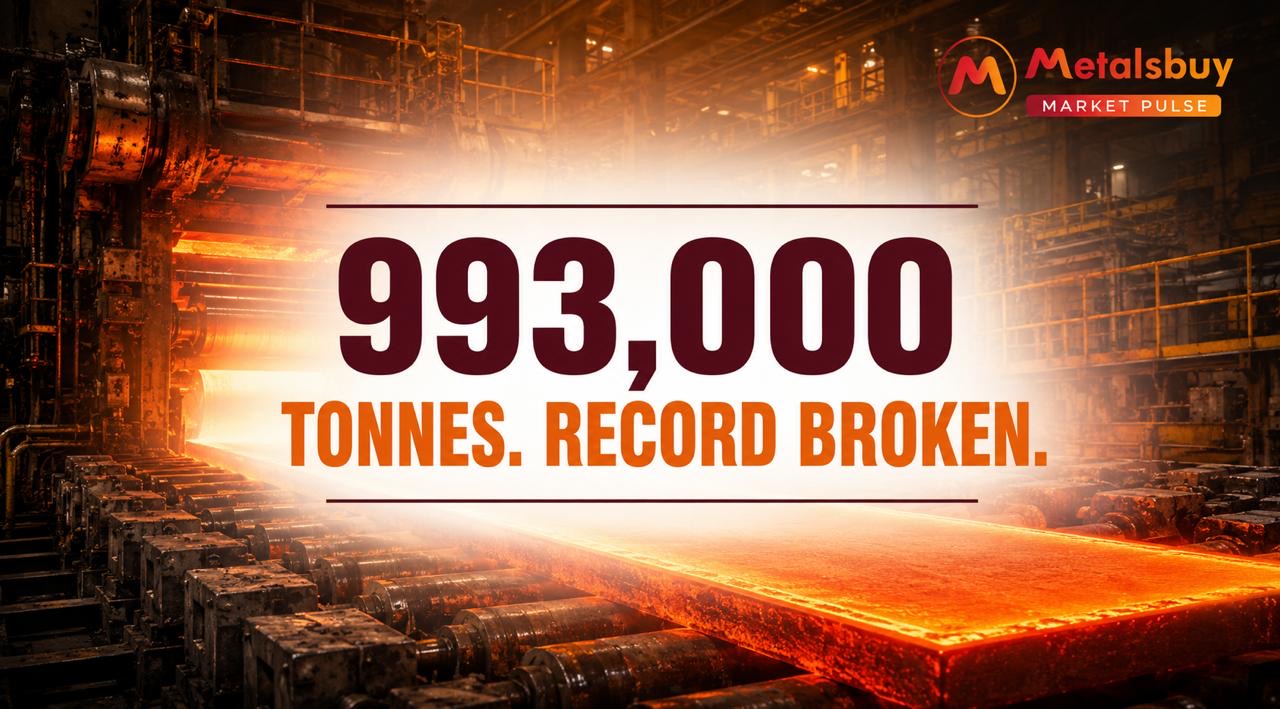
993,000 Tonnes : Annual output achieved at SAIL Rourkela’s plate mill
920,000 Tonnes : Original rated design capacity of the Danieli supplied mill
73,000 Tonnes : Output produced above rated capacity
Rourkela, Odisha : Location of SAIL’s integrated steel facility
Danieli : Technology supplier for the plate mill facility
Record Output : Multiple production milestones achieved during recent operating cycles
Automation Upgrades : Operational improvements contributing to higher throughput
Process Optimisation : Efficiency gains helping lift mill utilisation rates
Plate Steel Demand : Infrastructure and heavy engineering sectors continuing to absorb supply
Odisha : One of India’s most important steel and ferro alloy producing regions
⸻
MARKET ANALYSIS
Steel plants rarely announce stability with excitement.
They celebrate records instead.
SAIL’s Rourkela Steel Plant has now pushed its Danieli supplied plate mill beyond rated design capacity, producing roughly 993,000 tonnes annually against an original 920,000 tonne benchmark. On paper, the gap looks straightforward: seventy three thousand additional tonnes. Inside steelmaking economics, it signals something more important.
India’s large integrated mills are learning how to squeeze more output from existing infrastructure without waiting years for entirely new plants to arrive.
That matters because steel demand across India continues growing unevenly but persistently across infrastructure, railways, defence manufacturing, shipbuilding and heavy engineering sectors where plate steel consumption remains critical. Mills capable of extracting higher utilisation from existing lines gain an immediate advantage during periods when new greenfield capacity still requires long approval and construction timelines.
Efficiency has become strategy.
Rourkela’s improvement appears tied to automation upgrades, tighter process control and operating optimisation rather than dramatic structural expansion. Modern steelmaking increasingly depends as much on digital operating discipline as raw furnace size alone. Every percentage improvement in yield, downtime reduction or throughput efficiency compounds across integrated operations running continuously throughout the year.
The location matters too.
Odisha already sits at the centre of several interconnected industrial chains across steel, ferrochrome, pellets and mining. Large integrated mills operating more efficiently inside the state influence procurement behaviour across surrounding alloy and raw material markets because plate steel production requires stable upstream movement of iron ore, fluxes and alloy additions feeding the wider steelmaking cycle.
That relationship is becoming tighter over time.
Higher steel output ultimately increases consumption intensity across the entire metallurgical chain, including ferro manganese, silico manganese and other alloy inputs supporting specialised steel grades and refining operations. When mills push beyond rated capacity consistently, procurement patterns usually begin changing quietly before markets fully recognise the scale of operational improvement underway.
The market notices eventually.
⸻
INDUSTRY IMPACT
India’s steel sector is entering a phase where productivity gains may matter almost as much as fresh capacity announcements.
For years, expansion discussions focused heavily on new blast furnaces, fresh rolling mills and large greenfield investments. Those projects still matter enormously. But operational efficiency inside existing integrated plants can raise national steel output meaningfully even before entirely new facilities arrive online.
That creates pressure across the supply chain.
Raw material procurement becomes more disciplined when mills operate closer to optimal utilisation. Ferro alloy demand stabilises because higher throughput requires more predictable metallurgical inputs. Logistics networks tighten as mills reduce downtime and increase dispatch consistency. Producers capable of maintaining operational reliability gain advantages during periods when finished steel pricing remains competitive.
Plate steel itself occupies an important position inside India’s industrial expansion cycle.
Unlike commodity construction steel, heavy plate demand often reflects activity across capital intensive sectors such as infrastructure equipment, defence manufacturing, pressure vessels, industrial fabrication and transport engineering. Consistent plate mill performance therefore acts as a broader signal about underlying industrial activity beyond residential construction alone.
Rourkela’s performance also highlights the increasing importance of technology partnerships.
Modern automation systems, process monitoring and precision rolling technologies now directly influence how much usable output integrated mills can extract from existing infrastructure. That trend may gradually separate higher efficiency operators from producers still relying heavily on older process configurations.
⸻
WHAT TO WATCH NEXT
The next question is whether this becomes a one off production milestone or a sustained operating pattern.
Markets will watch whether Rourkela consistently maintains output above rated design capacity across multiple quarters without sacrificing maintenance stability, product quality or cost efficiency. Running above benchmark capacity temporarily is impressive. Sustaining it continuously is far harder.
Steel plate demand trends also deserve attention.
Infrastructure spending, defence manufacturing orders and industrial fabrication activity will determine whether higher plate production translates into healthy margins or simply larger inventory accumulation. Mills remain careful because output growth without matching demand quickly pressures pricing.
Watch Odisha’s wider industrial chain closely.
Higher steel throughput inside integrated plants eventually feeds into procurement activity across mining, pellets, ferro alloys and industrial logistics. Producers across eastern India will likely monitor whether stronger mill utilisation begins tightening alloy demand through the second half of 2026.
⸻
MARKET OUTLOOK
SAIL Rourkela’s production milestone reflects something larger than one mill exceeding design specifications.
India’s steel industry is becoming operationally sharper.
The next phase of growth may not come only from giant new projects announced every quarter. It may also come from integrated plants extracting more output, higher efficiency and tighter operational discipline from infrastructure already in place.
That matters for steel markets because efficient production changes competitive dynamics quietly. Mills with stronger automation, tighter process control and reliable throughput can protect margins more effectively during periods of uneven pricing pressure.
India still plans enormous capacity expansion over the next decade.
But the companies improving productivity today may gain advantages long before those future projects fully arrive.
SAIL Rourkela Pushes Past Rated Capacity. India’s Plate Steel Ambitions Are Getting Larger And More Efficient.