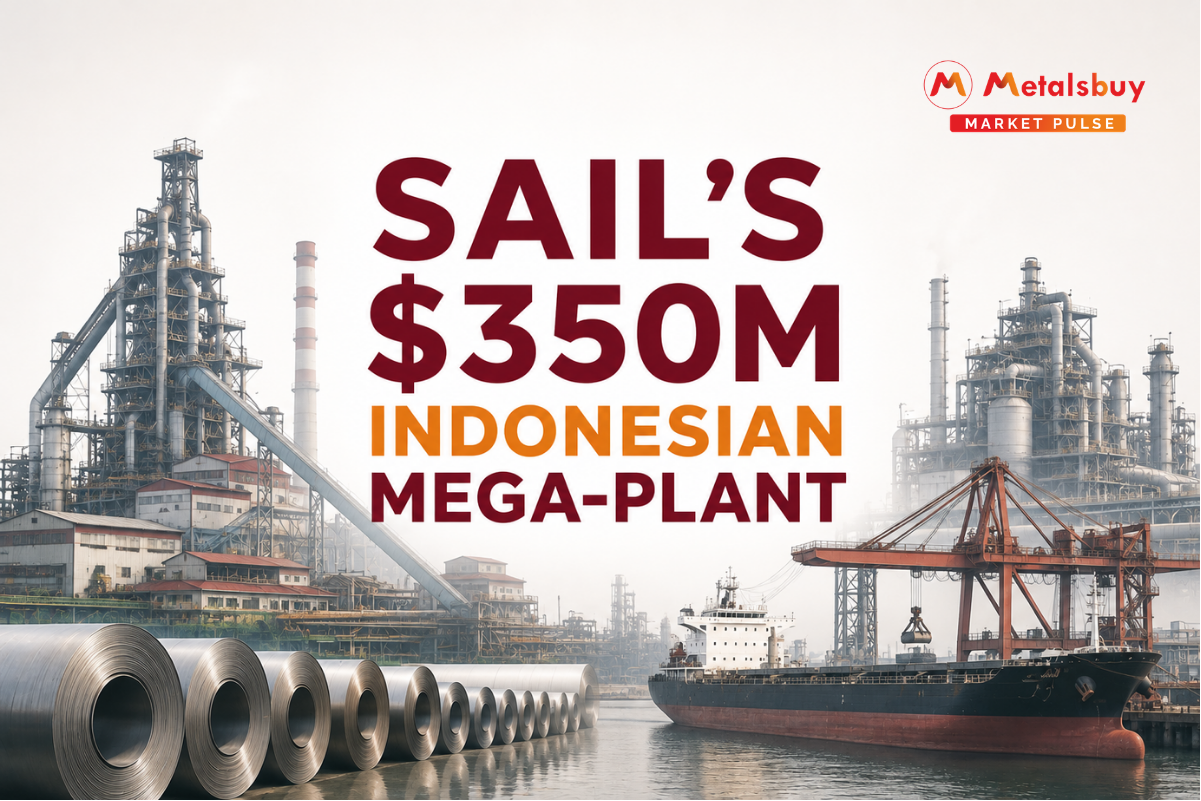
KEY HIGHLIGHTS
- Investment Capital: $350 million allocated for establishing a premium stainless steel slab manufacturing facility in Indonesia.
- Production Capacity: Designed to deliver 500,000 metric tons of raw stainless steel slabs annually upon full completion.
- Operational Timeline: Commercial manufacturing and output generation expected to commence within 36 to 48 months.
- Financial Leverage: Backed by robust Q1 FY27 performance showcasing a 121 percent year-on-year net profit jump to ₹1,644 crore.
- Strategic Supply: Slabs specifically designated to feed the Salem processing facility in Tamil Nadu while targeting lucrative Middle Eastern and European exports.
MARKET ANALYSIS
Steel Authority of India Limited is executing a decisive international expansion strategy by entering into a landmark joint venture with Indonesia-based Krakatau Steel. This collaboration involves a substantial capital expenditure of up to $350 million to construct a state-of-the-art stainless steel slab manufacturing plant on Indonesian soil. The initiative follows preliminary agreements established during recent high-level diplomatic visits between India and Indonesia, marking a significant milestone for Indian public sector undertakings expanding their manufacturing footprint overseas. A specialized technical delegation will finalize the exact joint venture structure and engineering timelines in the coming weeks.
This aggressive international maneuvering is backed by exceptionally strong recent financial fundamentals. During the first quarter of fiscal year 2027, Steel Authority of India recorded a massive 121 percent surge in consolidated net profit, reaching ₹1,644.05 crore, up from ₹744.58 crore in the corresponding period of the previous year. Operational efficiency metrics have also reached multi-year highs, with standalone EBITDA jumping 49 percent year-over-year to ₹4,356 crore. This operational leverage drove EBITDA margins to an impressive 16.6 percent, up substantially from 11.29 percent just twelve months prior. Furthermore, the company successfully reduced its standalone debt-to-equity ratio to 0.54, providing the necessary financial runway to fund large-scale international projects without overleveraging the balance sheet.
The strategic choice of Indonesia for this $350 million facility aligns perfectly with current macroeconomic trends in the metals sector. The global stainless steel market is currently experiencing a period of robust structural growth, with overall market valuation projected to approach $159.61 billion by the end of 2026. This expansion is largely driven by rapid industrialization across Asia and an increased global appetite for high-strength, corrosion-resistant materials necessary for modern infrastructure. By embedding a core manufacturing asset directly within Southeast Asia, Steel Authority of India is optimizing its production costs while securing a reliable, high-volume source of primary materials.
WHAT IT MEANS FOR THE STEEL INDUSTRY
The establishment of an international manufacturing base by India's premier state-owned steelmaker represents a paradigm shift in how domestic steel giants approach global supply chain management. Historically, Indian steel producers have largely concentrated on maximizing domestic capacity and exporting finished goods. This $350 million joint venture pivots that model toward establishing captive offshore raw material and intermediate processing hubs.
The most immediate domestic beneficiary of this Indonesian facility will be the company's Salem Steel Plant in Tamil Nadu. Globally recognized for its premium grade "Salem Stainless" brand, the Salem facility currently operates with a saleable production capacity of 340,000 tonnes per annum. By securing a guaranteed supply of 500,000 metric tons of raw stainless steel slabs annually from the new Indonesian joint venture, the Salem plant will eliminate intermediate supply bottlenecks, drastically reduce raw material procurement volatility, and maximize its cold and hot rolling capacities.
Furthermore, this development reshapes regional trade dynamics. By processing primary slabs in Indonesia and finishing them in India, Steel Authority of India creates a highly cost-competitive pipeline capable of undercutting traditional supply routes to the Middle East and Europe. The move signals to the broader industry that securing dedicated international supply nodes is becoming essential for maintaining competitive pricing and reliable delivery schedules in the premium steel segment. Other major industry players are likely to evaluate similar joint ventures in resource-rich nations to safeguard their own downstream manufacturing operations.
MARKET OUTLOOK
The long-term trajectory for the stainless steel sector remains exceptionally strong, with industry forecasts projecting a compound annual growth rate of 6.90 percent, pushing total market valuation toward $242.63 billion by 2032. This sustained demand is underpinned by structural shifts in global engineering and construction. Decarbonization initiatives, complex energy transition projects, and next-generation mobility solutions are entirely dependent on advanced, corrosion-resistant alloys.
Steel Authority of India's current expansion phase perfectly intersects with this rising demand curve. While the global steel industry frequently navigates cyclical pricing pressures and volatile raw material costs, companies that control their entire value chain—from international slab production to domestic finishing—are uniquely positioned to absorb market shocks and maintain stable profit margins.
Looking ahead to the next three to four years as the Indonesian facility comes online, the company is poised to transition from a largely domestic-focused producer into a globally integrated stainless steel powerhouse. The combination of falling domestic debt levels, expanding operating margins, and aggressive international capacity building provides a highly positive structural outlook for the enterprise. As global procurement standards increasingly prioritize supply chain transparency and reliable product availability, this $350 million strategic asset will ensure that Indian stainless steel products remain highly competitive across the world's most lucrative infrastructure markets.