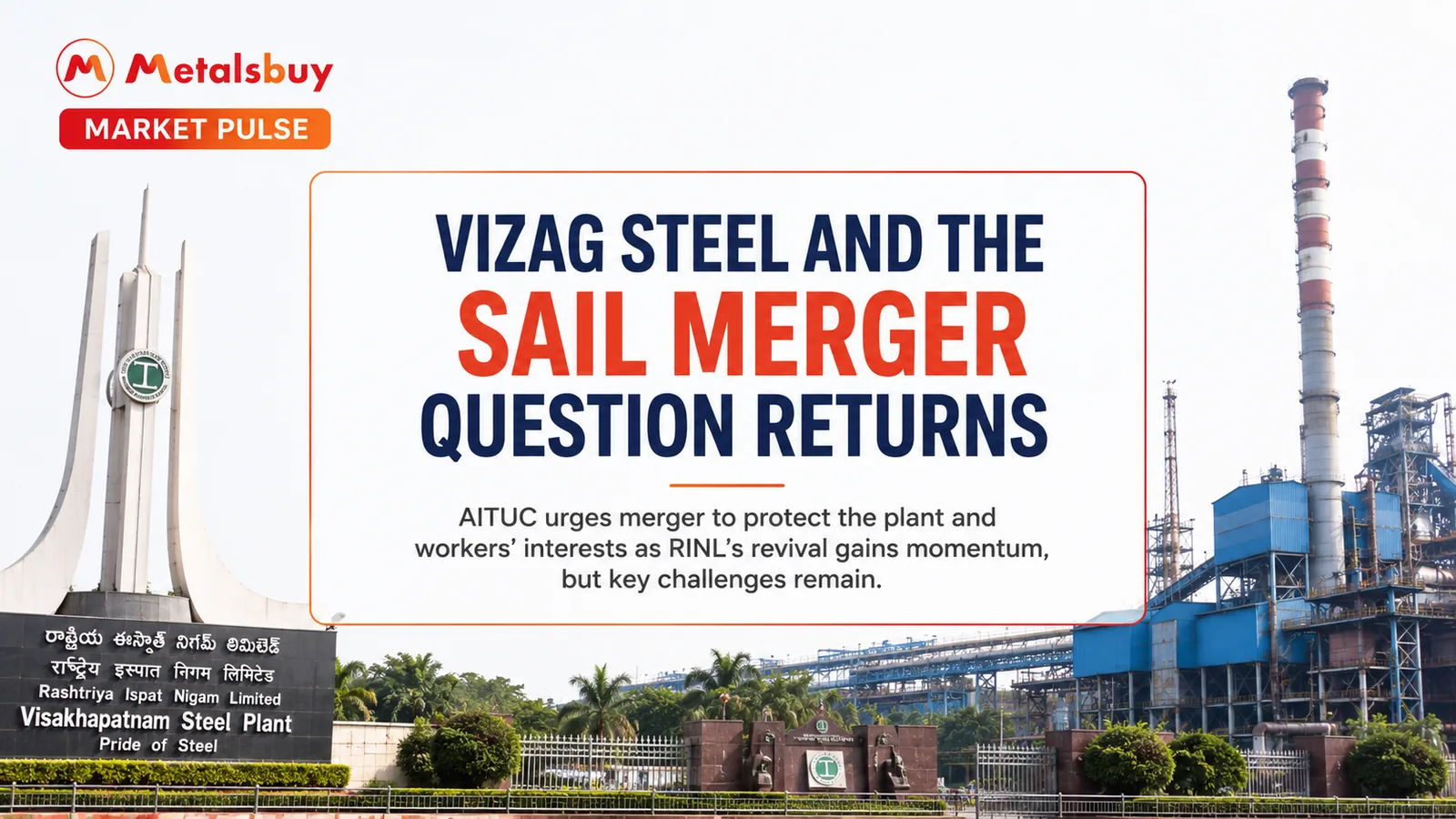
The question of merging Visakhapatnam Steel Plant with Steel Authority of India Limited (SAIL) is back in discussion after AITUC called for such a move, arguing that it would help protect both the plant and the interests of its workers.
The demand comes at a time when RINL, the company operating Vizag Steel, is in a much better position than it was a year ago. The Centre approved a ₹11,440 crore revival package in January 2025, operations have improved, and the plant has gradually returned towards higher utilisation. But the financial support has not removed the underlying issues that have troubled the company for years. That is why the merger debate keeps returning.
A large steel plant with a long-standing disadvantage
Vizag Steel is not a small operation struggling because of a lack of scale. RINL has an installed capacity of 7.3 million tonnes per annum of liquid steel, making it one of India's major integrated steel plants. Its biggest disadvantage has been the lack of captive iron ore mines.
For a steelmaker of this size, dependence on the market for iron ore creates a very different cost structure compared with producers that have their own mines. When iron ore prices rise, the impact is felt directly. The company has to arrange raw material supplies from external sources while also managing logistics and working capital requirements. This issue has remained central to RINL's financial troubles over the years. Even if the company improves production and sales, the question of raw material security does not simply disappear.
What a merger with SAIL could potentially change
This is the main reason unions continue to push the SAIL merger idea. SAIL operates some of India's largest integrated steel plants and has access to a much broader production and raw material ecosystem. A merger could potentially bring RINL under a larger organisation with established mining, procurement and marketing operations.
There could also be benefits from combining certain functions. Procurement, raw material sourcing, product marketing and technology could be handled within a larger system rather than by RINL independently.
However, a merger should not be viewed as an automatic solution. RINL's financial liabilities, working capital requirements and dependence on externally sourced raw materials would still have to be addressed. Simply changing the ownership structure would not immediately change the economics of running the plant. The government had earlier stated that a merger with SAIL was not under consideration, while SAIL itself had previously expressed concerns about taking on RINL's financial burden.
₹11,440 crore gave RINL breathing space
The Centre's revival package was a major intervention. Approved in January 2025, the package totalled ₹11,440 crore. This included ₹10,300 crore as equity capital, while ₹1,140 crore of working capital loan was converted into 7% non-cumulative preference share capital, redeemable after 10 years.
The financial support came after RINL's situation had become increasingly difficult. As of 31 March 2024, the company's net worth had turned negative by ₹4,538 crore. Its current liabilities stood at ₹26,114.92 crore, against current assets of ₹7,686.24 crore. The numbers explain why the revival package was necessary.
RINL had reached a stage where restoring regular operations required more than internal cost-cutting or better steel prices. It needed fresh financial support to stabilise the business, restart operations and meet its immediate obligations.
The situation at the plant has improved
The revival package has helped change the immediate picture at Vizag Steel. The plant, which had earlier faced operational disruptions and financial pressure, has seen an improvement in production activity. Reports earlier this year indicated that all three blast furnaces were operational and capacity utilisation had moved close to 94%. That is a significant improvement compared with the situation during the worst phase of the financial crisis.
But operational recovery and long-term sustainability are two different things. A steel plant can return to high utilisation, yet still remain exposed if its input costs are structurally higher than competitors. This is where the debate around Vizag Steel becomes more complicated than simply discussing privatisation versus public ownership.
The merger demand is also about protecting the public-sector identity of VSP
For unions, the SAIL merger is being projected as an alternative to strategic disinvestment. The movement against the proposed privatisation of Vizag Steel has continued for years, and the plant remains an important political and industrial issue in Andhra Pradesh.
Bringing RINL under SAIL would keep the plant within the public sector while giving it access to a larger state-owned steel ecosystem. That is the argument being made by those supporting the merger.
Whether the government sees merit in it is another matter. A merger of two large public-sector companies would involve questions around liabilities, employee structures, raw material allocation, management and future capital expenditure. It would not be a simple administrative exercise.
The bigger issue has not gone away
The ₹11,440 crore package has given Vizag Steel time and financial support. Production has improved, and the plant is in a better position than it was before the revival package. But the bigger question remains. How does a 7.3 MTPA integrated steel plant without captive iron ore mines build a sustainable cost structure over the long term?
AITUC's latest demand has brought the SAIL merger back into the conversation. Whether that proposal moves forward or not, the discussion has once again highlighted the fact that financial support alone may not answer every question surrounding Vizag Steel. For now, the plant has regained some stability. What remains to be seen is what structure will ensure that the same questions do not return a few years down the line.