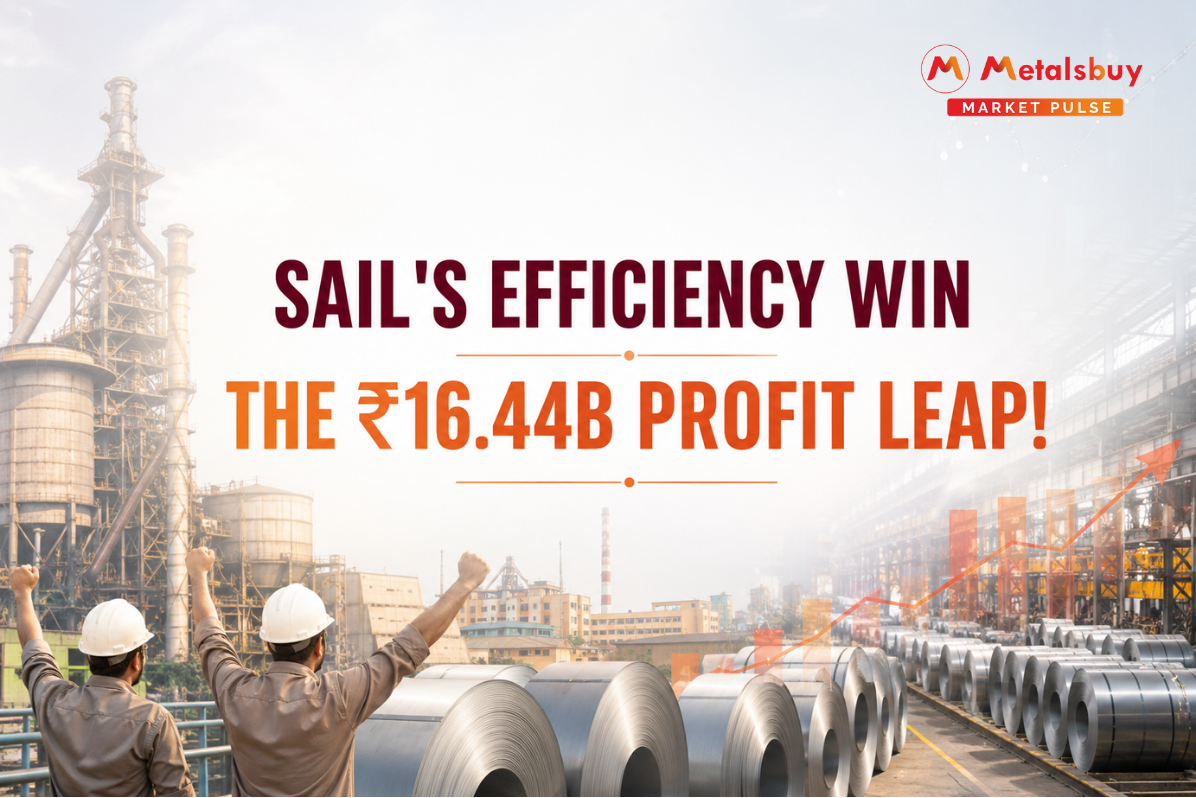
Steel Authority of India Limited (SAIL), the state-run integrated steelmaking giant, has delivered a robust financial performance for the first quarter of the fiscal year 2026-27 (April-June). Showcasing significant operational resilience, the company achieved a remarkable doubling of its consolidated net profit, navigating through a quarter characterized by moderated production volumes. This strategic pivot towards cost optimization has positioned SAIL favorably within the broader growth trajectory of the Indian steel sector.
KEY NUMBERS
- Consolidated Net Profit: INR 16.44 billion ($170.41 million), reflecting a surge of over 100% year-on-year.
- Total Income: INR 264.51 billion ($2.74 billion), representing a modest 1.4% growth year-on-year.
- Crude Steel Production: 4.76 million metric tonnes (MT), a slight decrease from 4.85 million MT in Q1 FY26.
- Sales Volume: 4.16 million MT, down from 4.55 million MT in the corresponding quarter of the previous year.
MARKET ANALYSIS
The standout metric from SAIL's Q1 FY27 earnings report is the stark contrast between volume and profitability. Despite a marginal decline in crude steel output and a notable dip in sales volumes, the company successfully doubled its net profit. This achievement is primarily attributed to a sharp, strategic reduction in operational expenses and enhanced overall efficiencies. SAIL deliberately moderated volumes during this quarter by advancing scheduled repairs and maintenance, a proactive measure necessitated by global supply chain disruptions stemming from ongoing geopolitical volatility.
While total revenue witnessed a steady 1.4% year-on-year increase to INR 264.51 billion, the dramatic profit leap underscores a focus on margin expansion over sheer volume growth. This internal financial discipline aligns well with the broader momentum in the Indian steel market, which saw domestic finished steel consumption rise by 8.3% to 41.6 million tonnes during the April-June 2026 quarter, driven by robust infrastructure demand.
WHAT IT MEANS FOR THE STEEL INDUSTRY
SAIL's performance serves as a bellwether for the domestic steel industry's capability to balance internal operational restructuring with external market demands. The company's focus on cost control over aggressive volume expansion amidst supply chain uncertainties provides a blueprint for resilience. It suggests that major players can maintain strong profitability even when deferring production for vital maintenance.
Furthermore, SAIL's commitment to modernization, evidenced by the recent consultancy agreement to expand the Bhilai Steel Plant's capacity from 7 MTPA to 10.2 MTPA, signals sustained long-term capital expenditure. This localized expansion mirrors broader industry trends, such as Vraj Iron and Steel's recent approval of a ₹450 crore greenfield integrated plant in Bastar, Chhattisgarh, adding 201,000 TPA capacity. These moves collectively reinforce the industry's drive towards the National Steel Policy target of 300 MTPA by 2030, currently sitting at approximately 222 MTPA.
MARKET OUTLOOK
The near-to-medium-term outlook for the Indian steel sector remains highly positive, underpinned by substantial government infrastructure spending. Industry analysts project domestic steel demand to grow by an accelerated 9-10% in FY2027. This surge is heavily reliant on a projected 25% increase in budgetary allocations toward steel-intensive sectors like roads, railways, and urban infrastructure projects under initiatives like the National Infrastructure Pipeline.
While global pressures, such as fluctuating raw material costs (particularly coking coal and iron ore) and geopolitical uncertainties, remain potential headwinds, the robust domestic consumption fundamentals provide a strong safety net. For SAIL, the strategic maintenance undertaken in Q1 positions the company to operate at optimal efficiency and capitalize on this anticipated surge in domestic demand in the forthcoming quarters, solidifying its pivotal role in India's infrastructure narrative.