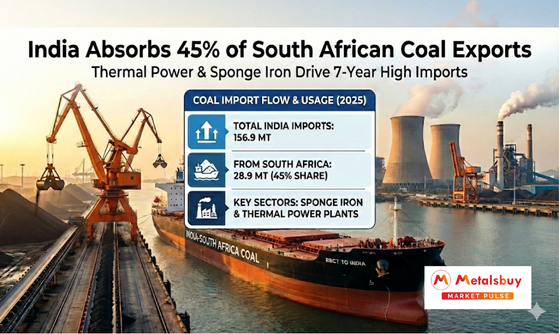
As global energy markets fragmented further in 2025, a critical trade symbiosis solidified in the Indian Ocean. While European and East Asian demand for thermal coal waned under aggressive decarbonization mandates, India’s industrial engine—specifically its surging sponge iron and cement sectors—effectively rescued South African coal exporters from a precipitous volume collapse.
Data released this week by the Richards Bay Coal Terminal (RBCT) confirms the trend: South Africa’s thermal coal exports defied bearish forecasts to hit 57.66 million tonnes in 2025, an 11% recovery from the previous year. Crucially, India solidified its position as the anchor client, absorbing 25.75 million tonnes—nearly 45% of total throughput.
This surge comes as Indian buyers aggressively substituted Indonesian supply with higher-grade South African material, capitalizing on a price dip to ~$76/tonne (FOB) that made high-energy coal economically viable for industrial kilns.
Key Market Metrics: 2024 vs. 2025
The following table illustrates the dramatic pivot in trade flows and logistics recovery that defined the last fiscal year:
|
Metric |
2024 Statistics |
2025 Statistics |
Change (YoY) |
|
Total RBCT Exports |
51.90 Mt |
57.66 Mt |
▲ 11.1% |
|
Exports to India |
~22.70 Mt |
25.75 Mt |
▲ 13.4% |
|
India's Share of Total |
43% |
44.7% |
▲ 1.7% |
|
RBCT Train Arrivals |
17 trains/day |
20 trains/day |
▲ 17.6% |
|
Realized Price (Thungela) |
~$91.56/tonne |
~$75.89/tonne |
▼ 17.1% |
The "Rescue" Act: Anatomy of a Trade Shift
The narrative of 2025 was defined by two parallel forces: the stabilization of South African logistics and the specific metallurgical hunger of India’s steel belt.
- The Transnet Turnaround After years of decline, South Africa’s state-owned logistics operator, Transnet, began to turn the corner. The deployment of new 23E locomotives and a drastic reduction in copper cable theft—down from 180km in 2024 to just 59km in 2025—allowed miners to move stock from the Mpumalanga coalfields to the coast with renewed reliability.
- The Substitution Effect While India’s total thermal coal imports dipped slightly due to record domestic output by Coal India Ltd, imports from South Africa bucked the trend. Indian buyers reduced reliance on lower-CV Indonesian coal, switching to South African RB1 (6,000 kcal/kg) and RB2 (5,500 kcal/kg) grades. This flight to quality was driven by the "value-in-use" economics of the sponge iron sector, which requires stable, high-heat content fuel that domestic Indian coal (often high-ash) cannot provide.
The Structural Drivers: Why Sponge Iron Rules the Market
The symbiotic relationship is underpinned by the specific chemistry of Direct Reduced Iron (DRI) production.
- Production Surge: According to provisional data from the Joint Plant Committee (JPC), India’s sponge iron production crossed 50.81 million tonnes in FY25-26. This sector alone now consumes more high-grade imported coal than many small nations combined.
- The Quality Imperative: Unlike power plants, which can blend high-ash domestic coal, sponge iron kilns in Odisha and Chhattisgarh risk "accretion" (ring formation) inside the kiln if coal ash content is too high. South African coal, with its lower moisture and superior fixed carbon, remains the non-negotiable fuel of choice.
- Corporate Performance: Major miners like Thungela Resources and Exxaro reported resilient export volumes despite softer global prices. Thungela, for instance, achieved export saleable production of roughly 13.7 Mt, explicitly citing the "consistent rail performance" and steady Indian demand as buffers against the broader market downturn.
Strategic Outlook: The 2030 Horizon
The trajectory suggests this dependence will deepen before it eases. India’s National Steel Policy targets have kept the pressure on, with a clear roadmap for the remainder of the decade.
- Production Targets: India’s sponge iron production is projected to hit 75 million tonnes by 2030.
- Import Dependency: Analysts at MetaMarket forecast that unless India achieves a breakthrough in coal gasification or green hydrogen viability for DRI, the import requirement for high-grade thermal coal will remain sticky.
- Price Sensitivity: With the realized price of South African coal stabilizing around the $75–$80 mark, it remains in the "sweet spot" for Indian industrial buyers—expensive enough to sustain South African miners, but cheap enough to keep Indian steel competitive.
“The symbiotic relationship is clear,” notes industry analyst Arjun Kapadia. “South Africa has the geology, and India has the geology-defying industrial demand. Until the hydrogen economy scales, RBCT is essentially an annex of India’s steel supply chain.”