Export Concentration Signals Structural Dependence
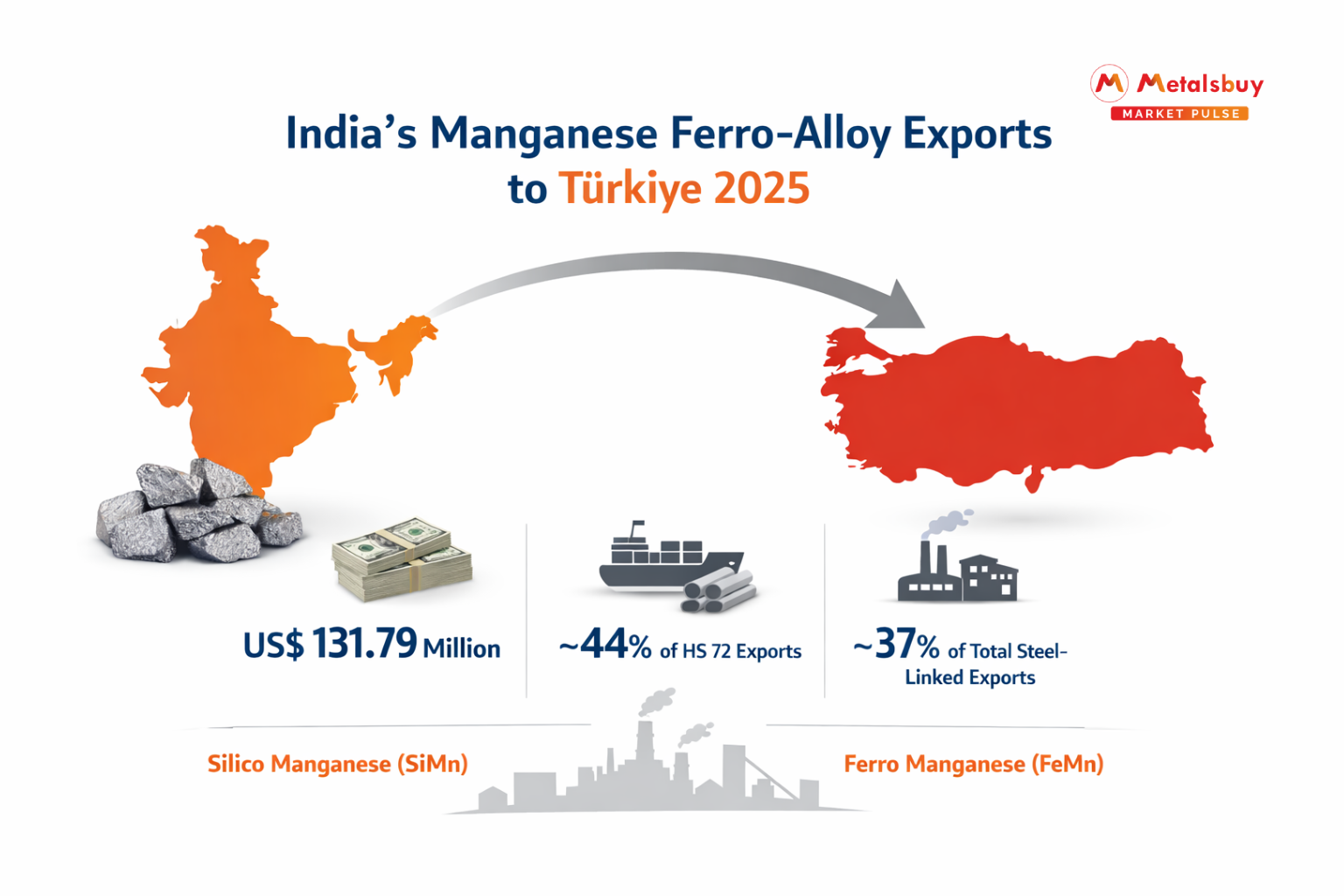
India’s exports of ferro-alloys to Türkiye have reached US$131.79 million in 2025, making ferro-alloys the single largest contributor within the bilateral steel trade basket.
The segment now accounts for nearly 44 percent of India’s HS 72 exports to Türkiye and approximately 37 percent of total steel-linked exports to the country.
This level of concentration is economically significant. It shows that India’s exposure to Türkiye is not broadly diversified across multiple finished steel categories. Instead, it is heavily centered on manganese-based ferro-alloys, particularly Silico Manganese (SiMn) and Ferro Manganese (FeMn).
Production-Linked Demand, Not Consumption-Led Trade
Manganese alloys are used during steel production to improve strength, remove impurities, and maintain chemical balance. They are not final-use products and are not directly tied to construction or retail demand. As a result, export demand for these alloys is determined primarily by steel plant operating levels.
Türkiye typically produces between 35 and 40 million tonnes of crude steel annually, with a significant share allocated to alloy and specialty grades. These grades require consistent manganese inputs during melting and refining.
This means India’s export performance in this segment is closely linked to Turkish steel output. When production levels rise, alloy imports increase. When output slows, imports decline proportionally. The demand is therefore industrial and throughput-driven.
India’s Position Within the Turkish Steel Ecosystem
The dominance of manganese alloys in the trade mix indicates that India’s competitive strength lies upstream in the steel value chain. Rather than exporting large volumes of finished flat or long steel products, India is supplying metallurgical inputs required for Turkish steel production itself.
This positioning embeds Indian exporters within the operational cycle of Turkish mills. The trade is tied to production schedules, furnace utilisation rates, and grade mix requirements, rather than short-term market speculation. Such integration provides structural depth to the corridor, but it also means export volumes are directly sensitive to changes in steelmaking activity.
Contract Structure and Volume Stability
Industry feedback suggests that a meaningful share of manganese alloy exports to Türkiye is conducted under structured supply arrangements rather than purely spot transactions. These arrangements provide relative shipment stability and better visibility on volumes.
However, stability does not eliminate risk. If Turkish crude steel output were to decline by 5 to 10 percent due to weaker export orders or industrial slowdown, manganese alloy imports would likely fall in similar proportion. Export resilience is therefore conditional on sustained production activity.
Key Variables Influencing Forward Demand
The trajectory of India’s manganese ferro-alloy exports to Türkiye will depend on several measurable factors:
-
Turkish crude steel capacity utilisation
-
Demand for stainless and alloy steel products
-
Export performance of Turkish steelmakers
-
Broader industrial conditions in key markets such as Europe
Because manganese alloys are production inputs, their import levels will track these industrial indicators closely.
Metalsbuy Market Pulse Assessment
The US$131.79 million export figure confirms that manganese ferro-alloys form the backbone of India’s steel-linked trade with Türkiye in 2025. The corridor is structurally important, industrially anchored, and directly linked to steel output levels. Its durability will depend less on price volatility and more on the trajectory of Turkish steel production in the coming quarters.