KEY NUMBERS
- Double-Digit Export Growth recorded during April–May FY27
- India's Merchandise Exports (FY26): ~$437 Billion
- Total Exports Including Services (FY26): ~$825 Billion
- Government Target: $2 Trillion Exports by 2030
- Manufacturing Sector Share: More than 60% of merchandise exports
- Major Growth Drivers: Engineering Goods, Petroleum Products, Electronics, Chemicals and Pharmaceuticals
- Export Growth Despite: Weak global manufacturing activity and geopolitical uncertainty
- Outlook: Strong external demand continues supporting India's industrial production
MARKET ANALYSIS
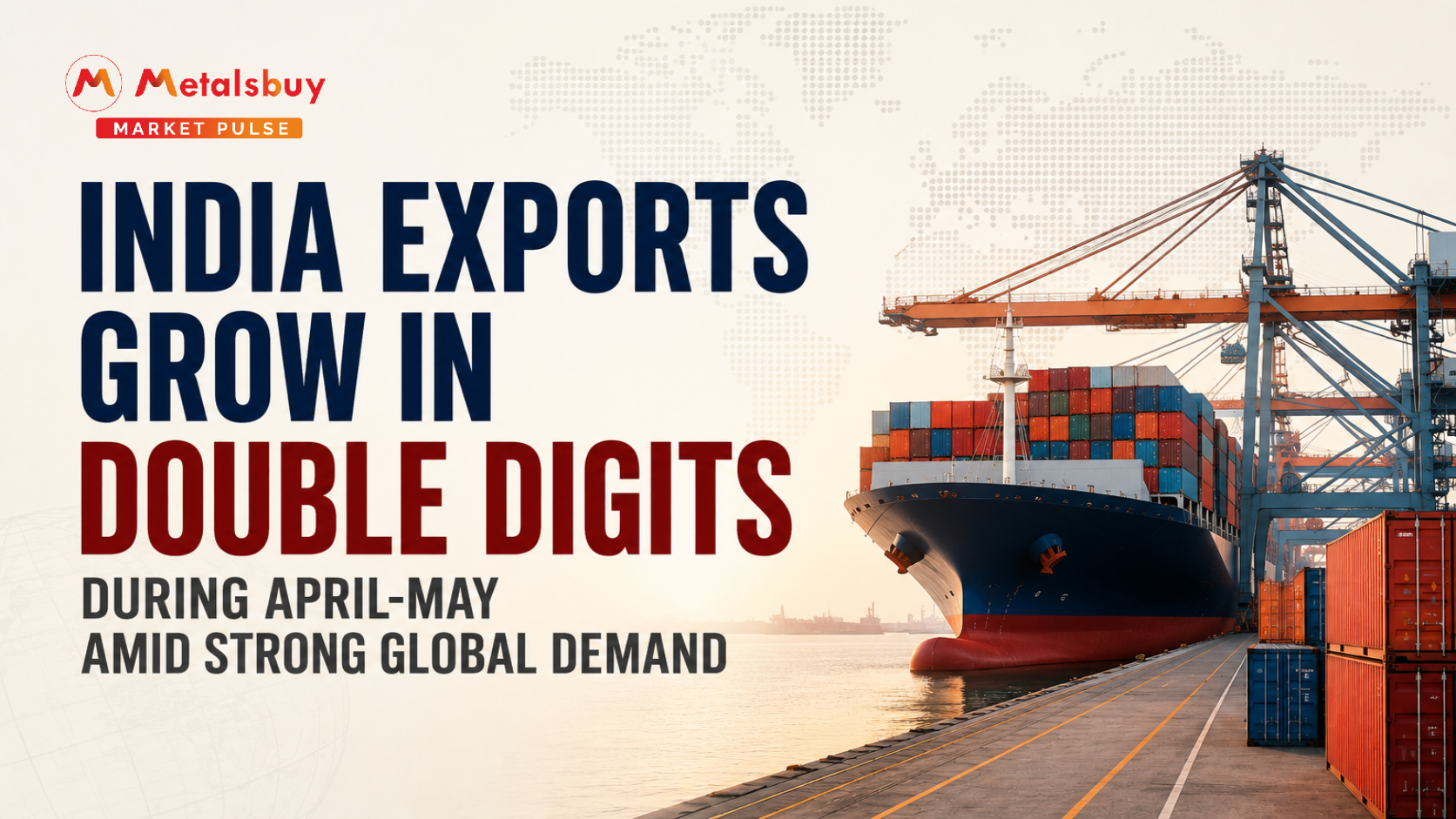
India has started FY27 on a strong note, with exports reportedly registering double-digit growth during April and May despite a challenging global economic environment. The development is particularly significant because it comes at a time when several major economies continue grappling with slower industrial activity, inflationary pressures, supply chain disruptions, and geopolitical uncertainties. Against this backdrop, India's export performance reflects both the growing competitiveness of its manufacturing sector and the diversification of its export basket.
The latest momentum suggests that India's exporters are increasingly benefiting from shifts in global supply chains. Over the past few years, international buyers have actively diversified sourcing strategies to reduce dependence on a single geography. India has emerged as one of the key beneficiaries of this trend, particularly across sectors such as engineering goods, electronics, chemicals, pharmaceuticals, textiles, and refined petroleum products.
What makes the recent export growth even more noteworthy is that it has been achieved despite slower economic activity in several developed markets. Global manufacturing indicators across Europe and parts of Asia have remained under pressure, while trade activity continues to face disruptions arising from geopolitical tensions and elevated logistics costs. Yet Indian exporters have managed to maintain growth momentum, indicating stronger market penetration and expanding international demand.
ENGINEERING GOODS CONTINUE TO LEAD THE STORY
One of the most important contributors to India's export performance continues to be the engineering goods sector. The segment has evolved into India's largest merchandise export category and now plays a critical role in supporting industrial growth and foreign exchange earnings.
Engineering exports include steel products, industrial machinery, automobiles, auto components, capital equipment, fabricated products, and industrial inputs. Strong performance in this category often serves as a reliable indicator of broader manufacturing health because it reflects industrial demand both within India and across export destinations.
For the metals sector, this trend carries particular significance. Higher exports of engineering products generally translate into stronger demand for steel, ferro alloys, aluminum, copper, and other industrial raw materials. The continued expansion of engineering exports therefore supports consumption across the broader metals value chain.
The government's focus on manufacturing initiatives such as Production Linked Incentive (PLI) schemes and infrastructure investments has also contributed to strengthening India's industrial export capability. As production capacity expands across multiple sectors, export opportunities are expected to grow further.
WHAT THIS MEANS FOR THE STEEL INDUSTRY
The export growth story has important implications for India's steel sector. While domestic infrastructure and construction remain major demand drivers, export-oriented manufacturing creates an additional source of steel consumption. Products such as automobiles, engineering equipment, industrial machinery, renewable energy components, and capital goods all require significant volumes of steel during production.
A stronger export environment also improves capacity utilization across manufacturing facilities. When factories operate at higher utilization levels, demand for industrial inputs rises correspondingly. This creates positive spillover effects for steel producers, alloy manufacturers, mining companies, logistics operators, and industrial service providers.
Recent months have witnessed mixed sentiment within global steel markets, with several regions facing pricing pressure due to slower demand growth. However, India's export performance suggests that domestic manufacturing activity remains relatively resilient. This resilience may help support steel demand even if global market conditions remain uneven.
The development is particularly encouraging for secondary steel producers and alloy manufacturers, many of whom depend heavily on industrial production trends. A healthy export sector often provides an important buffer against fluctuations in domestic demand.
PETROLEUM, CHEMICALS AND PHARMACEUTICALS ADD MOMENTUM
Beyond engineering goods, several other sectors have contributed significantly to export growth. Petroleum products continue to remain one of India's largest export categories, benefiting from refining capacity and international demand. Similarly, chemicals and pharmaceuticals have strengthened India's position as a reliable supplier to global markets.
Electronics exports have also emerged as a major success story in recent years. Government incentives and investments from global manufacturers have helped India become an increasingly important production hub for electronic products. The sector's rapid growth has added another layer of diversification to India's export portfolio.
This broad-based participation across multiple sectors is particularly important because it reduces dependence on any single industry. A diversified export structure generally provides greater stability during periods of global economic uncertainty.
EXPORT GROWTH AND THE COMMODITY SECTOR
For commodity producers, stronger exports often create indirect but meaningful benefits. Increased manufacturing activity typically leads to higher consumption of industrial raw materials including steel, ferro alloys, coal, aluminum, copper, and energy products.
The ferro alloy industry, in particular, stands to benefit from sustained export-led manufacturing growth. Steelmaking remains one of the largest consumers of ferro alloys, and stronger industrial output generally supports alloy demand. While the impact may not be immediate, continued export growth strengthens the long-term demand outlook for several commodity segments.
Logistics and port infrastructure providers also benefit from higher trade volumes. Increased movement of goods creates demand for transportation services, warehousing, container handling, and shipping operations, further supporting economic activity.
MARKET OUTLOOK
India's strong export performance during the opening months of FY27 sends a positive signal for the broader industrial economy. The ability to achieve double-digit export growth despite global uncertainties highlights the increasing competitiveness of Indian manufacturing and the growing diversification of export markets.
Looking ahead, export momentum will remain an important factor supporting industrial production, manufacturing investments, and commodity demand. While risks from geopolitical developments, global growth slowdown, and trade disruptions continue to exist, India's current trajectory suggests that exports could remain a significant pillar of economic growth during FY27.
For the metals and commodities sector, the message is encouraging. Stronger exports ultimately translate into stronger industrial activity, higher manufacturing output, and increased demand for raw materials. If the current trend continues, it could provide an important source of support for steel, ferro alloys, and the wider industrial value chain in the months ahead.