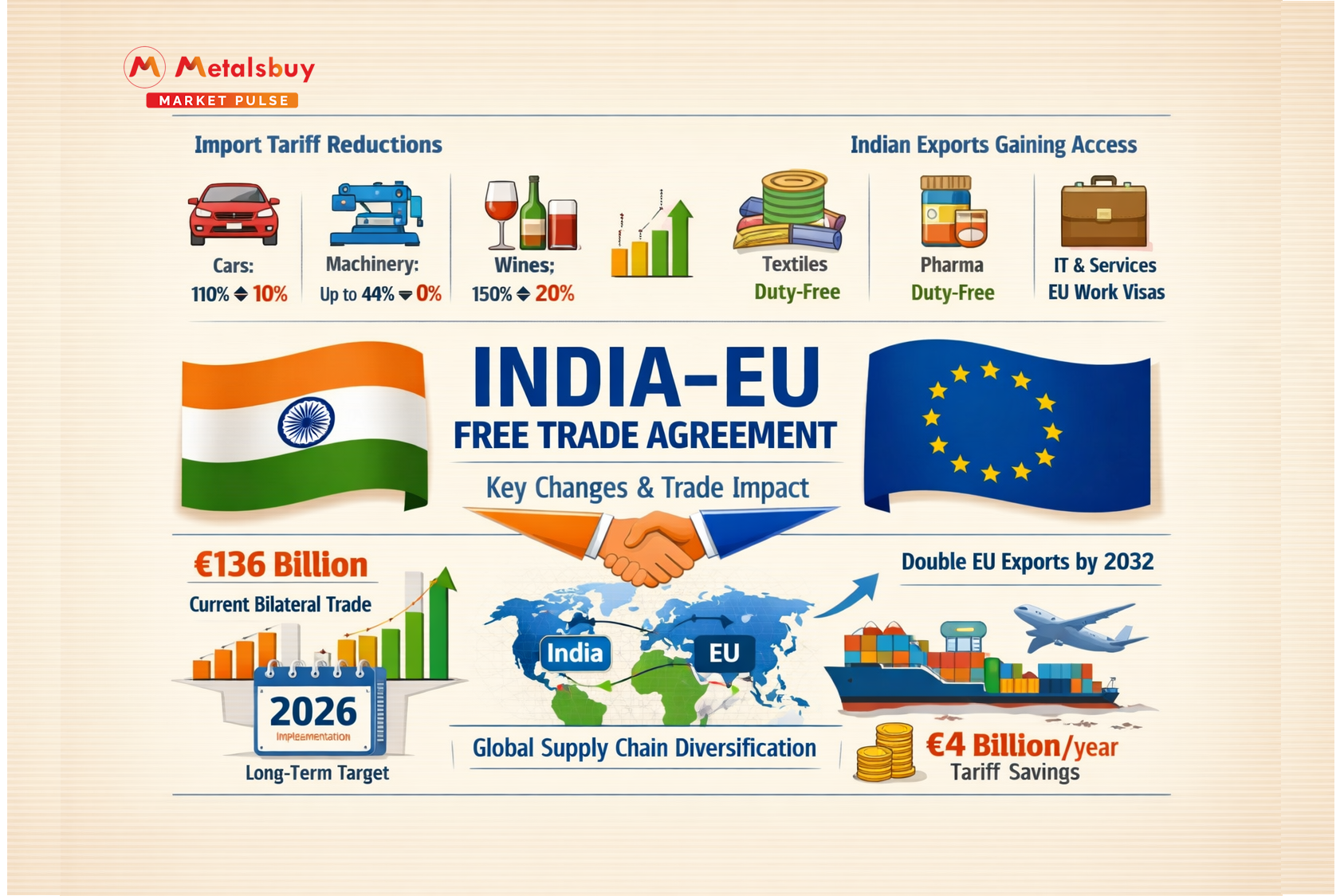
India and the European Union have finalized a comprehensive Free Trade Agreement that significantly lowers trade barriers between the two economies. The deal provides for major import duty reductions in India on automobiles, industrial machinery, wines, and spirits, while granting Indian exporters duty-free access to the EU market for textiles, pharmaceuticals, and select services. The agreement also improves mobility for Indian professionals and supports deeper supply-chain integration. With implementation expected from 2026, the FTA represents a long-term structural shift aimed at expanding bilateral trade, strengthening manufacturing competitiveness, and reducing exposure to global supply-chain risks.
Key Changes Under the India–EU FTA
| Sector / Area | Earlier Position | Change Under FTA |
|---|---|---|
| EU Automobiles | Up to 110% import duty in India | Reduced to 10% (quota: 250,000 units/year) |
| Industrial Machinery | Duties up to 44% | Reduced to 0% |
| Wines | 150% import duty | 75% initially, phased down to 20% |
| Spirits | High import duties | Reduced to 40% |
| Indian Textiles | 10–12% duty in EU | Duty-free access |
| Indian Pharmaceuticals | 6–10% duty in EU | Duty-free access |
| Services (IT, Nursing) | Restricted mobility | Easier workforce access |
| Overall Trade | ~€136 billion (2024–25) | Targeted expansion by 2032 |