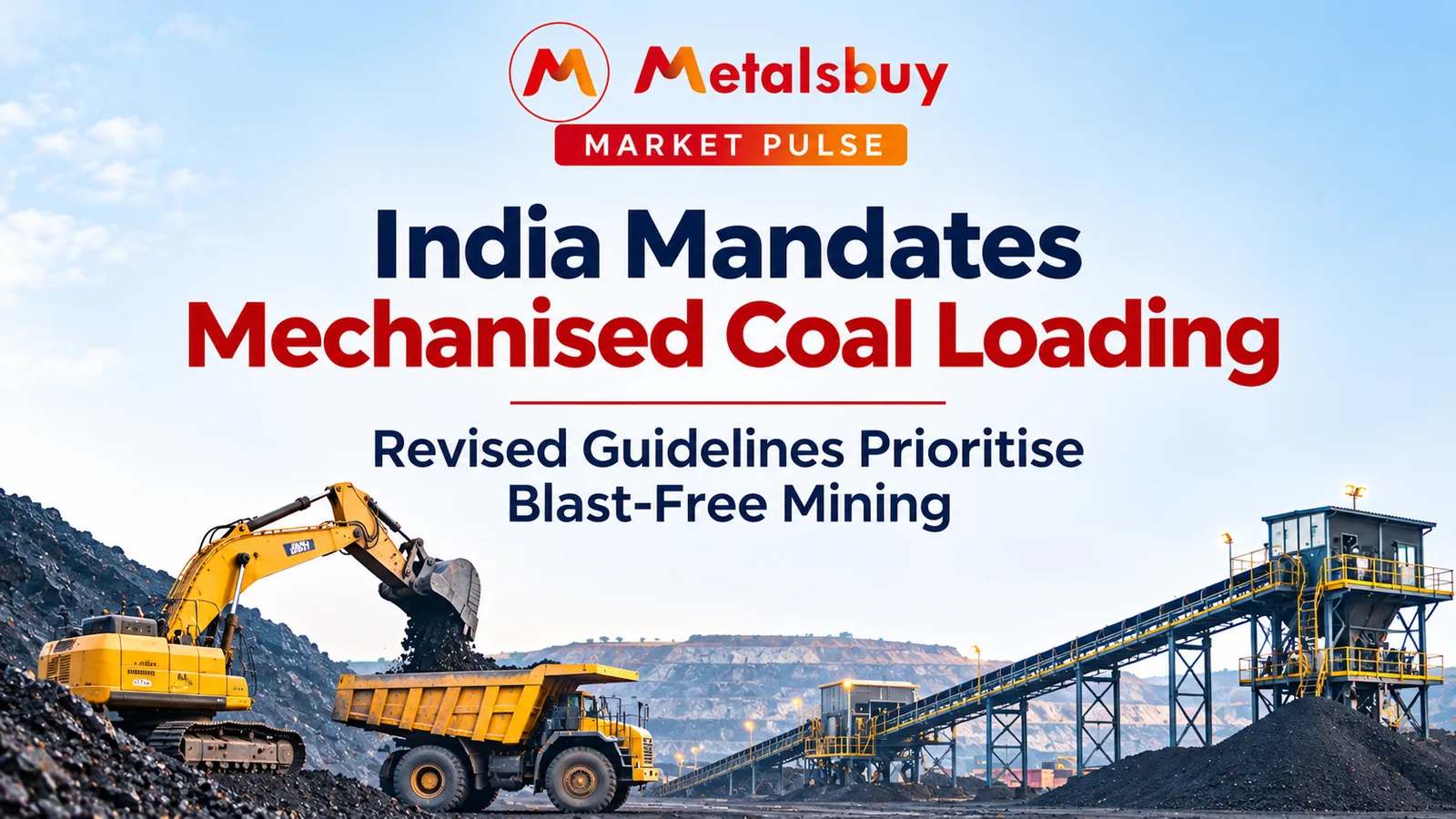
The Ministry of Coal's new mining framework strengthens requirements for mechanisation, transportation and mine planning, with potential long-term implications for coal supply efficiency and India's sponge iron and steel industries.
India's Ministry of Coal has introduced revised guidelines for coal and lignite mining that make mechanised loading infrastructure mandatory and establish blast-free extraction as the standard mining approach, marking an important step towards modernising the country's mining operations. The changes are intended to improve operational efficiency, strengthen environmental safeguards and support more systematic management of coal resources.
The Guidelines for Preparation of Mining Plan and Mine Closure Plan for Coal and Lignite Mines, 2026, issued on November 20 and publicly announced on November 23, will come into effect 30 days after issuance. The framework introduces specific requirements relating to mining technology, coal evacuation infrastructure, safety considerations and environmental management.
The development is particularly relevant to India's energy-intensive manufacturing sector, where domestic coal plays an important role in electricity generation, sponge iron production and other industrial applications. Although the regulations directly govern mining operations rather than steel manufacturers, improvements in coal extraction and transportation efficiency could influence the reliability and economics of industrial coal supply over time.
Mechanised Loading Becomes a Mandatory Requirement
One of the most significant changes is the requirement for all coal and lignite mines to ensure mechanised loading infrastructure. This represents a stronger regulatory position than the earlier framework, under which mechanisation was encouraged as part of efforts to improve mining efficiency and reduce dependence on conventional material handling practices.
Mechanised loading can involve conveyor systems, coal handling plants, silos, automated loading arrangements and other equipment designed to improve material movement from mining operations to dispatch facilities. The appropriate infrastructure will depend on the mine's size, production method, location and transportation arrangements.
For mine operators, implementation may require additional capital investment in equipment and supporting infrastructure. However, greater mechanisation can potentially improve loading consistency, reduce manual handling and support more efficient movement of coal between production and dispatch points.
The Ministry's broader objective is to encourage scientific mining and the adoption of modern technology while maintaining appropriate operational and environmental standards. The effectiveness of these measures will ultimately depend on how consistently they are implemented across individual mining operations.
Blast-Free Mining Becomes the Default Extraction Method
The revised guidelines also establish blast-free extraction as the standard approach for coal and lignite mining. Mine operators are expected to deploy suitable technologies that can extract coal without conventional drilling and blasting wherever technically and commercially feasible.
Technologies such as surface miners and continuous mining equipment can reduce reliance on blasting in suitable geological conditions. These methods may also help improve extraction precision and reduce certain operational disturbances associated with conventional mining, although performance varies according to seam characteristics and site conditions.
Importantly, the new framework does not impose an absolute prohibition on drilling and blasting. Mine operators may continue using conventional methods when blast-free technology is technically unsuitable or commercially unviable, provided they submit appropriate justification for the decision.
This distinction is especially relevant to mines with challenging geological formations or operating conditions where alternative extraction technologies may not provide comparable commercial or technical performance. The regulation therefore combines a stronger preference for modern mining methods with limited operational flexibility.
Larger Mines Must Plan Non-Road Coal Transportation
Another important requirement concerns coal evacuation infrastructure. Mines with a peak rated capacity of 2 million tonnes per annum or more must include provisions in their mining plans for transporting coal through alternatives to road-based movement.
The guidelines state that such arrangements should be implemented within five years of production commencement, as far as practicable. This creates a planning obligation for larger mining projects while recognising that actual implementation may depend on infrastructure development and site-specific constraints.
Rail-linked transportation, conveyor systems and other mechanised evacuation arrangements can improve the movement of coal from mines to industrial consumers and transportation networks. Reducing excessive dependence on road transportation may also help address congestion, material handling losses and logistical inefficiencies in major coal-producing regions.
However, the commercial benefits will not necessarily be immediate. Developing rail sidings, conveyors and integrated handling facilities requires capital expenditure, engineering work and coordination with infrastructure providers.
For industrial coal consumers, the long-term value of these changes will depend on whether improvements in mine-level evacuation translate into more predictable dispatch schedules and competitive delivered coal costs.
Implications for Sponge Iron and Secondary Steel Manufacturers
The revised mining guidelines carry particular significance for India's sponge iron industry, where coal availability, quality and procurement costs strongly influence production economics. Coal-based direct reduced iron plants rely on suitable grades of non-coking coal as both a reductant and an energy source, making consistent supply an important operational requirement.
Manufacturers operating in Chhattisgarh, Odisha and Jharkhand remain sensitive to changes in coal transportation expenses, dispatch reliability and raw material quality. In these regions, the delivered cost of coal can be influenced by several factors beyond the mine price, including rail availability, road transportation, handling charges and distance from the supply source.
Improved mine mechanisation and coal evacuation infrastructure could support greater supply consistency over the longer term. Nevertheless, additional equipment and infrastructure investment may also increase costs for some mining operations, particularly during the implementation phase.
The revised guidelines do not announce a reduction in coal prices, a change in coal allocation policy or a guaranteed increase in production volumes. Consequently, secondary steel manufacturers should distinguish between the potential benefits of improved mining efficiency and actual changes in their procurement costs.
For sponge iron producers, the development reinforces the importance of monitoring domestic coal supply conditions alongside imported coal alternatives, transportation availability and plant-specific quality requirements.
Coal Quality and Supply Reliability Remain Important
Beyond the quantity of coal produced, quality consistency remains an important consideration for industrial consumers. Sponge iron plants require coal with characteristics suitable for their processes, including appropriate calorific value, ash content, volatile matter and other technical properties.
More systematic extraction and handling may help improve material management under suitable operating conditions. However, mechanised loading or blast-free mining does not automatically guarantee higher coal quality, since mineral characteristics are influenced by geological conditions, beneficiation practices and blending arrangements.
The ability of mining companies to deliver material according to required specifications will therefore remain essential. Manufacturers will continue to evaluate suppliers based on both delivered cost and actual operating performance rather than relying on mine-level production improvements alone.
The growing emphasis on coal evacuation infrastructure is equally important because higher mining output has limited commercial value if material cannot be transported efficiently to consumers.
For industrial users, the effectiveness of the new framework will ultimately be measured through tangible improvements in coal availability, dispatch reliability and procurement economics.
Stronger Mine Closure and Environmental Planning
The revised regulations also place additional emphasis on environmental management and mine closure obligations. Mining plans are required to incorporate mine closure planning, including progressive rehabilitation and arrangements for restoring or repurposing mining areas after operations conclude.
The Ministry has introduced clearer approval timelines and reduced the prescribed processing period for reimbursement of eligible mine closure expenditure from escrow accounts to one month after receipt of claims, subject to verification provisions.
These changes are intended to improve regulatory clarity while strengthening accountability for rehabilitation and environmental responsibilities.
For mining companies, the framework reinforces the need to consider environmental expenditure and closure requirements as part of long-term project planning. Such obligations form an important component of mining economics, particularly for operators developing new projects or expanding existing facilities.
The broader objective is to support responsible resource extraction while encouraging the adoption of modern mining practices.
Metalsbuy Market Pulse Analysis
India's revised coal mining guidelines represent an important change in the regulatory approach to extraction, handling and transportation. By mandating mechanised loading and prioritising blast-free mining, the government is attempting to improve operational standards while encouraging technological advancement across the mining industry.
For the domestic coal industry, the transition could create additional demand for mining equipment, mechanised loading systems and integrated transportation infrastructure. The benefits will depend on the ability of operators to implement the requirements efficiently without creating disproportionate financial or operational burdens.
For India's sponge iron and secondary steel manufacturers, the implications are primarily linked to supply-chain efficiency rather than immediate coal price movements. Improved extraction and dispatch practices could eventually support more dependable coal procurement, but actual cost benefits will depend on mining expenses, transportation infrastructure and market conditions.
The transition will be particularly relevant to coal-consuming industrial clusters in Chhattisgarh and Odisha, where raw material supply reliability can influence production planning and working capital requirements.
Manufacturers should therefore monitor the implementation of the new guidelines, particularly investments in coal evacuation infrastructure and changes in dispatch performance across major producing regions.
India's shift towards mechanised and blast-free coal mining could strengthen the long-term efficiency of its coal supply chain, but the real benefit for secondary steel producers will depend on whether regulatory improvements translate into reliable availability, consistent quality and competitive delivered coal costs.
— Metalsbuy Market Pulse | Industry Intelligence & Market Analysis