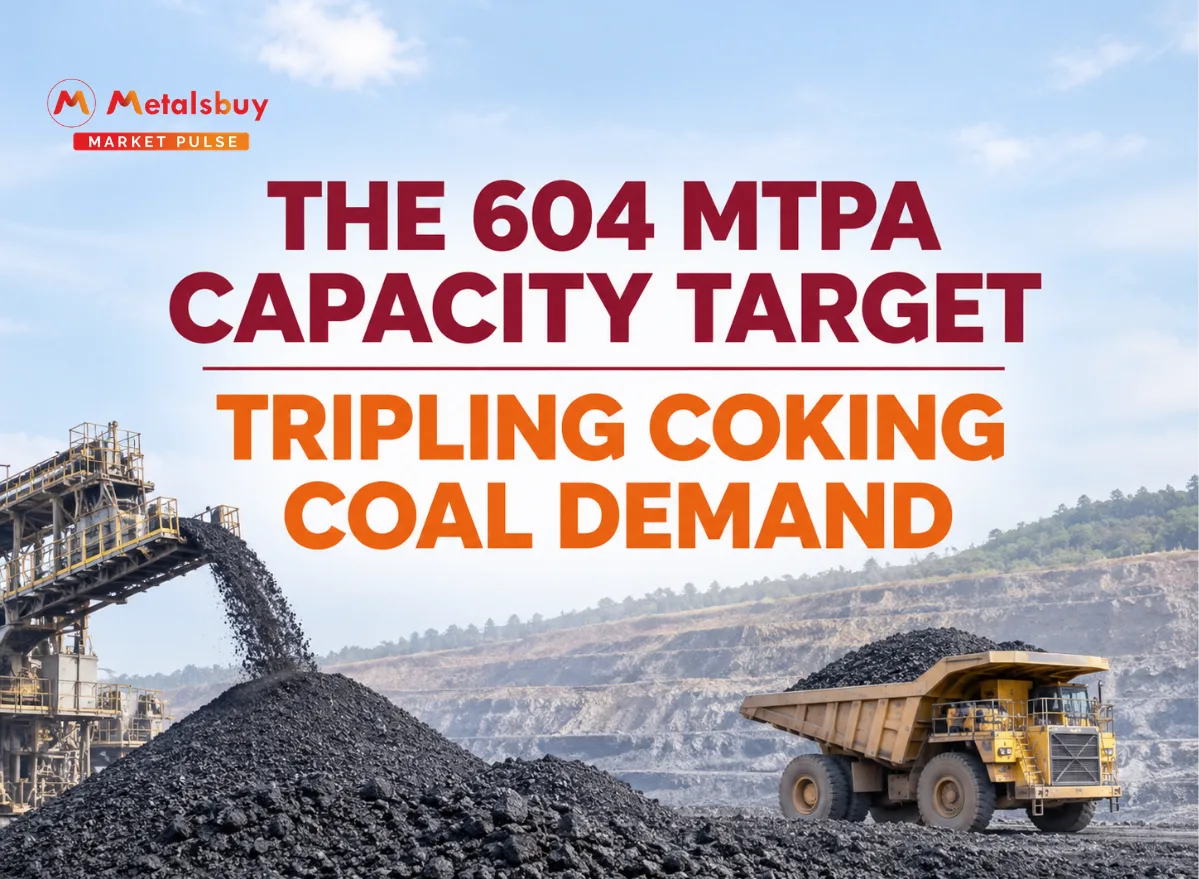
The Indian metallurgical sector is standing at a historic crossroads as it maps out its long-term growth trajectory. A recent strategic analysis released by the Institute for Energy Economics and Financial Analysis has brought the industry's future raw material requirements sharply into focus. The report carefully evaluates the logistical and supply chain realities of feeding India's highly ambitious Draft National Steel Policy target, which aims to achieve an unprecedented 604 million metric tonnes of annual crude steel capacity by 2047. While the institute raises valid concerns regarding the global availability of metallurgical coal required to meet this massive target, industry leaders and policymakers are viewing this assessment as a highly positive catalyst. It provides the exact analytical push needed to accelerate India's transition away from traditional, carbon-heavy blast furnaces toward self-reliant, sustainable green steel technologies.
Assessing the coking coal requirements for massive capacity targets
The core of the recent analytical report centers on the sheer volumetric realities of scaling up traditional steelmaking processes. Currently, the Indian steel industry relies heavily on the blast furnace and basic oxygen furnace route, which accounts for a dominant share of the country’s crude steel output. This specific metallurgical process requires massive, continuous feeds of high-grade coking coal to act as both a reducing agent and a heat source. According to industry data, India currently imports approximately 85 to 90 percent of its metallurgical coal, translating to roughly 55 to 60 million tonnes of inbound seaborne cargo annually.
The Institute for Energy Economics and Financial Analysis points out that to reach the 604 million tonne capacity benchmark by 2047 using the current technological mix, India's coking coal demand would essentially have to triple. Securing over 150 million tonnes of premium metallurgical coal annually from the international market presents a complex logistical and financial puzzle. The report highlights that pushing the global supply chain to accommodate this massive incremental demand could expose domestic integrated steelmakers to severe price volatility and supply-side bottlenecks.
Global supply dynamics and import dependency challenges
Understanding the limitations of the international seaborne market is crucial for shielding domestic producers from future margin compression. The global supply of premium hard coking coal is structurally tight and geographically concentrated. Australian mining conglomerates have historically dominated the export market, supplying the vast majority of India's requirements. However, the report astutely notes that the global metallurgical coal mining sector has suffered from a prolonged period of underinvestment. Stringent environmental regulations and shifting capital allocations toward future-facing green minerals have restricted the development of new, high-yield coking coal mines across traditional hubs like Queensland and North America.
Furthermore, existing mining operations frequently face severe weather-related disruptions, which routinely push benchmark spot prices well above the 250 dollars per tonne threshold. If Indian steelmakers remain completely tethered to this single raw material, scaling up to 604 million tonnes of capacity would require massive foreign exchange outflows and leave corporate balance sheets highly vulnerable to unpredictable international trade shocks.
Pivoting toward domestic solutions and green technology
Rather than interpreting these supply constraints as a roadblock, the Indian manufacturing ecosystem is leveraging these insights to pivot aggressively toward alternative, localized production methods. The potential scarcity of global coking coal acts as a powerful financial incentive for primary steelmakers to rapidly adopt direct reduced iron and electric arc furnace technologies. India is already the world's largest producer of coal-based sponge iron. By upgrading this existing infrastructure and aggressively investing in advanced coal gasification projects, domestic mills can utilize India's abundant reserves of non-coking thermal coal to reduce iron ore, effectively bypassing the need for expensive imported metallurgical coal.
Moreover, the industry is laying the groundwork for true green steel production. Major conglomerates are piloting green hydrogen-based reduction processes. While currently in the early stages of commercialization, replacing coking coal with renewable hydrogen completely neutralizes the carbon footprint of primary ironmaking. Alongside this, the government is heavily pushing a circular economy framework, targeting the processing of over 120 million tonnes of domestic metal scrap annually by 2047. Melting this recycled scrap in electric furnaces requires a fraction of the energy and zero coking coal, presenting a highly lucrative and sustainable pathway for secondary steelmakers to expand their output.
Building a resilient and sustainable industrial future
From a broader macroeconomic perspective, the findings by the Institute for Energy Economics and Financial Analysis perfectly align with India's overarching climate commitments and industrial modernization goals. The necessity to reduce coking coal dependency naturally accelerates the sector's decarbonization efforts. This is an absolute commercial imperative, as major international markets like the European Union are actively implementing carbon border tariffs that will financially penalize high-emission steel imports. By treating the projected coal supply constraints as a strategic warning, Indian steelmakers are being forced to innovate today. Redirecting multi-billion dollar capital expenditures toward scrap recycling, coal gasification, and renewable energy integration guarantees that India's push toward a 604 million tonne capacity will not just be a volumetric triumph, but a sustainable, globally competitive, and deeply self-reliant industrial achievement.