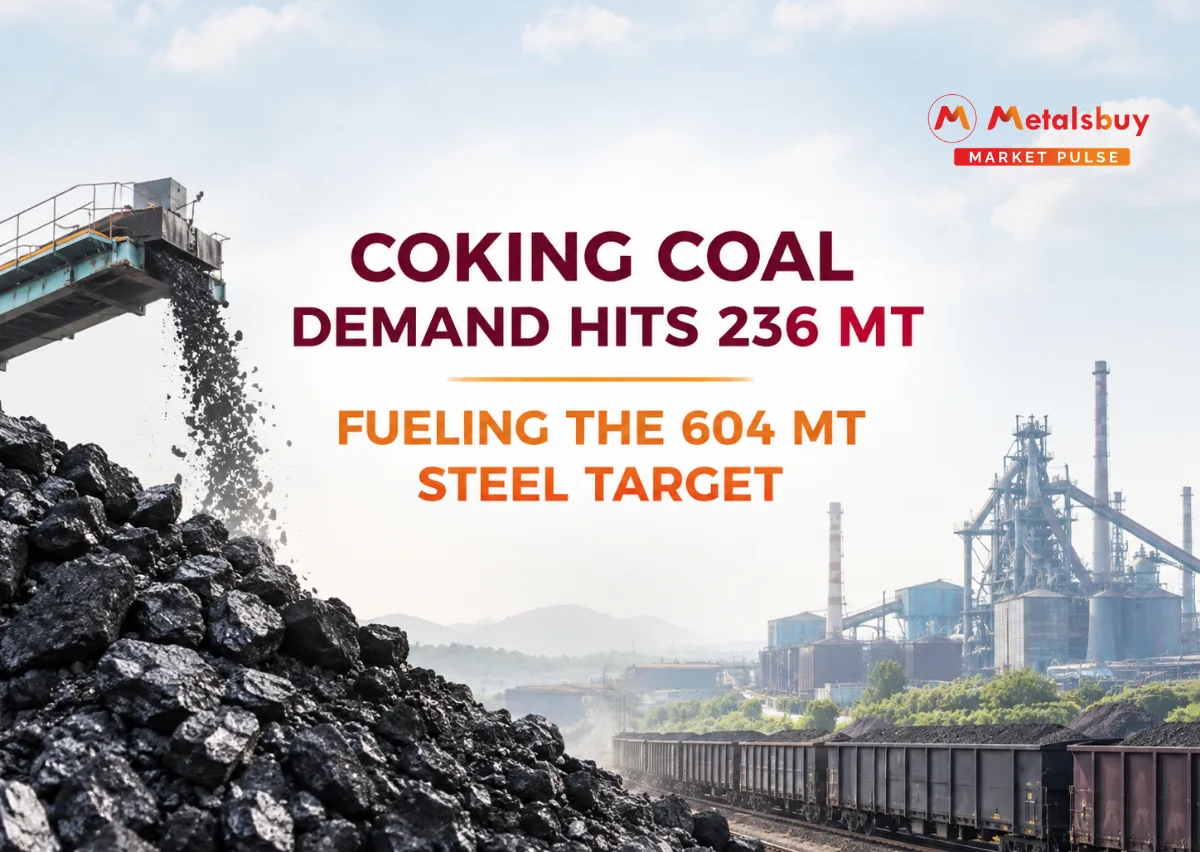
The Indian government has laid out a staggering projection for the future raw material requirements of its booming heavy manufacturing sector. According to the newly released Draft National Steel Policy Vision 2047, the country’s annual demand for coking coal is expected to triple over the next two decades. This massive surge in metallurgical fuel consumption is inextricably linked to the nation's highly ambitious target of expanding its domestic crude steelmaking capacity to 604 million metric tonnes. For the global raw materials market and domestic policymakers, this projection highlights the urgent need to fundamentally restructure and secure India's supply chains to prevent future bottlenecks and protect operational margins.
Soaring demand linked to massive capacity expansion
The core of the draft policy's projection rests on the relentless expansion of India's primary steelmaking infrastructure. The Vision 2047 document outlines a bold roadmap to push the nation's installed crude steel capacity from the current baseline of approximately 220 million metric tonnes to an unprecedented 604 million metric tonnes annually.
To fuel blast furnaces of this magnitude, the requirement for premium metallurgical coal will accelerate sharply. The draft policy projects that annual coking coal demand will skyrocket from roughly 72 million metric tonnes in 2025 to an estimated 236 million metric tonnes by 2047. Coking coal is a non-negotiable, essential ingredient in traditional steel manufacturing. When processed into metallurgical coke, it acts as both the primary heat source and the vital reducing agent necessary to strip oxygen from iron ore inside the blast furnace. Correspondingly, the policy also anticipates a massive parallel surge in iron ore consumption, expecting demand to hit 772 million metric tonnes by 2047, up from 299 million metric tonnes.
Mitigating heavy reliance on international seaborne imports
The most pressing challenge highlighted by these staggering projections is India's acute lack of high-grade domestic coking coal reserves. Currently, the domestic steel industry is forced to import approximately 92 percent of its coking coal requirements from the international seaborne market, heavily relying on traditional hubs like Australia and North America.
This near-total import dependency exposes Indian steelmakers to severe financial and operational vulnerabilities. Sudden weather disruptions in global mining regions or unexpected spikes in international freight rates frequently cause raw material costs to fluctuate wildly, directly compressing the profit margins of domestic mills. To neutralize this structural weakness, the Draft National Steel Policy proposes a multi-pronged approach to raw material security. The government is strongly advocating for the aggressive expansion of domestic coal mining and the establishment of advanced coal washeries to improve the yield and quality of locally extracted minerals.
Diversifying supply channels and leveraging modern technology
Recognizing that domestic extraction alone cannot bridge a 236 million metric tonne deficit, the draft policy outlines highly proactive international procurement strategies. The government plans to actively encourage Indian steel conglomerates and state-owned enterprises to pursue the strategic acquisition of overseas mining assets. By securing equity stakes in international coking coal mines, Indian manufacturers can guarantee a steady, cost-controlled flow of raw materials back to the subcontinent. Furthermore, the policy stresses the importance of diversifying supply corridors, establishing long-term supply agreements with emerging exporters like Russia and Mongolia to break the historical reliance on a single geographic region.
In a significant nod to modern operational efficiency, the draft also identifies the deployment of artificial intelligence and advanced data analytics as critical tools for the future. By utilizing AI to optimize complex coal blending processes at the factory level, domestic mills can maximize their use of lower-grade, cheaper domestic coal without compromising the thermal integrity or efficiency of their blast furnaces.
Balancing heavy production with emission reduction targets
From a macroeconomic perspective, the projected surge in coking coal consumption presents a complex environmental challenge. The Indian steel industry must navigate the delicate balance of tripling its production capacity while simultaneously adhering to increasingly strict national and global decarbonization mandates.
The Draft National Steel Policy addresses this by establishing firm efficiency benchmarks. Alongside massive production growth, the policy seeks to structurally lower the sector's average emissions intensity. The target is to reduce emissions from the current average of 2.54 metric tonnes of carbon dioxide to approximately 1.54 metric tonnes of carbon dioxide per metric tonne of crude steel produced by 2047. Achieving this reduction in emissions intensity, even while overall fuel consumption triples, will require massive capital investments in energy-efficient furnace technologies, widespread adoption of green hydrogen where feasible, and significant improvements in raw material quality. As the Ministry of Steel opens the draft for public consultation until late October 2026, the industry is closely evaluating how these massive projections will reshape capital deployment and global trade routes for decades to come.