In a rapidly shifting global energy landscape, India is taking decisive steps to safeguard its economic momentum against regional supply chain bottlenecks. As geopolitical tensions temporarily constrain international gas supplies, the nation is proactively transforming an external hurdle into a sweeping infrastructural advantage. At the heart of this pivot is an aggressive, data-backed initiative to expand India's Liquefied Natural Gas (LNG) storage and regasification capacity. This move is specifically designed to shield the domestic market from volatile external shocks while ensuring uninterrupted, price-stable growth for its core industrial sectors.
The core advantage of this development lies in India’s forward-thinking approach. Rather than merely reacting to the recent pause in gas supplies from the Middle East, Indian energy conglomerates are leveraging this moment to build a robust, self-reliant energy buffer that will fundamentally upgrade the country's energy security architecture.
Navigating the Supply Pause with Strategic Precision
To understand the magnitude of India’s infrastructural response, one must look at the immediate catalyst and the sheer volume of energy involved. India currently imports roughly half of its natural gas requirements, utilizing it to generate electricity, produce agricultural fertilizers, and fuel millions of households and CNG vehicles. In the 2024-2025 financial year, India imported over 27 million metric tonnes of LNG. Historically, Qatar has been the bedrock of these imports, supplying 11.2 million tonnes—or roughly 41 percent of India’s total incoming LNG—followed closely by the United Arab Emirates.
However, recent geopolitical events in early 2026 created a severe bottleneck in the Strait of Hormuz, effectively shutting off 17 percent of Qatar’s LNG export capacity. For India, the impact was immediate. Petronet LNG Ltd, India’s largest gas importer, typically receives a highly reliable stream of 9 to 10 cargoes per month from Qatar under a 7.5 million tonnes per annum long-term contract. With zero cargoes arriving from key Gulf suppliers in March and April, the global spot market experienced severe price volatility. Spot prices, which had been comfortably stable, briefly spiked to a staggering $24 to $25 per million British thermal units (MMBtu) before easing back down to around $16 per MMBtu.
Because India’s domestic demand is highly sensitive to price fluctuations, the government and industry leaders recognized that relying purely on transit routes was no longer viable. An accelerated physical hedge was urgently required.
Funding a Resilient Infrastructure Network
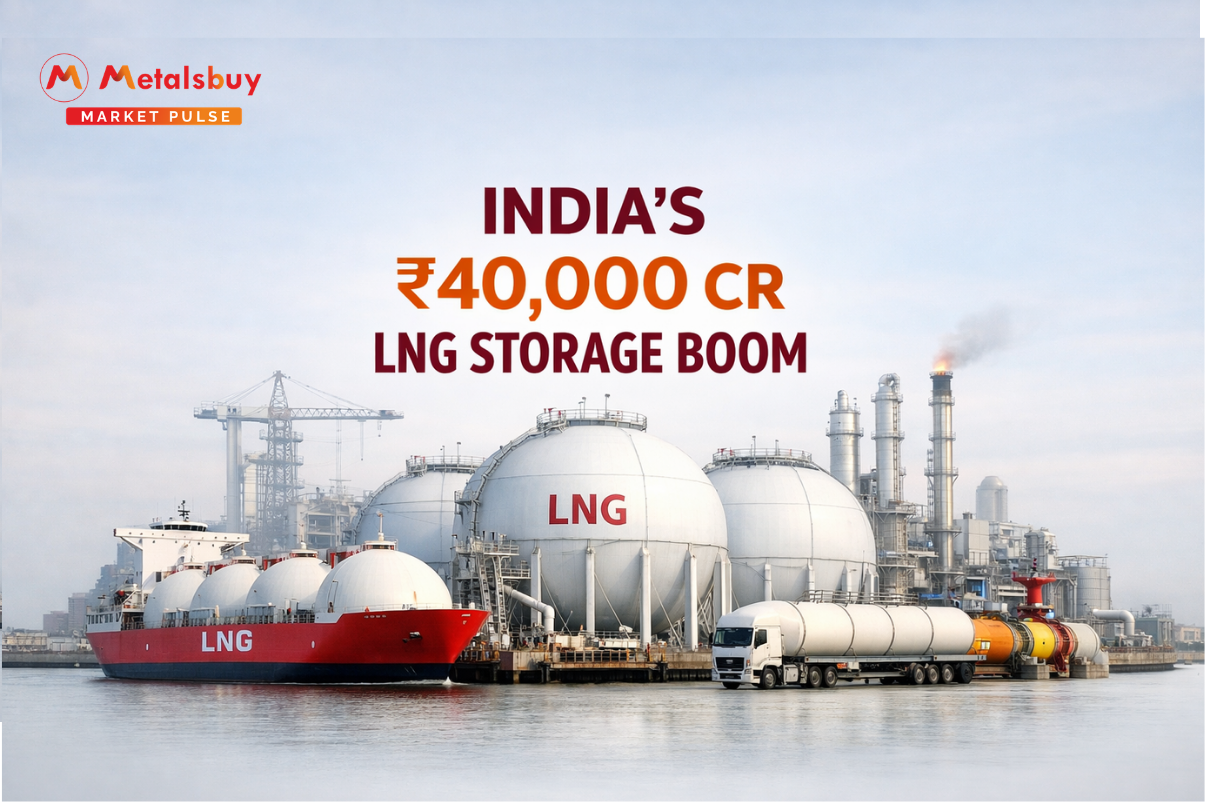
Rather than waiting for global tides to settle, India is aggressively expanding its physical footprint with deep financial commitments. Petronet LNG has outlined a sweeping investment blueprint of approximately Rs 40,000 crore to fortify its domestic and international supply chain over the next few years.
The data behind this domestic expansion reveals a meticulously calculated strategy. Currently, India houses a total of 23 LNG storage tanks, out of which Petronet operates 10. During the recent fiscal year, these facilities efficiently handled 26.5 million tonnes of imported fuel. To boost this buffer, Petronet recently commissioned an upgrade at its flagship Dahej import facility in Gujarat, increasing its regasification capacity from 17.5 to 22.5 million metric tonnes per annum. The company is actively investing an estimated Rs 1,250 crore to construct additional storage tanks at the Dahej site to complement the existing eight tanks.
Simultaneously, expansions are taking root across the coastline. At the Kochi terminal in Kerala, which currently manages 5 million tonnes through two tanks, plans are underway to integrate an additional storage unit to better serve the southern corridor. On the eastern seaboard, Petronet has committed Rs 1,600 crore to deploy a 4 million tonne floating storage and regasification unit at Gopalpur in Odisha. This floating facility is programmed to eventually transition into a permanent 5 million tonne land-based terminal, complete with two massive new storage tanks. In total, seven state-of-the-art tanks are on the drawing board to drastically increase the volume of physical gas held on Indian soil.
Market Agility and the Road Ahead
The resilience of India’s energy sector has also been vividly demonstrated by its rapid market pivot. When traditional supplies stalled in early 2026, Indian aggregators immediately diversified their import basket. Shipments from Oman surged by over 160 percent to reach 585,000 tonnes in April, while supplies from Nigeria and the United States saw massive upticks. This agility ensured that priority sectors like city gas distribution faced minimal disruptions, even as overall domestic demand was temporarily rationalized.
Looking ahead, the future outlook is overwhelmingly positive. Qatari officials have assured New Delhi that their core supply infrastructure remains intact and that full shipments will resume as regional stability is restored. Furthermore, the two nations recently secured a $78 billion agreement to extend gas supplies for another 20 years starting in 2028.
India is using the current disruption not as a setback, but as a vital stress test. By rapidly building out its tank capacity, Indian aggregators will soon be able to capitalize on periods of low international prices by buying bulk spot fuel and storing it domestically. This initiative aligns perfectly with the government's broader vision of increasing the share of natural gas in its energy mix from 6 percent to 15 percent by 2030. Ultimately, India’s massive capital injection into LNG storage is a profound statement of economic sovereignty, guaranteeing that its industrial engine will continue to hum smoothly regardless of geopolitical storms brewing across the oceans.