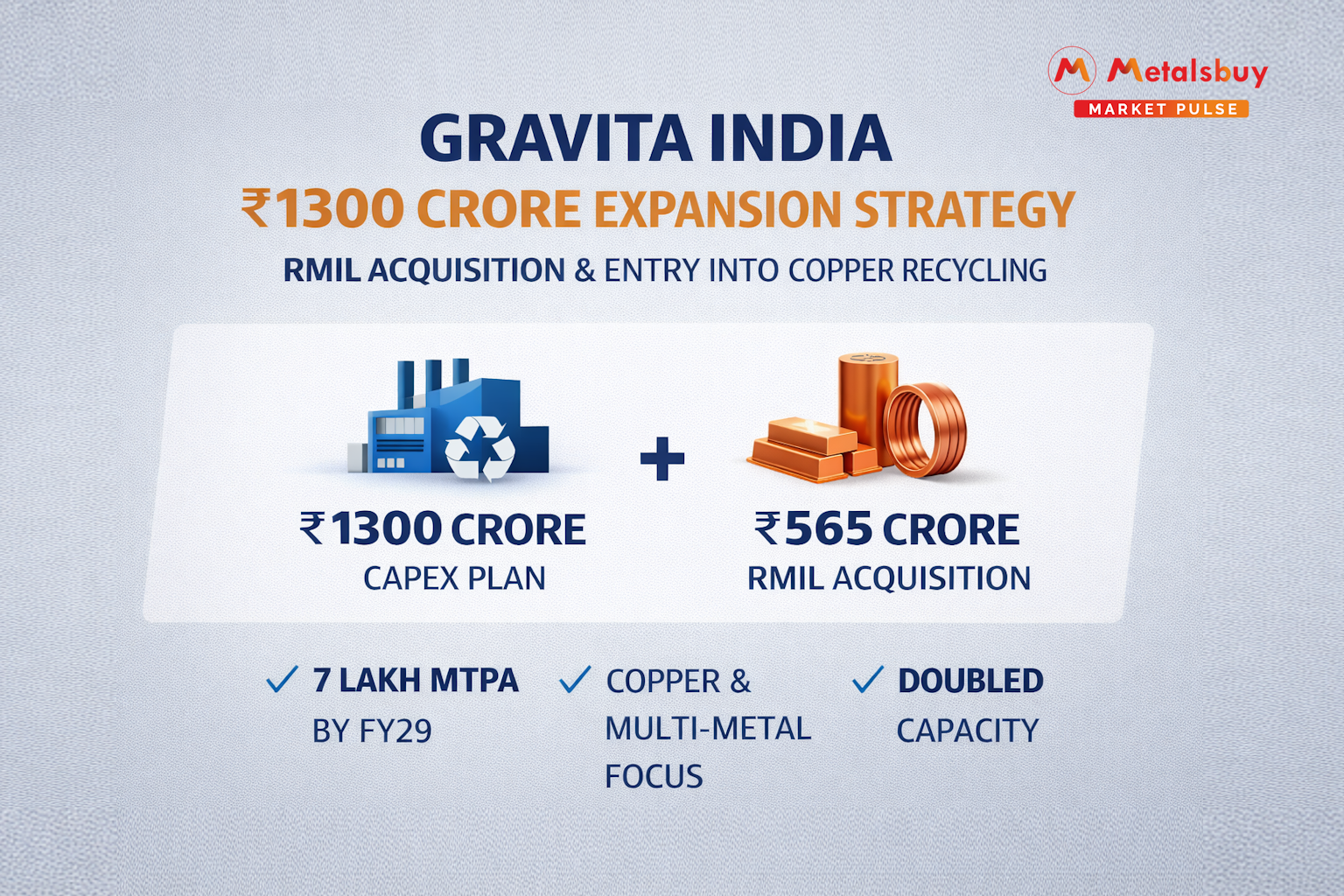
India’s recycling major Gravita India Ltd has moved decisively to operationalise its previously announced ₹1200 to ₹1300 crore expansion roadmap, signalling a structural shift from a lead dominated recycler to a diversified multi metal circular economy platform.
The company recently signed a binding term sheet to acquire up to 100 percent stake in Rashtriya Metal Industries Ltd for approximately ₹565 crore cash consideration, marking Gravita’s formal entry into the copper and copper alloys segment. The deal is expected to close by March 31 2026 subject to regulatory approvals and due diligence.
This acquisition is not an isolated transaction. It is a key pillar of Gravita’s larger ₹1300 crore capacity expansion strategy aimed at nearly doubling its processing scale by FY29.
1. The Expansion Blueprint Scaling from 3.3 Lakh to 7 Lakh MTPA
Gravita’s current consolidated recycling capacity stands at approximately 3.3 lakh metric tonnes per annum across lead, aluminium, plastic and rubber recycling verticals.
Under the announced roadmap:
• Target capacity by FY29 approximately 7 lakh MTPA
• Total capex outlay approximately ₹1300 crore
• Volume CAGR target above 25 percent
• Profit CAGR target above 35 percent
• ROIC target above 25 percent
This implies incremental addition of nearly 3.7 lakh MTPA capacity over the next three financial years.
Analytical Insight
If executed successfully, Gravita’s capacity expansion represents more than 100 percent growth in operational scale within four years. In the recycling industry where regulatory approvals and feedstock security often limit rapid expansion, this scale up is structurally significant.
2. Copper The Strategic Diversification
The acquisition of Rashtriya Metal Industries Ltd introduces copper and copper alloys into Gravita’s portfolio at a time when copper demand is structurally strengthening due to electric mobility, renewable energy expansion and grid infrastructure upgrades.
Copper recycling plays a critical role in global supply chains because copper can be recycled indefinitely without performance degradation.
Strategic advantages of copper entry include:
• Reduced revenue concentration risk from lead
• Exposure to high growth energy transition sectors
• Enhanced margin profile through value added alloy manufacturing
• Stronger export positioning in non ferrous segments
Analytical Insight
Copper alloys typically deliver better EBITDA per tonne compared to basic scrap melting operations. If integration is executed efficiently, Gravita’s overall blended margin could strengthen despite commodity price volatility.
3. Financial Momentum Supporting Capex
Recent quarterly performance indicates operational strength:
• Net profit growth approximately 25 percent year on year
• Revenue growth supported by higher volumes
• Stable operating margins despite metal price fluctuations
This profitability provides internal accrual support for phased capex deployment.
Assuming a phased three year expansion:
• Average annual capex deployment approximately ₹400 to ₹450 crore
• Mix of internal accruals and structured debt funding
• Manageable leverage assuming stable operating cash flow
4. Multi Metal Circular Strategy
Post expansion Gravita’s portfolio spans:
• Lead recycling
• Aluminium recycling
• Plastic recycling
• Rubber recycling
• Lithium ion battery recycling
• Copper and copper alloys
This positions the company as a diversified recycling platform aligned with India’s circular economy push and import substitution objectives.
India remains dependent on refined metal imports across several non ferrous segments. Domestic recycling expansion improves supply resilience and reduces trade exposure.
5. Financial Projection Scenario FY29
Below is an illustrative projection based on announced capacity targets and conservative margin assumptions. This is an analytical scenario and not company guidance.
Assumptions
• Capacity reaches 7 lakh MTPA by FY29
• Capacity utilisation at 85 percent
• Average blended realisation ₹220000 per tonne
• EBITDA margin 9 percent
• Net profit margin 5 percent
Financial Projection Table FY29 Scenario
| Metric | FY25 Estimated | FY29 Projected Scenario |
|---|---|---|
| Installed Capacity | 3.3 lakh MTPA | 7 lakh MTPA |
| Capacity Utilisation | 80 percent | 85 percent |
| Sales Volume | 2.64 lakh tonnes | 5.95 lakh tonnes |
| Average Realisation | ₹210000 per tonne | ₹220000 per tonne |
| Revenue | ₹5544 crore | ₹13090 crore |
| EBITDA Margin | 8 percent | 9 percent |
| EBITDA | ₹444 crore | ₹1178 crore |
| Net Profit Margin | 4 percent | 5 percent |
| Net Profit | ₹222 crore | ₹654 crore |
Analytical Interpretation
Under this scenario revenue more than doubles while EBITDA nearly triples due to operating leverage and scale benefits. Return on invested capital could exceed 25 percent if margin stability is maintained.
Even if realisations fluctuate with commodity cycles, higher scale combined with portfolio diversification improves resilience.
6. Risks to Monitor
• Scrap feedstock availability and pricing volatility
• Copper price cycles affecting alloy margins
• Integration risks with RMIL
• Debt management during expansion
• Global industrial demand cycles
Recycling profitability depends more on spread management than outright metal prices. Efficient procurement and cost control will determine expansion success.
Outlook
Gravita India’s ₹1300 crore expansion plan anchored by its copper sector entry marks a structural inflection point in India’s non ferrous recycling landscape.
Rather than incremental growth, the company is pursuing transformational scale backed by diversification, operational momentum and disciplined capital deployment.
If execution aligns with ambition, Gravita could emerge as one of India’s largest integrated multi metal recycling platforms by FY29.
For the metals market, this signals accelerating consolidation and increasing capital intensity in the recycling sector. Companies that scale early may define pricing power and supply chain leadership in the coming decade.