Key Numbers
-
Innovation: Green Concrete using LD Slag-based Manufactured Sand (M-Sand)
-
Raw Material: Linz-Donawitz (LD) Steel Slag
-
Concrete Grades Developed: M15, M20 and M25
-
Material Usage: Nearly 1 tonne of LD slag-based M-sand per cubic metre of concrete
-
Standards Followed: IS 10262 and IS 456
Market Analysis
Tata Steel Advances Circular Economy Through Green Concrete Innovation
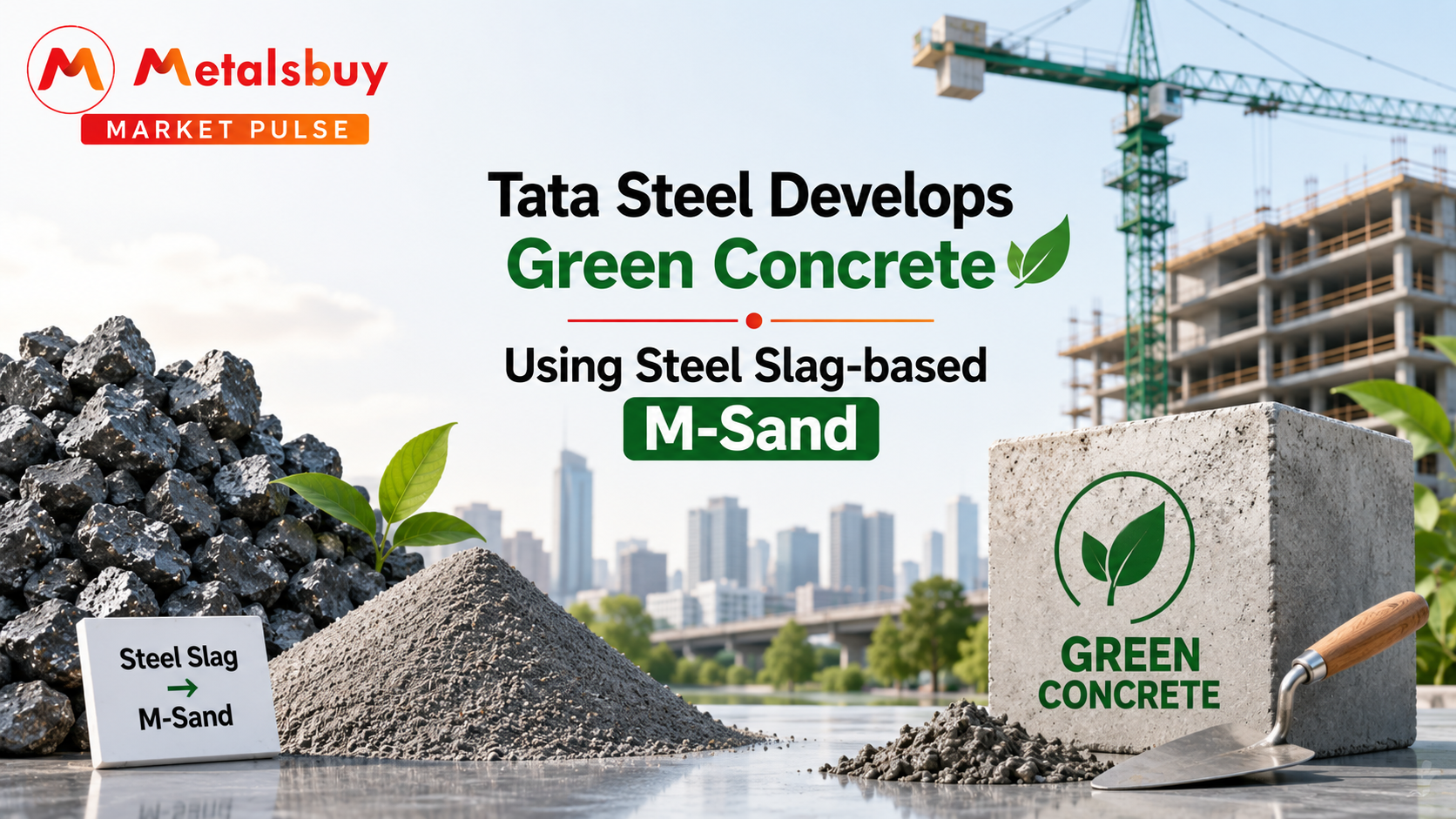
Tata Steel has developed an innovative green concrete using manufactured sand (M-sand) produced from Linz-Donawitz (LD) steel slag, marking another important step in the company's efforts to promote sustainable construction and circular economy practices. The innovation transforms one of the steel industry's largest by-products into a high-value construction material, reducing dependence on natural river sand while improving the utilisation of industrial waste. The project was developed by Tata Steel's Industrial By-Products Management Division (IBMD) in collaboration with Tata Steel UISL.
The initiative demonstrates how steelmaking by-products can contribute beyond the steel industry itself. Instead of treating LD slag as waste, Tata Steel has engineered it into manufactured sand suitable for producing structural concrete, creating both environmental and economic value while supporting India's growing infrastructure sector.
Steel Slag Finds a High-Value Construction Application
LD slag is generated during the basic oxygen furnace steelmaking process and has traditionally been used in applications such as road construction, cement manufacturing and aggregates. By processing this slag into manufactured sand, Tata Steel has expanded its application into ready-mix concrete, where natural sand has long been the preferred fine aggregate.
The newly developed concrete mixes have been designed for M15, M20 and M25 grades in accordance with Indian Standards IS 10262 and IS 456. According to Tata Steel, each cubic metre of concrete utilises approximately one tonne of LD slag-based M-sand, significantly reducing the requirement for natural sand extraction while increasing the productive utilisation of steelmaking by-products.
Supporting Sustainable Construction
Construction remains one of the largest consumers of natural resources, particularly sand and cement. Rapid urbanisation and infrastructure development have significantly increased pressure on natural sand reserves, making manufactured alternatives increasingly important. By substituting natural sand with processed steel slag, the innovation addresses two environmental challenges simultaneously—industrial waste management and conservation of natural resources.
Beyond sustainability, Tata Steel has reported that the new concrete exhibits good cohesiveness, pumpability and workability retention for up to two hours. Laboratory testing and field validation have also confirmed satisfactory performance, indicating that the material is suitable for practical construction applications without compromising engineering requirements.
Circular Economy Gains Momentum in the Steel Industry
Steel producers worldwide are increasingly focusing on circular economy initiatives as part of their decarbonisation strategies. Rather than viewing slag as a disposal challenge, companies are investing in technologies that convert by-products into commercially valuable materials for the cement, construction and infrastructure sectors.
Tata Steel has been among the pioneers in this area, having previously introduced branded LD slag products for roads, fly ash bricks and clinker manufacturing. The latest development further strengthens the company's portfolio of sustainable construction materials while demonstrating how industrial symbiosis can reduce waste and improve resource efficiency across sectors.
Opportunities for India's Infrastructure Sector
India's infrastructure pipeline continues to expand rapidly through highways, railways, urban development, industrial corridors and affordable housing projects. These sectors consume enormous quantities of concrete every year, creating significant demand for sustainable construction materials. Innovations such as slag-based M-sand could therefore play an increasingly important role in supporting environmentally responsible infrastructure development.
Greater adoption of such technologies may also reduce pressure on river sand mining, an issue that has attracted increasing regulatory attention across several states. If commercially scaled, steel slag-based manufactured sand could become an important supplementary raw material for the country's growing construction industry while simultaneously improving steel plant waste utilisation.
Innovation Strengthens ESG and Decarbonisation Goals
The development aligns with Tata Steel's broader sustainability strategy focused on resource efficiency, waste minimisation and lower carbon construction materials. Globally, steelmakers are increasingly collaborating with cement and construction companies to identify new applications for blast furnace slag, basic oxygen furnace slag and electric arc furnace slag as part of industrial decarbonisation efforts.
Although green concrete alone will not eliminate emissions from the construction sector, innovations that replace virgin raw materials with industrial by-products contribute meaningfully towards reducing environmental impact. Such initiatives also demonstrate how steel companies can create additional value beyond conventional steel production by developing integrated solutions for the broader infrastructure ecosystem.
Industry Impact
The successful development of green concrete using LD slag-based M-sand represents an important advancement for both the steel and construction industries. It highlights how industrial by-products can be transformed into commercially viable materials while supporting sustainable infrastructure development. Wider adoption of similar technologies could reduce dependence on natural resources, improve waste utilisation and strengthen circular economy practices across India's manufacturing sector.
Outlook
As India continues investing heavily in infrastructure and urban development, demand for sustainable construction materials is expected to increase steadily. Steelmakers are likely to continue exploring higher-value applications for industrial by-products, creating new opportunities across the cement, aggregates and construction industries.
For Tata Steel, the latest innovation reinforces its position as a leader in sustainable steelmaking and circular economy initiatives. If adopted on a larger commercial scale, slag-based green concrete could become an important component of India's transition towards lower-carbon infrastructure and resource-efficient construction practices.
Disclaimer: This analysis is based on publicly available information and independently verified industry reports. Product adoption and commercial deployment will depend on customer acceptance, regulatory approvals and future market developments.