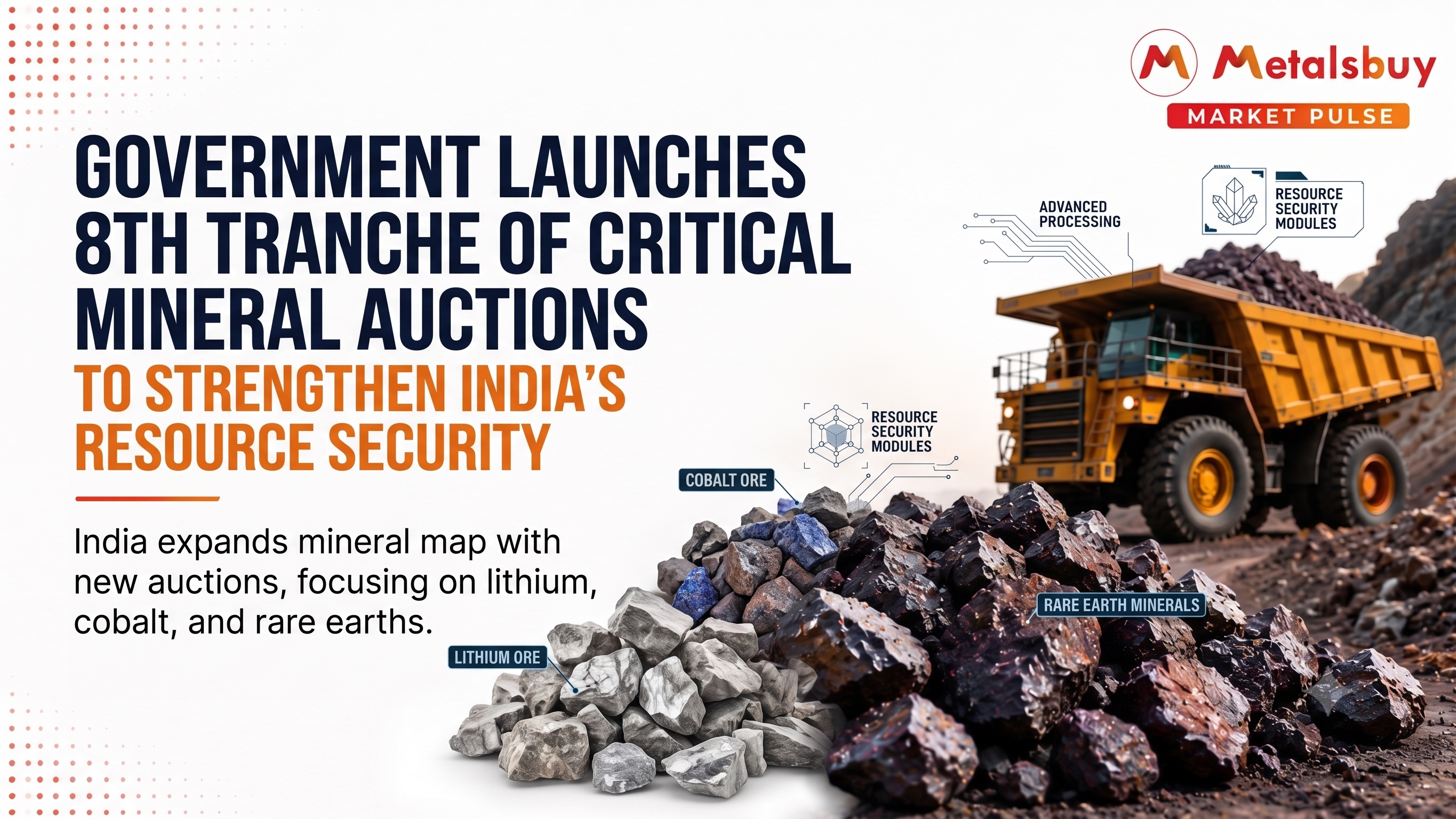
As India accelerates its transition towards clean energy and advanced manufacturing, securing a reliable supply of critical minerals has become a national priority. In line with this objective, the Ministry of Mines has launched the 8th Tranche of Critical and Strategic Mineral Block Auctions, offering 20 mineral blocks across nine states. The latest auction aims to attract private investment, reduce import dependence, and strengthen domestic availability of minerals that are essential for sectors such as electric vehicles, renewable energy, defence, electronics, aerospace, and advanced steel manufacturing.
Key Highlights
- 20 critical and strategic mineral blocks put up for auction.
- Blocks are spread across 9 Indian states.
- 13 newly identified blocks and 7 re-auctioned blocks.
- Minerals include Lithium, Rare Earth Elements (REE), Graphite, Vanadium, Gallium, Titanium, Tungsten, Molybdenum, Potash, Phosphorite, Cesium and Rubidium.
- Auction to be conducted through a transparent online two-stage ascending forward bidding process.
- Tender document sales began on 15 July 2026, while bid submissions close on 21 September 2026.
India's Push Towards Mineral Self Reliance
Critical minerals have become the backbone of modern industrial economies, supporting everything from lithium-ion batteries and wind turbines to semiconductors and defence equipment. India has traditionally relied heavily on imports for many of these strategic minerals, exposing industries to geopolitical risks and supply chain disruptions. Through successive auction rounds, the Government is creating a transparent framework that encourages private participation while building long-term domestic mining capacity. With this eighth tranche, India continues its effort to establish resilient supply chains capable of supporting future industrial growth.
The current tranche includes a diverse portfolio of mineral assets located across Andhra Pradesh, Arunachal Pradesh, Chhattisgarh, Jharkhand, Karnataka, Maharashtra, Odisha, Rajasthan, Telangana, Punjab and West Bengal, covering a broad spectrum of high-value strategic resources. These minerals are increasingly becoming indispensable for clean energy technologies, high-performance alloys, fertilisers, electronics, and aerospace applications. By bringing more exploration and mining opportunities to the private sector, the Government aims to accelerate resource development while reducing India's dependence on imported raw materials.
Why It Matters for the Steel and Mining Industry
Although several minerals in the auction are primarily associated with battery manufacturing and renewable energy, the initiative also carries significant implications for the steel industry. Minerals such as graphite, vanadium, titanium, tungsten and molybdenum are widely used in producing specialty steels, high-strength alloys, wear-resistant products and advanced engineering materials. Improved domestic availability of these resources can strengthen India's value-added steel manufacturing capabilities while reducing procurement risks associated with volatile international markets. As infrastructure, defence and automotive sectors continue to expand, demand for these alloying materials is expected to rise steadily.
For mining companies, the auction presents an opportunity to diversify portfolios beyond conventional iron ore and coal mining. The increasing global focus on critical minerals is attracting substantial investments, and companies securing these assets today could benefit from long-term demand growth driven by electrification and decarbonisation. Successful development of these blocks could also stimulate downstream industries, encourage mineral processing investments, and generate employment across multiple states.
Market Outlook
The launch of the eighth tranche reflects India's broader strategy of positioning itself as a reliable participant in global critical mineral supply chains. Industry response to earlier auction rounds has steadily improved, with the Government highlighting increasing investor confidence in the transparent auction framework. As global competition for strategic minerals intensifies, India's proactive approach could enhance raw material security, attract technology investments, and support the country's ambition of becoming a major manufacturing hub under the vision of Viksit Bharat 2047.