KEY NUMBERS
2 MTPA : New pellet plant commissioned by Godawari Power & Ispat
4.7 MTPA : Total pellet production capacity after expansion
Integrated Steel Unit Approved : New downstream steelmaking expansion cleared by the company
Backward Integration Focus : Mining, pellets and steel now increasingly connected under one chain
Chhattisgarh : Core operating base of the company’s mining and steel operations
Higher Efficiency : Expansion aimed at reducing raw material dependency and improving production economics
India Steel Growth Cycle : Domestic steelmakers continue adding capacity across eastern and central India
⸻
MARKET ANALYSIS
Godawari Power & Ispat is not simply adding another pellet plant. It is tightening control over its entire steelmaking ecosystem.
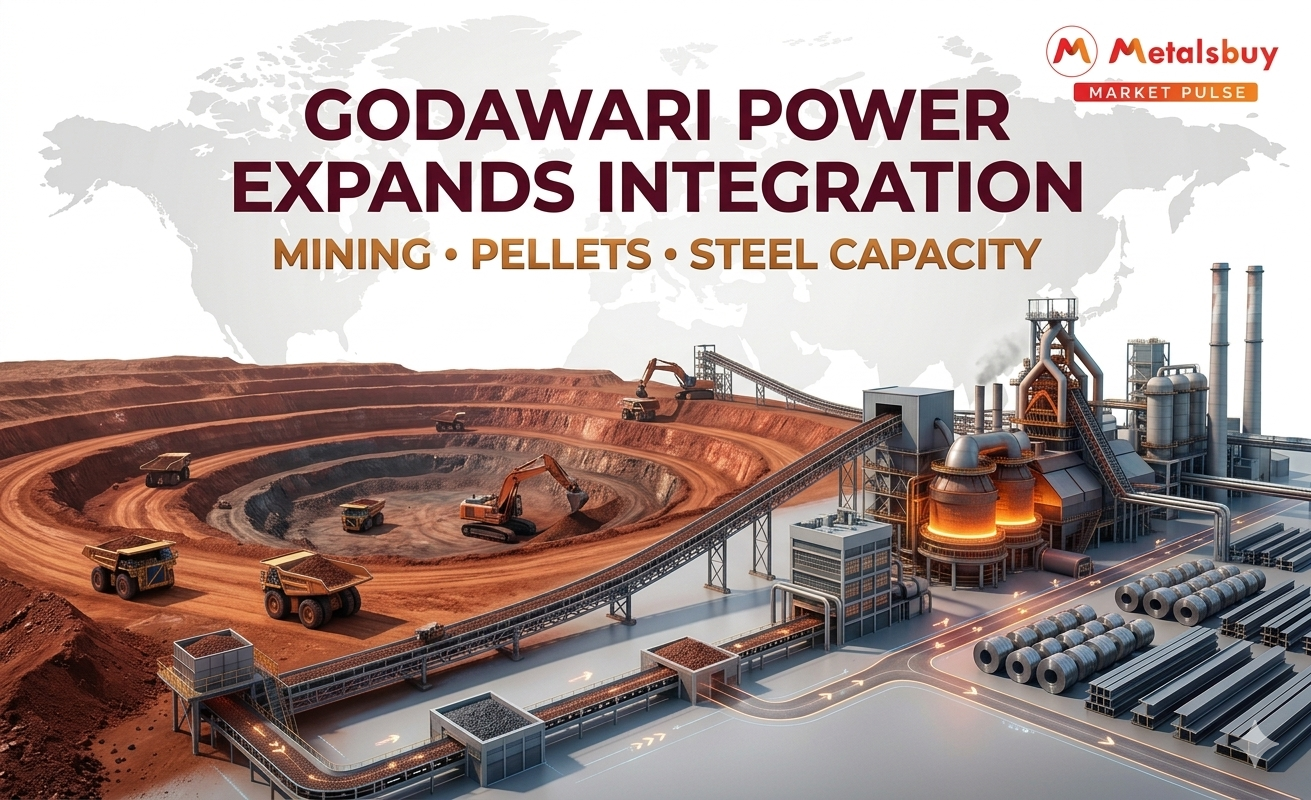
The company has now commissioned a new 2 million tonne per annum pellet plant, taking total pellet capacity to 4.7 MTPA while simultaneously expanding mining operations and approving plans for a new steel unit. On paper, these look like separate announcements. In reality, they are all part of the same strategy.
Control the ore. Process the ore. Convert the ore into steel. Keep as much value as possible inside the system.
That is the logic driving the next phase of India’s steel industry.
For years, Indian secondary and mid sized steel producers operated in fragmented structures. Ore procurement depended on market availability. Pellet sourcing fluctuated with pricing cycles. Freight volatility regularly distorted margins. Companies could produce steel, but many could not fully control the economics behind it.
That model is now changing rapidly.
The strongest producers are moving aggressively toward backward integration because the volatility of the last three years exposed exactly where the vulnerabilities sit. Iron ore prices surged. Coal prices became unpredictable. Freight markets tightened. Energy costs rose. Companies with captive mining access and internal pellet capacity protected margins far better than those dependent on external supply chains.
Godawari Power’s expansion fits directly into that larger industry shift.
The new pellet capacity matters because pellets are no longer just an intermediate product. In India’s evolving steel economy, pellet plants are becoming strategic infrastructure. They improve blast furnace efficiency, reduce wastage, stabilise raw material quality and create greater operational flexibility during periods of ore price volatility.
When linked directly with captive mining operations, the economics become even stronger.
That combination mining plus pellets plus steel creates insulation.
Not immunity. But insulation.
And in commodity industries, that difference matters enormously.
⸻
WHY PELLETS HAVE BECOME STRATEGIC
India’s steel expansion story is increasingly becoming a raw material story.
Every producer is announcing capacity additions. Blast furnaces are being expanded. New electric arc furnace projects are entering planning stages. Infrastructure demand remains strong across railways, housing, renewable energy and industrial manufacturing. But steel capacity alone is not enough. The real competition is shifting toward who can secure inputs efficiently and consistently over the next decade.
Pelletisation sits at the centre of that equation.
Pellets allow steel producers to use lower grade iron ore fines more effectively while improving furnace productivity and reducing emissions intensity relative to some traditional burden materials. As environmental compliance becomes stricter and cost optimisation becomes more important, pellet capacity stops being optional and starts becoming structural.
That is why integrated producers across India are scaling aggressively.
And geography matters here.
Chhattisgarh and Odisha are no longer just mining regions. They are evolving into integrated steel ecosystems where ore extraction, beneficiation, pelletisation, sponge iron and finished steel production increasingly operate within the same industrial corridor. Logistics costs fall. Supply reliability improves. Production planning becomes more stable.
Godawari Power is positioning itself directly inside that model.
⸻
THE BIGGER SIGNAL FOR INDIA’S STEEL INDUSTRY
The most important part of this announcement may not even be the pellet plant itself.
It is the approval of the new steel unit.
Because that signals confidence.
Companies do not commit downstream steel investments unless they believe raw material visibility, long term demand and financing conditions support multi year expansion. Steelmaking is capital intensive. Integrated steelmaking even more so. These are not short cycle decisions.
India’s steel industry is entering a phase where scale alone is no longer enough. The market is rewarding integration, efficiency and supply chain control.
The producers best positioned for the next decade are increasingly the ones building self contained industrial systems rather than isolated production assets.
That changes competition dynamics across the market.
Standalone processors face margin pressure during raw material spikes. Integrated players absorb shocks more effectively. During periods of supply tightness, captive mining and pellet operations become competitive advantages rather than operational conveniences.
That advantage compounds over time.
⸻
WHAT TO WATCH NEXT
The key question now is utilisation.
Commissioning capacity is one thing. Running it efficiently is another.
Markets will be watching how quickly Godawari ramps the new pellet plant toward stable operating levels and how effectively the expanded mining operations support feedstock integration across the chain. Any acceleration in domestic steel demand during the second half of 2026 would strengthen utilisation economics significantly.
The company’s steel unit timeline is equally important. Investors and industry participants will watch closely for details around planned capacity, technology route, raw material linkage and commissioning schedules.
More broadly, the expansion offers another indicator of where India’s steel sector is heading.
Not toward fragmentation.
Toward consolidation, integration and raw material security.
⸻
MARKET OUTLOOK
Godawari Power’s latest expansion is not about chasing short term steel prices. It is about building structural resilience inside an increasingly competitive industrial environment.
The steel industry is entering a decade where procurement efficiency, captive resources and integrated operations may matter just as much as finished steel demand itself.
Mining capacity alone is not enough. Pellet capacity alone is not enough. Steelmaking capacity alone is not enough.
The companies positioning themselves strongest for the next phase are the ones connecting all three.
And that is exactly what Godawari Power appears to be doing.
Godawari Power Is Building More Than Capacity. It Is Building Control.