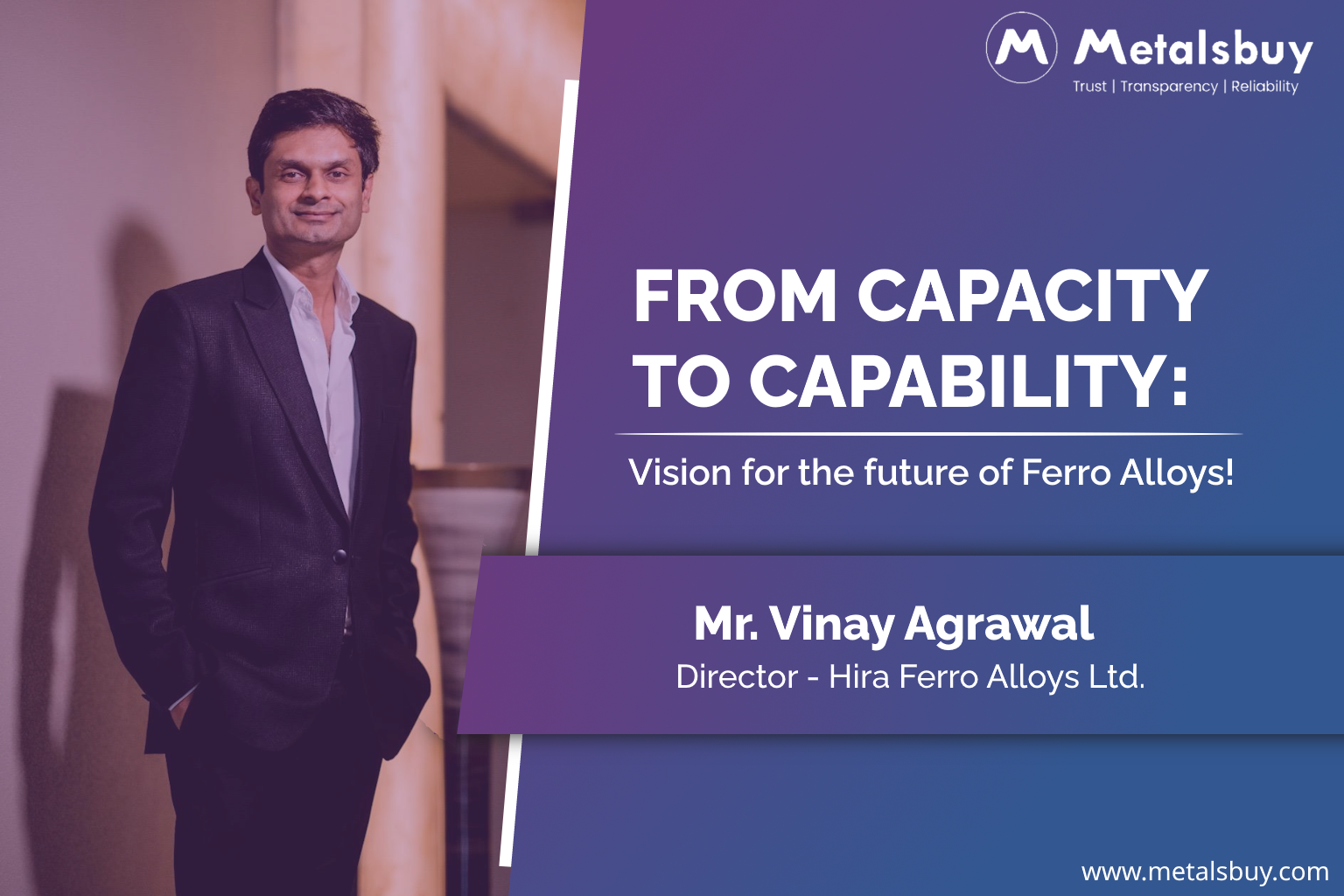
While the industry debates prices and power tariffs, the real shift underway is far deeper, one from capacity to capability.
India’s ferro alloy industry is frequently assessed through short-term lenses: price corrections, raw material volatility, and power costs. Yet beneath these visible debates, a more structural transformation is unfolding. The sector is steadily moving away from a volume-led mindset toward one anchored in operational discipline, sustainability, and long-term resilience.
In a detailed interaction with Metalsbuy, Mr. Vinay Agrawal, Director, HIRA Ferro Alloys Ltd., explains why the next phase of growth will be shaped not by how fast capacity is added, but by how deliberately capability is built.
Capability Will Define the Next Growth Cycle
“The next phase of the ferro alloy industry will not reward those who add capacity fastest, but those who build the strongest operational capability.”
Capacity expansion in manganese alloys is often misread as a sign of stress when prices soften. Mr. Agrawal views this differently. He believes expansion is a natural outcome of market evolution and must be evaluated in the context of long-term industry cycles.
Every industrial sector passes through a phase where fragmentation gives way to integration and efficiency. The steel industry’s transition from standalone rolling mills to integrated operations is a case in point. Ferro alloys, he notes, are undergoing a similar recalibration.
Price fluctuations will continue to occur. What will separate leaders from followers is not scale alone, but the ability to manage the entire value chain with consistency and discipline.
Consolidation Reflects Maturity, Not Distress
“Consolidation is not a failure of the industry. It is a sign of maturity.”
The Indian ferro alloy sector has witnessed the rapid emergence of smaller units, particularly in resource-rich regions. Many of these were driven by raw material availability rather than long-term strategic planning.
As markets mature, consolidation becomes inevitable. Well-run businesses with clear intent, operational efficiency, and financial prudence will continue to strengthen their position. Others will consolidate, adapt, or gradually exit.
Mr. Agrawal emphasizes that this process should be seen as healthy. It signals an industry learning to operate at a higher level of discipline rather than one facing structural weakness.
Power Strategy Will Differentiate Winners
Power remains one of the most critical cost components in ferro alloy production, contributing approximately 20–40 percent of total manufacturing costs. As a result, power strategy has become a central element of competitive positioning.
However, Mr. Agrawal cautions against framing the debate narrowly around captive versus grid-based power.
“In the long run, power strategy will differentiate winners, but it will not eliminate well-run grid-based producers.”
While captive power offers a strategic advantage, its relevance varies by region. In Chhattisgarh, captive generation is more common, whereas in regions such as West Bengal, Vizag, and Andhra Pradesh, several producers continue to operate sustainably on grid power.
Ultimately, competitiveness depends less on the source of power and more on whether investments are aligned with realistic cost structures and long-term planning.
Grid-Based Producers Are More Resilient Than Assumed
There is a growing perception that current SiMn prices are pushing grid-based producers into losses. Mr. Agrawal challenges this assumption.
He stresses that production costs must always be assessed against prevailing grid tariffs. If backward integration does not achieve grid parity, the issue lies in the investment decision rather than market pricing.
Several grid-dependent plants, particularly in eastern India, continue to operate efficiently. Unlike steel, which benefits from safeguard and import duties, manganese alloys operate in a more open global market, where efficiency and market access determine sustainability.
What Indian Producers Should Start Preparing for Today
With sustainability-linked regulations such as the EU’s Carbon Border Adjustment Mechanism (CBAM) approaching implementation, Indian producers must shift from reactive compliance to proactive preparation.
Mr. Agrawal outlines three areas that require immediate attention:
- Data readiness to ensure traceability, transparency, and auditability
- Emissions benchmarking to understand positioning relative to global peers
- Cost of carbon visibility to integrate carbon exposure into strategic and financial decision-making
Regulatory change creates uncertainty, but it also establishes new competitive benchmarks. Early movers gain flexibility, while late adopters are forced into constrained choices.
Sustainability as a Strategic Enabler at HIRA
“For HIRA, sustainability investments are not compliance costs, they are strategic enablers for long-term relevance.”
HIRA Ferro Alloys Ltd. is not pursuing aggressive capacity expansion in manganese alloys. The company already has sufficient capacity to cater to domestic demand, with room for organic growth as required.
Instead, HIRA’s investments are focused on backward integration, cleaner operations, and alignment with evolving global sustainability standards. The objective is to remain relevant and competitive as regulatory expectations tighten across Europe, the US, and eventually India.
Balanced Market Access Builds Business Strength
HIRA Ferro Alloys Ltd. maintains a balanced approach between export markets and domestic demand. According to Mr. Agrawal, diversified market access is a key source of business resilience.
Exports impose discipline and global benchmarking, while domestic demand provides stability. Together, they allow companies to navigate cycles more effectively and avoid over-dependence on any single market.
An Industry Learning to Operate at a Higher Level
“In a maturing ferro alloy industry, resilience will matter more than scale, and intent more than inertia.”
The ferro alloy industry is not under stress; it is learning to operate at a higher level of discipline.
As markets evolve and sustainability expectations rise, long-term success will depend on clarity of intent, operational resilience, and early alignment with global standards. The transition underway is not disruptive, but transformative.
Mr Vinay Agrawal’s perspective offers a clear takeaway: the future of ferro alloys belongs to those who prepare early, think strategically, and build businesses designed to endure.
Editor’s Note – Metalsbuy
This interview is part of Metalsbuy’s ongoing effort to bring forward strategic voices from the ferro alloys industry, helping stakeholders navigate market transitions, regulatory shifts, and long-term transformation.