Overview
Seaborne manganese ore offers for February 2026 shipments have provided fresh direction to the global manganese market, with selective price increases led by Australian-origin material, while Gabonese supply remains stable. Since CIF China pricing acts as the global benchmark, these movements have direct implications for the Indian manganese ore ecosystem, influencing import parity, domestic pricing, and cost structures for ferro-alloy producers.
The latest offers show a moderate firming trend, particularly for higher-grade material, signalling tightening availability and improved demand sentiment at the start of 2026.
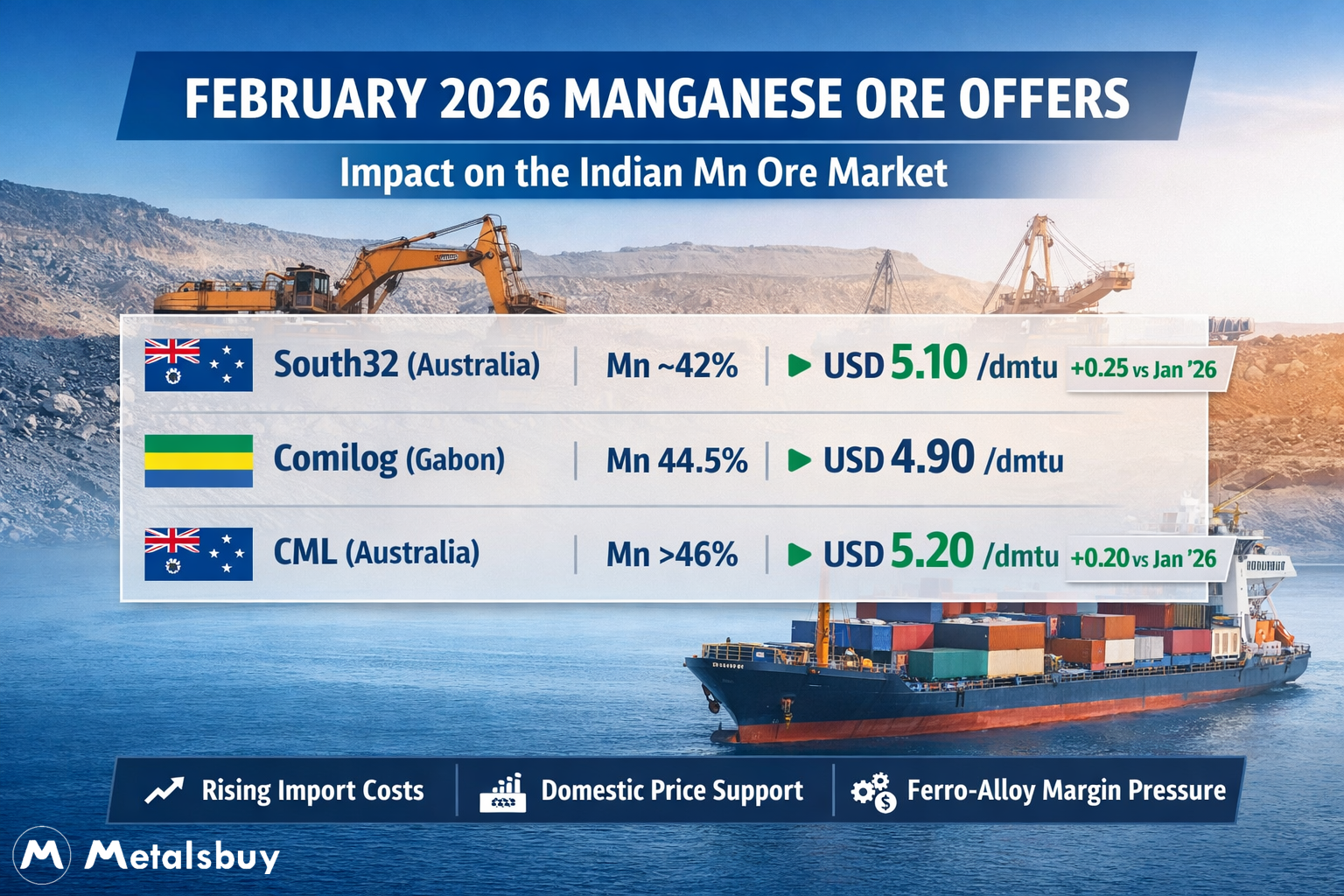
Key February 2026 Offers Snapshot
-
South32 (Australia)
Mn ~42% Lumpy
USD 5.10/dmtu, CIF China
Up USD 0.25/dmtu compared to January 2026 offer -
Comilog (Gabon)
Mn 44.5%, Fe 5%, P 0.14% Lumpy
USD 4.90/dmtu, CIF China
Unchanged from January 2026 offer -
CML (Australia)
Mn >46%, Fe <6%, SiO₂ <18% Lumpy
USD 5.20/dmtu, CIF China
Up USD 0.20/dmtu compared to January 2026 offer
What the Price Signals Indicate
The February 2026 offers reflect a clear grade-based price differentiation:
-
Australian high-grade manganese ore (>46% Mn) continues to command a premium, supported by tighter availability and better furnace efficiency.
-
Mid-grade Gabonese material remains competitively priced, indicating balanced supply-demand conditions.
-
The sharper increase in South32’s 42% Mn offer suggests improved baseline demand and limited downside risk even for lower-grade seaborne material.
Overall, the market is shifting away from aggressive discounting and moving toward price stability with upward bias, particularly for reliable, high-grade supplies.
Impact on the Indian Manganese Ore Market
1. Import Cost Parity for India
CIF China prices serve as the global reference for seaborne manganese ore. With February offers moving higher, CIF India landed costs are expected to firm, factoring in freight, insurance, and port handling. This reduces the scope for cheap imports and strengthens the competitiveness of domestic Indian ore.
2. Support for Domestic Mn Ore Prices
India’s domestic manganese ore pricing, led by PSU miners and supported by private producers, typically tracks global benchmarks with a short lag. The firming seaborne offers provide pricing headroom for domestic suppliers, reinforcing recent upward adjustments and limiting the risk of price corrections in the near term.
3. Pressure on Ferro-Alloy Producers’ Margins
For silico-manganese and ferro-manganese producers:
-
Rising ore input costs may compress margins if alloy prices do not move in tandem.
-
Plants dependent on imported high-grade ore will feel the impact more sharply.
-
Producers with blending flexibility using domestic lower-grade ore will be better positioned to manage costs.
4. Grade Substitution and Blending Strategy
The widening premium between 42%, 44.5%, and 46%+ Mn ore makes grade optimisation critical:
-
Some Indian producers may increase blending of lower-grade domestic ore to offset higher import costs.
-
High-efficiency furnaces may still prefer premium-grade imports to improve yield and reduce overall consumption.
-
Beneficiation and ore-upgrading strategies gain relevance in this environment.
5. China’s Role as the Price Anchor
China remains the largest consumer and price setter in the manganese ore market. The February 2026 offers suggest measured restocking rather than speculative buying, which supports prices without triggering volatility. For India, this implies a stable but firm market, rather than a sharp rally.
Short- to Medium-Term Outlook for India
-
Short term (1–3 months):
Domestic Mn ore prices remain firm, imports slightly costlier, ferro-alloy margins under watch. -
Medium term (3–9 months):
Sustained high-grade premiums may encourage beneficiation investments and tighter domestic supply discipline.
Unless there is a sharp downturn in Chinese steel or alloy demand, downside risks to manganese ore prices appear limited in early 2026.
Conclusion
The February 2026 manganese ore offers mark a structural shift toward price firmness, especially for high-grade Australian material. For India, this translates into stronger domestic price support, reduced import arbitrage, and a greater need for cost optimisation among ferro-alloy producers.
While the immediate impact is manageable, sustained firmness in seaborne prices could reshape sourcing strategies and accelerate domestic value addition across the Indian manganese ore value chain.