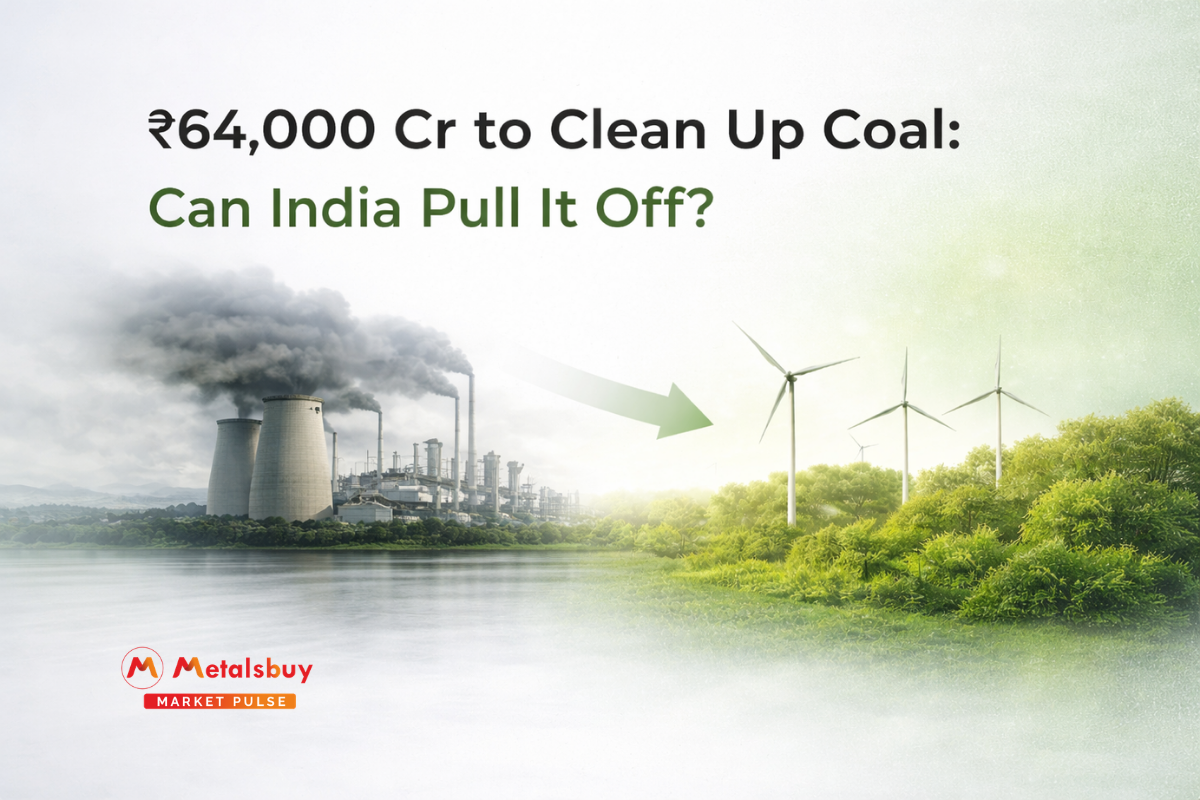
India's energy landscape is undergoing a profound, data-driven transformation. After achieving a historic milestone by producing a record 1,047.57 million tonnes of coal in the 2024-25 financial year—a near five percent jump from the previous year—the nation is now radically altering how it utilizes its most abundant resource. Instead of merely burning this fuel to generate electricity, the Indian government is pivoting toward advanced chemical transformation. This strategic shift is anchored by a massive ₹64,000 crore investment aimed at establishing seven cutting-edge coal gasification projects across the country.
This transition is far more than an infrastructure upgrade; it is a calculated economic maneuver designed to drastically reduce India's multibillion-dollar import bills, insulate the domestic market from global energy shocks, and forge a pragmatic, low-carbon pathway for the future.
The Blueprint: Tracing the ₹64,000 Crore Expansion
The scale of this transition was recently detailed in the Rajya Sabha by the Union Minister for Coal and Mines, G. Kishan Reddy, who confirmed the aggressive rollout of these seven strategic facilities. To maximize logistical efficiency, the master plan places these projects strictly in mineral-rich corridors: four facilities are designated for Maharashtra, two will rise in Odisha, and one is slated for West Bengal. Reflecting the government's urgency, early-stage implementation and groundwork have already commenced for four of these sites.
At the technical level, coal gasification bypasses traditional combustion. It is a highly controlled thermo-chemical process that exposes solid coal to steam and oxygen under extreme heat and pressure. The output is "syngas"—a highly versatile blend of carbon monoxide, hydrogen, and methane. This synthetic gas serves as a crucial building block for manufacturing high-value industrial commodities, ranging from methanol and synthetic natural gas to essential agricultural fertilizers like ammonia and urea.
Overcoming the Ash Barrier with Financial Engineering
Implementing this technology in India presents a unique engineering challenge. Unlike imported coal, Indian coal reserves naturally contain a very high ash content, typically ranging between 25 percent and 45 percent. To successfully process this material, the country is adopting specialized circulating fluidized bed gasification technologies designed specifically for high-ash variants.
Because these advanced facilities require immense capital outlays, the government has stepped in to de-risk the ecosystem. A robust financial safety net has been deployed through an ₹8,500 crore Viability Gap Funding (VGF) scheme approved in early 2024. Under this framework, participating Public Sector Undertakings (PSUs) can receive direct financial incentives of up to ₹1,350 crore per project, effectively covering up to 15 percent of their capital expenditure. This crucial intervention is successfully attracting heavyweights from both the public and private sectors to establish a new downstream chemical industry.
The Strategic Catalyst: Slashing the Multibillion-Dollar Import Bill
To fully grasp the "why" behind this ₹64,000 crore initiative, one must examine the staggering numeric reality of India's import dependencies. While India boasts the world's fourth-largest coal reserves—totaling roughly 378 billion tonnes, of which 199 billion tonnes are proven—it remains acutely vulnerable to foreign chemical and energy markets.
Presently, India imports a massive 83 percent of its crude oil requirements and upwards of 90 percent of its methanol. The agricultural sector's vulnerability is even more pronounced. In the 2023-24 fiscal year alone, India imported a staggering 70.42 lakh tonnes of agricultural-grade urea at a cost of roughly ₹21,827 crore ($2.6 billion). Of this, imports from China alone accounted for 18.65 lakh tonnes, costing the exchequer over ₹6,127 crore. Additionally, the country imported 106.53 lakh tonnes of phosphatic and potassic fertilizers in the same period.
Herein lies the unique selling proposition of the entire gasification mission: import substitution. By chemically converting domestic coal into syngas, India can manufacture ammonia and urea within its own borders. Industry experts project that a fully realized coal gasification sector could generate an import substitution economy worth between ₹60,000 crore and ₹90,000 crore annually, preserving vital foreign exchange reserves while shielding Indian farmers from international supply chain disruptions.
A Balanced Transition: Marrying Growth with Sustainability
The brilliance of this masterplan rests in its pragmatism. India’s rapidly expanding economy requires immense, reliable baseload power. Currently, coal-based thermal plants generate roughly 73 to 74 percent of the nation's electricity, consuming about 80 percent of domestic coal output. A sudden, complete pivot away from coal is economically impossible.
Gasification provides the ideal middle ground. It allows India to utilize its abundant natural wealth but in a significantly cleaner manner. The process inherently captures pollutants, drastically reducing emissions of sulfur dioxide, nitrogen oxides, and harmful particulate matter compared to conventional burning.
The Future Outlook: The Road to 2030
Looking ahead, these initial seven projects are merely the foundation of a grander vision. Guided by the National Coal Gasification Mission, the government is marching toward a definitive target: successfully gasifying 100 million tonnes of coal annually by the year 2030.
Ultimately, this ₹64,000 crore investment is a decisive leap toward genuine energy sovereignty. By embracing cutting-edge engineering and robust financial incentives, India is proving that it can reinvent its oldest fossil fuel. This strategic pivot promises to spark widespread job creation, establish a booming domestic chemical sector, and solidify India's position as a global pioneer in clean coal utilization—demonstrating that robust economic growth and environmental stewardship can successfully coexist.