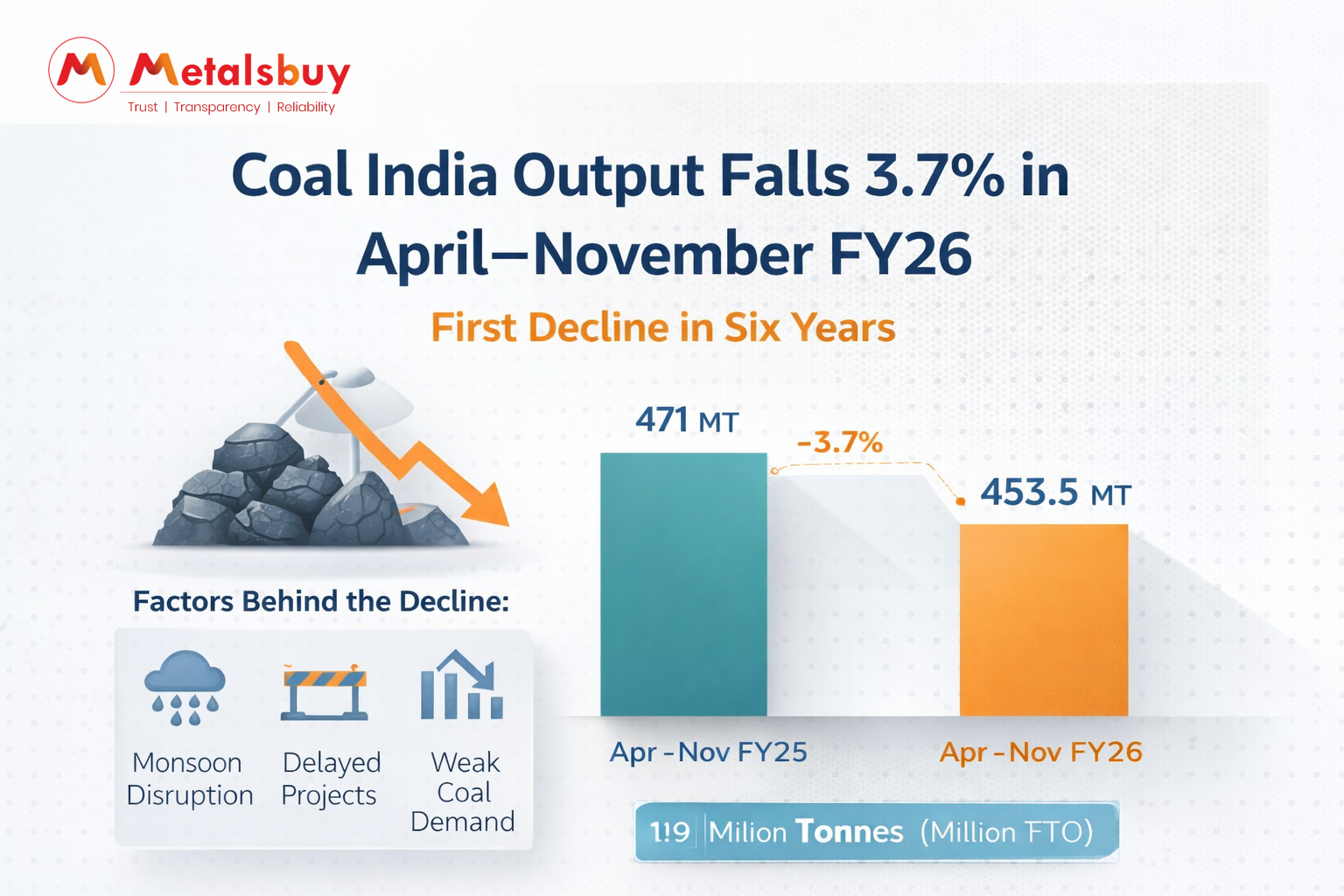
Coal India Limited (CIL), India’s largest coal producer, has reported a 3.7% year-on-year decline in coal production during April–November FY26, marking its first output contraction in six years. The slowdown interrupts a prolonged growth phase and comes amid operational challenges, weather disruptions, and softer demand signals from the power sector.
According to provisional data, Coal India produced 453.5 million tonnes (MT) of coal during the April–November FY26 period, compared with 471 MT in the corresponding period last year.
Production Trend Snapshot (Apr–Nov)
| Period | Production (MT) | YoY Change |
|---|---|---|
| Apr–Nov FY25 | 471.0 | — |
| Apr–Nov FY26 | 453.5 | -3.7% |
The decline of 17.5 MT translates mathematically to a 3.72% drop, rounded to 3.7%.
What Led to the Production Decline?
1. Monsoon Disruptions in Key Mining Regions
Prolonged and intense monsoon rainfall affected mining operations across coal-bearing states such as Jharkhand, Chhattisgarh, Odisha, and West Bengal, impacting overburden removal, dispatch logistics, and mine productivity during the early months of FY26.
2. Land and Infrastructure Constraints
Coal India continues to face land acquisition delays and forest clearance-related bottlenecks at several projects, restricting timely capacity ramp-ups despite available reserves.
3. Softer Power Sector Demand
Dispatches to the power sector remained muted during parts of the year due to:
-
Lower-than-expected power demand growth
-
Adequate coal stock levels at thermal power plants
-
Reduced urgency for incremental coal lifting
This led to cautious production planning, particularly during the first half of the fiscal year.
Monthly Performance Shows Partial Recovery
Despite the cumulative decline, November FY26 production increased marginally year-on-year, reaching approximately 68 MT, compared with around 67.2 MT in November last year. This suggests operational recovery post-monsoon, although not sufficient to offset earlier losses.
Target Pressure Mounts
Coal India has set an annual production target of around 875 MT for FY26, with offtake guidance of about 900 MT. The slower pace in the first eight months raises questions around:
-
Full-year target achievability
-
Need for higher monthly run-rates in the remaining months
-
Operational execution during peak demand periods
Market Implications
1. Domestic Coal Supply Outlook
While coal stock levels at power plants remain comfortable for now, sustained production weakness could tighten supply if power demand rises sharply during peak summer or industrial recovery phases.
2. Impact on Power and Steel Sectors
Thermal power generators and steel producers continue to rely heavily on Coal India supplies. Any prolonged supply-side tightness could:
-
Increase spot procurement pressure
-
Revive import dependency during high-demand periods
3. Import Dynamics
So far, India’s thermal coal imports have not shown a sharp surge, indicating that demand softness has partly absorbed the domestic supply shortfall. However, this balance remains sensitive to weather and economic activity.
Metalsbuy Outlook
Coal India’s FY26 production decline appears structural rather than cyclical, driven by a mix of weather disruption, project execution challenges, and moderated demand. While short-term recovery is visible, sustaining long-term growth will require:
-
Faster project clearances
-
Improved mine productivity
-
Better alignment between production planning and demand cycles
The FY26 output dip serves as a reminder that volume growth alone is no longer guaranteed, even for India’s largest coal producer. Market participants should closely monitor dispatch trends, stock levels, and monthly production momentum in the second half of the fiscal year.