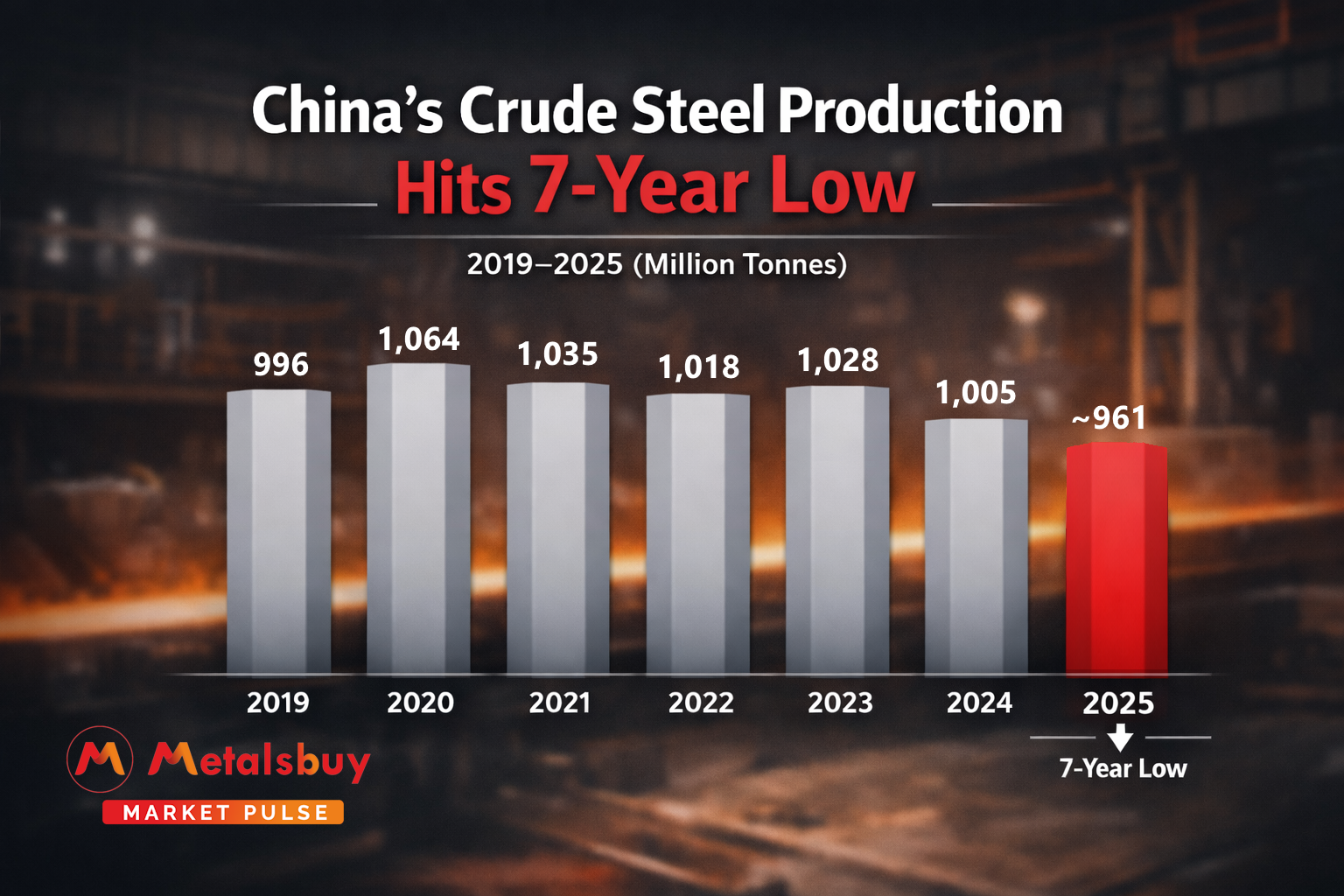
China’s steel industry marked a significant inflection point in 2025, with annual crude steel production declining to its lowest level in seven years, reflecting persistent structural weakness in domestic demand, particularly from the real estate and construction sectors.
According to official and industry-validated data, China’s crude steel output fell to approximately 960.8 million tonnes in 2025, a 4.4% year-on-year decline, pushing national production well below the psychologically important one-billion-tonne mark for the first time since 2018.
Seven-Year Trend: China Crude Steel Production
| Year | Crude Steel Production (Million Tonnes) | YoY Change |
|---|---|---|
| 2019 | 996.3 | – |
| 2020 | 1,064.0 | ▲ 6.8% |
| 2021 | 1,035.2 | ▼ 2.7% |
| 2022 | 1,018.0 | ▼ 1.7% |
| 2023 | 1,028.9 | ▲ 1.1% |
| 2024 | 1,005.1 | ▼ 2.3% |
| 2025 | 960.8 | ▼ 4.4% |
Source: National Bureau of Statistics of China, World Steel Association, industry estimates
The data clearly illustrates that China’s steel output peaked in 2020, supported by aggressive infrastructure stimulus, and has since entered a gradual but sustained downtrend, with the sharpest contraction visible in 2025.
Property Sector Slump Reshapes Steel Consumption
The prolonged downturn in China’s property sector remains the central drag on steel demand. Construction activity, traditionally the largest consumer of long steel products, continues to weaken, leading to a sharp contraction in rebar production.
Industry estimates suggest that rebar’s share in total steel output has fallen to around 13% in 2025, compared with approximately 23% in 2019, highlighting the structural nature of demand erosion rather than a temporary slowdown.
Product Mix Shift and Export Dependence
In response to weak domestic demand, steelmakers have increasingly shifted production toward flat steel products, including hot-rolled coil, which are better aligned with export and manufacturing demand.
Despite lower overall production, China’s steel exports surged to record levels in 2025, exceeding 119 million tonnes. Competitive pricing, surplus capacity, and muted local consumption pushed mills to rely more heavily on overseas markets to sustain volumes and margins.
Improving Margins Amid Falling Volumes
Interestingly, profitability across the sector improved despite declining output. More than half of Chinese steel producers reported profits in 2025, compared with roughly one-third in the previous year. This improvement was driven by:
-
Better cost control
-
Reduced low-margin construction steel output
-
Strong export realizations
At the same time, monthly production trends showed seven consecutive months of decline, with December output dropping to roughly 68 million tonnes, the lowest monthly level since late 2023.
Policy Discipline and Outlook
China’s policymakers continue to emphasize capacity discipline, emissions reduction, and supply-side control, with steel production management forming a key part of the country’s carbon-neutral roadmap through 2030.
Market expectations suggest that crude steel production may continue to soften in 2026, though at a slower pace, as authorities balance economic stability with environmental targets and as demand recovery in the property sector remains uncertain.
Market Implications
-
Global steel supply growth is likely to remain constrained, offering price support in key regions
-
Export competition from China will remain intense, particularly in flat steel segments
-
Raw material demand growth, especially for iron ore and coking coal, may stay capped, impacting seaborne markets
China’s steel industry is increasingly transitioning from a high-growth model to one defined by lower volumes, tighter regulation, and export-led balancing, a shift with far-reaching implications for global steel and raw material trade.